

100 francs cfa – Central African Republic
Add to wishlist
Central African Republic
Context
Years: 1975–1990
Issuer: Central African Republic
Issuing organization: Bank of Central African States
Period:
(since 1979)
Currency:
(since 1973)
Total mintage: 8,400,000
Material
References
KM: #
Numista: #1801
Value
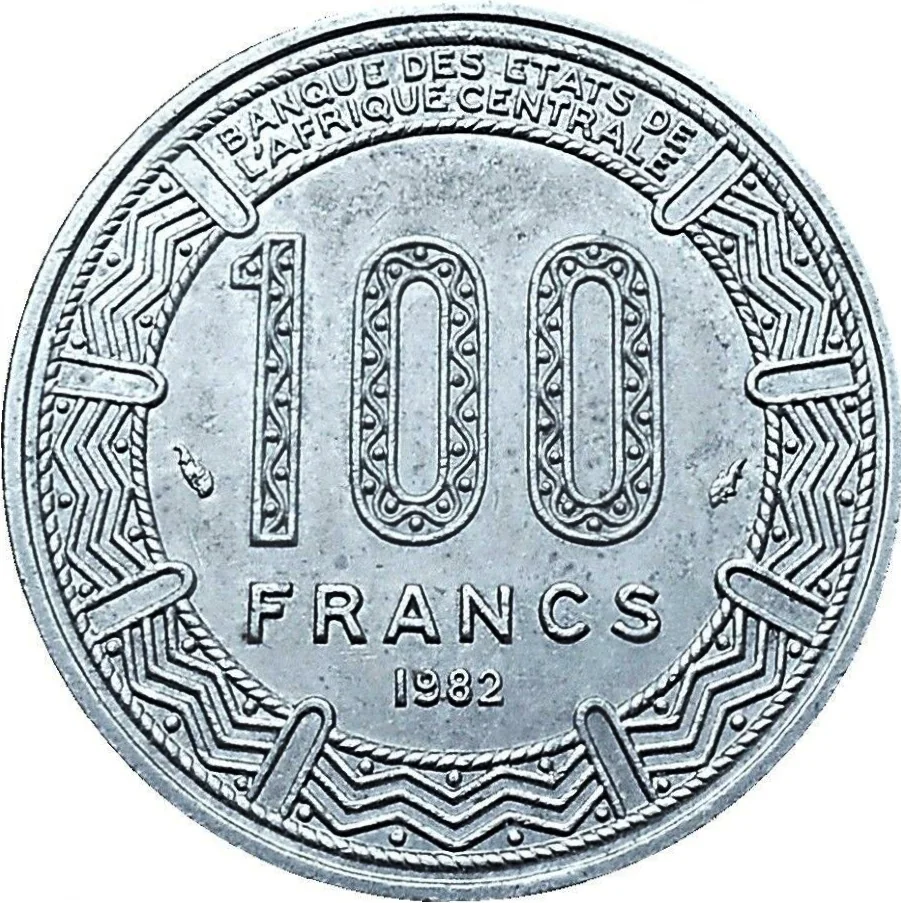
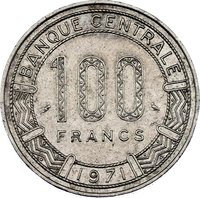
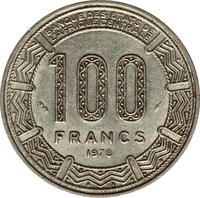
Exchange value: 100 XAF
Obverse
Description:
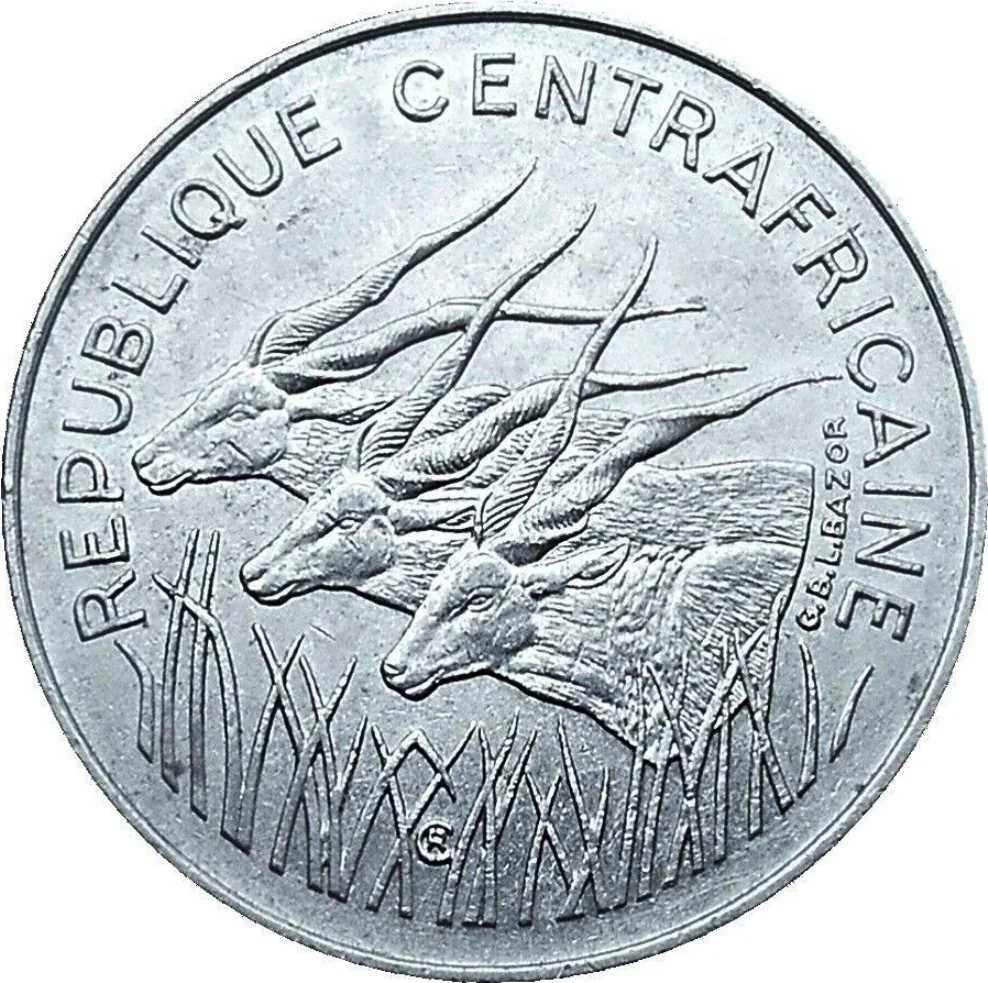
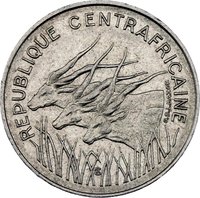
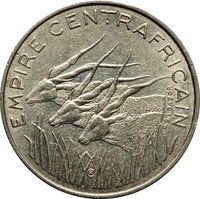
Three Lord Derby elands (Taurotragus derbianus) facing left.
Inscription:
REPUBLIQUE CENTRAFRICAINE
G.B.L.BAZOR
CR
G.B.L.BAZOR
CR
Translation:
CENTRAL AFRICAN REPUBLIC
G.B.L.BAZOR
G.B.L.BAZOR
Script: Latin
Language: French
Engraver: Lucien Georges Bazor
Reverse
Edge
Milled
Mints
| Name | Mark |
|---|---|
| Monnaie de Paris | — |
Mintings
| Year | Mint Mark | Mintage | Quality | Collection |
|---|---|---|---|---|
| 1975 | — | 2,000,000 | ||
| 1976 | — | 1,000,000 | ||
| 1979 | — | 900,000 | ||
| 1982 | — | — | ||
| 1983 | — | 3,000,000 | ||
| 1984 | — | — | ||
| 1985 | — | 1,000,000 | ||
| 1988 | — | 500,000 | ||
| 1990 | — | — |
Historical background
In 1975, the Central African Republic (CAR) was part of the Franc de la Coopération Financière en Afrique (CFA franc) zone, a monetary union underpinned by a fixed exchange rate and guaranteed convertibility by the French Treasury. The currency in circulation was the CFA franc, issued by the Banque des États de l'Afrique Centrale (BEAC), which served the six members of the Central African Monetary Union. This arrangement provided monetary stability and low inflation, but it also meant the CAR had no independent monetary policy, ceding control over interest rates and money supply to the regional central bank and its ties to France.
Economically, the country was under the authoritarian rule of President Jean-Bédel Bokassa, whose lavish and erratic spending—culminating in his infamous coronation as emperor in 1976—placed severe strain on public finances. The economy remained heavily dependent on volatile commodity exports, particularly diamonds, coffee, and cotton. While the CFA franc's stability facilitated trade with France and other regional partners, it did not shield the CAR from the underlying structural weaknesses, fiscal mismanagement, and corruption that characterized the Bokassa era.
Therefore, the "currency situation" in 1975 was one of external stability but internal economic fragility. The fixed CFA franc provided a reliable medium of exchange and stored value, avoiding the hyperinflation seen in some other developing nations. However, this monetary framework existed alongside a deteriorating real economy, where government debt was rising and productive investment was stifled. The fundamental economic challenges were political and structural, with the currency system acting as a stable but passive backdrop to the country's deepening governance and fiscal crises.
Economically, the country was under the authoritarian rule of President Jean-Bédel Bokassa, whose lavish and erratic spending—culminating in his infamous coronation as emperor in 1976—placed severe strain on public finances. The economy remained heavily dependent on volatile commodity exports, particularly diamonds, coffee, and cotton. While the CFA franc's stability facilitated trade with France and other regional partners, it did not shield the CAR from the underlying structural weaknesses, fiscal mismanagement, and corruption that characterized the Bokassa era.
Therefore, the "currency situation" in 1975 was one of external stability but internal economic fragility. The fixed CFA franc provided a reliable medium of exchange and stored value, avoiding the hyperinflation seen in some other developing nations. However, this monetary framework existed alongside a deteriorating real economy, where government debt was rising and productive investment was stifled. The fundamental economic challenges were political and structural, with the currency system acting as a stable but passive backdrop to the country's deepening governance and fiscal crises.
🌱 Common