

100 francs cfa – Central African Republic
Add to wishlist
Central African Republic
Context
Year: 1978
Issuer: Central African Republic
Issuing organization: Bank of Central African States
Period:
(1976—1979)
Currency:
(since 1973)
Demonetized: Yes
Total mintage: 1,200,000
Material
References
KM: #
Numista: #10091
Value
Exchange value: 100 XAF
Obverse
Description:
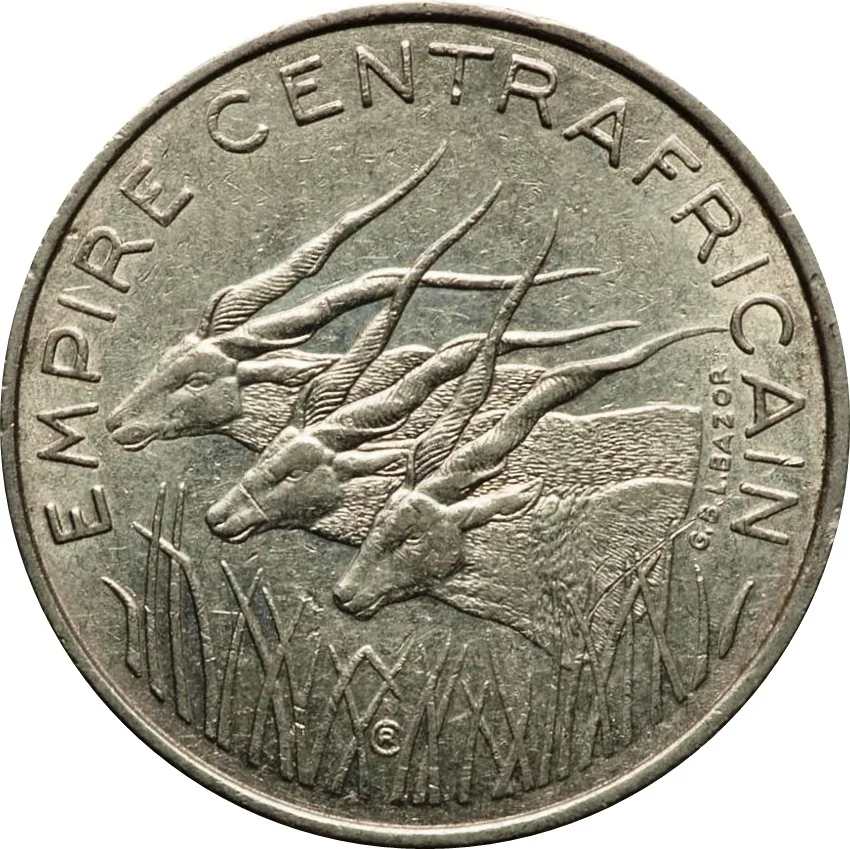
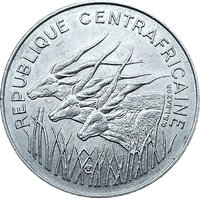
Three Giant Elands (Taurotragus derbianus) facing left.
Inscription:
EMPIRE CENTRAFRICAIN
G.B.L.BAZOR
CR
G.B.L.BAZOR
CR
Translation:
CENTRAL AFRICAN EMPIRE
G.B.L. BAZOR
100 FRANCS
G.B.L. BAZOR
100 FRANCS
Script: Latin
Language: French
Engravers: Gabriel Bernard, Lucien Bazor
Reverse
Description:
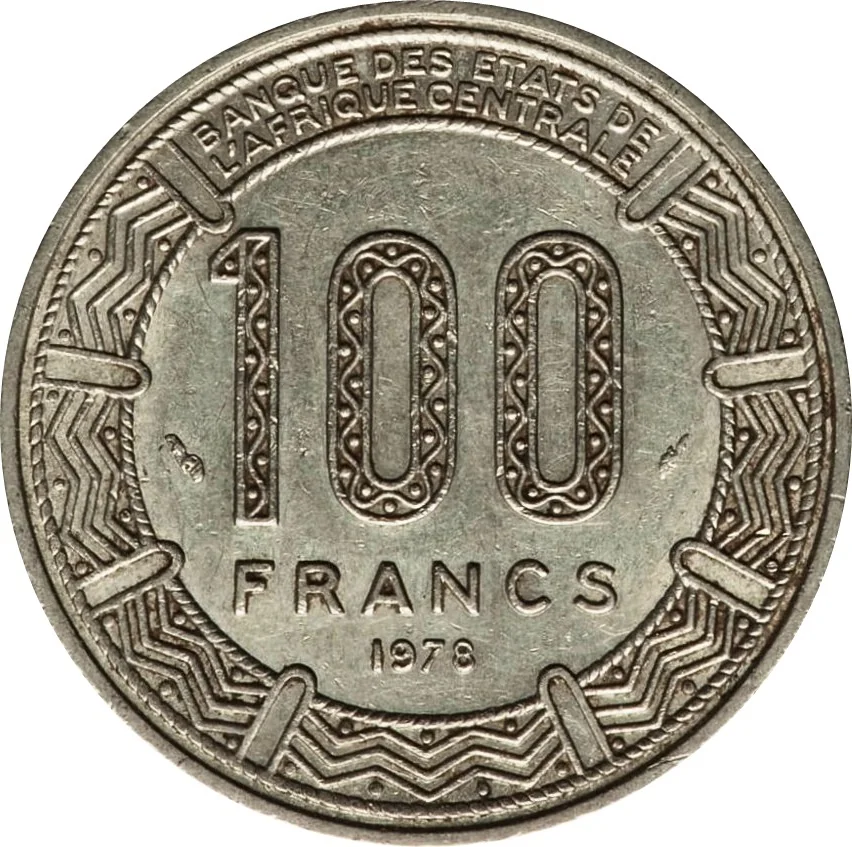
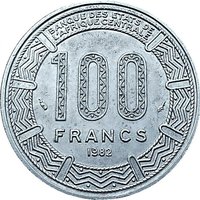
Denomination and date in circle.
Inscription:
BANQUE DES ETATS DE
L'AFRIQUE CENTRALE
100
FRANCS
1978
L'AFRIQUE CENTRALE
100
FRANCS
1978
Translation:
BANK OF THE STATES OF
CENTRAL AFRICA
100
FRANCS
1978
CENTRAL AFRICA
100
FRANCS
1978
Script: Latin
Language: French
Engravers: Gabriel Bernard, Lucien Bazor
Edge
Milled
Mints
| Name | Mark |
|---|---|
| Monnaie de Paris | — |
Mintings
| Year | Mint Mark | Mintage | Quality | Collection |
|---|---|---|---|---|
| 1978 | a | 1,200,000 |
Historical background
In 1978, the Central African Republic (CAR) operated under the CFA franc system, a colonial-era monetary arrangement that continued to define its currency situation. The nation was part of the Central African Monetary Union (UMAC), which used the CFA franc (XAF). This currency was, and remains, pegged to the French franc at a fixed exchange rate, with convertibility guaranteed by the French Treasury. For the CAR, this meant its monetary policy was largely outsourced to the Bank of Central African States (BEAC), based in Cameroon, providing macroeconomic stability but limiting national financial sovereignty.
Economically, the country was under the authoritarian rule of Emperor Bokassa I, whose extravagant and brutal regime (financed largely by diamond exports and French support) had severely mismanaged the economy. While the CFA franc provided a stable currency in a region prone to inflation, it could not shield the CAR from the consequences of corruption, declining commodity prices, and poor fiscal discipline. The fixed peg also made the country's exports less competitive, a problem exacerbated by a reliance on a narrow base of primary goods like coffee, timber, and diamonds.
Thus, the currency situation in 1978 was a paradox: a technically stable and internationally convertible currency existed alongside a collapsing domestic economy. The institutional framework of the CFA zone prevented a currency crisis, but it did not address the fundamental issues of state bankruptcy, decaying infrastructure, and widespread poverty. This disconnect between monetary stability and fiscal chaos would culminate later in 1979 with Bokassa's overthrow, but the underlying dependency on the CFA franc and its associated constraints remained a permanent feature of the nation's financial landscape.
Economically, the country was under the authoritarian rule of Emperor Bokassa I, whose extravagant and brutal regime (financed largely by diamond exports and French support) had severely mismanaged the economy. While the CFA franc provided a stable currency in a region prone to inflation, it could not shield the CAR from the consequences of corruption, declining commodity prices, and poor fiscal discipline. The fixed peg also made the country's exports less competitive, a problem exacerbated by a reliance on a narrow base of primary goods like coffee, timber, and diamonds.
Thus, the currency situation in 1978 was a paradox: a technically stable and internationally convertible currency existed alongside a collapsing domestic economy. The institutional framework of the CFA zone prevented a currency crisis, but it did not address the fundamental issues of state bankruptcy, decaying infrastructure, and widespread poverty. This disconnect between monetary stability and fiscal chaos would culminate later in 1979 with Bokassa's overthrow, but the underlying dependency on the CFA franc and its associated constraints remained a permanent feature of the nation's financial landscape.
🌱 Fairly Common