

100 francs cfa – Central African Republic
Add to wishlist
Central African Republic
Context
Years: 1971–1972
Issuer: Central African Republic
Issuing organization: Central Bank of Equatorial African States and Cameroon
Period:
(since 1979)
Currency:
(1961—1973)
Total mintage: 6,000,000
Material
References
KM: #
Numista: #1375
Value
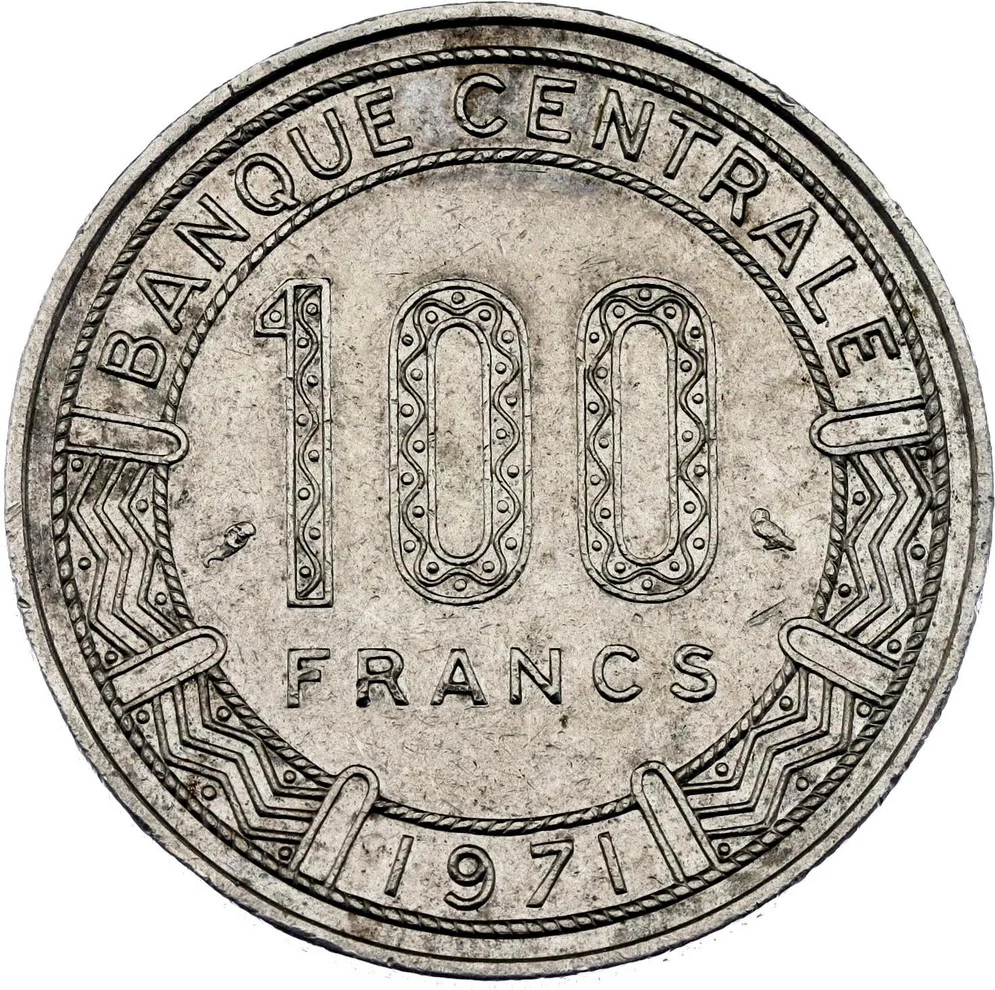
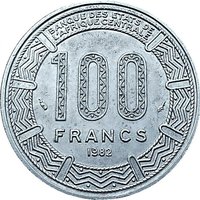
Exchange value: 100 FCFA
Obverse
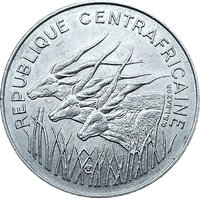
Description:
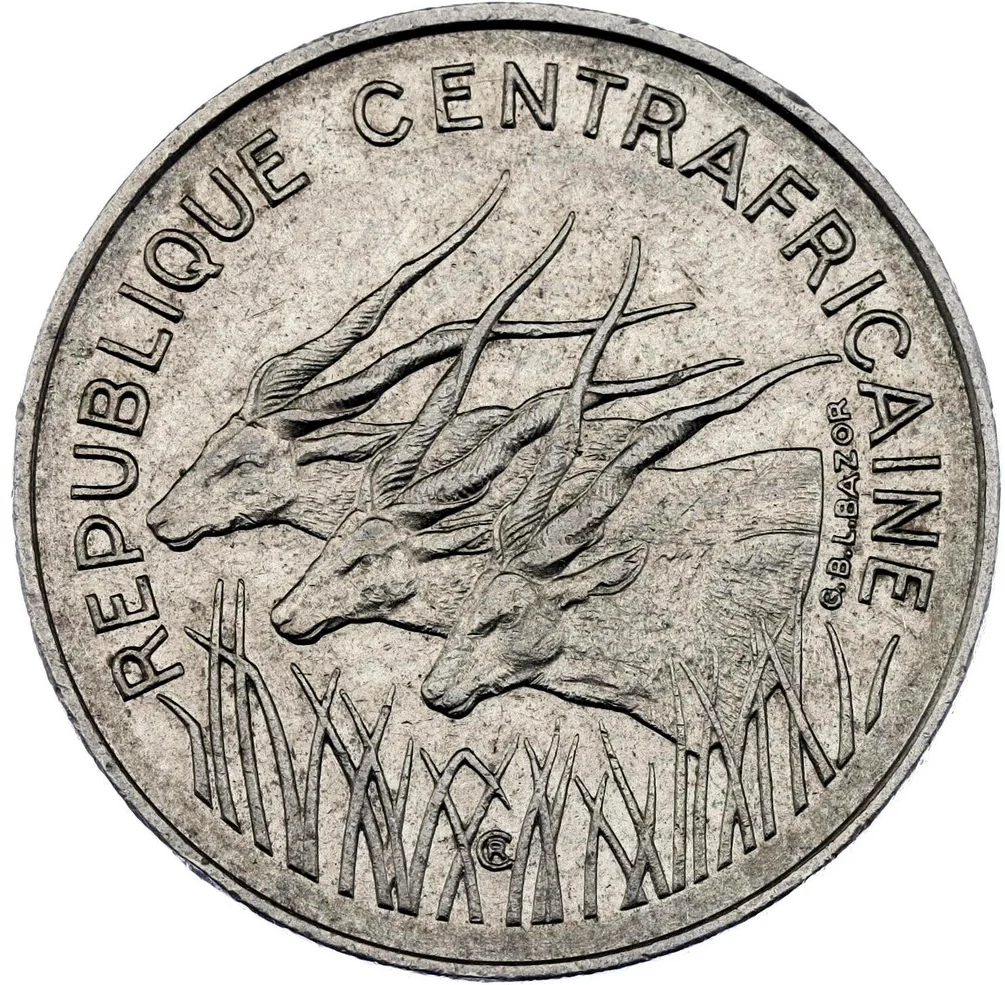
Three giant eland remain.
Inscription:
REPUBLIQUE CENTRAFRICAINE
G.B.L.BAZOR
CR
G.B.L.BAZOR
CR
Translation:
CENTRAL AFRICAN REPUBLIC
G.B.L.BAZOR
G.B.L.BAZOR
Script: Latin
Language: French
Engraver: Lucien Georges Bazor
Reverse
Edge
Reeded
Mints
| Name | Mark |
|---|---|
| Monnaie de Paris | — |
Mintings
| Year | Mint Mark | Mintage | Quality | Collection |
|---|---|---|---|---|
| 1971 | — | 2,500,000 | ||
| 1972 | — | 3,500,000 |
Historical background
In 1971, the Central African Republic (CAR) was part of the Central African Monetary Union, operating within the broader CFA franc zone established by France. The currency in circulation was the CFA franc (BEAC), specifically the coins and banknotes issued by the Bank of Central African States (BEAC). This system guaranteed the currency's convertibility and fixed parity with the French franc, providing monetary stability but closely tying the CAR's economy to French monetary policy and the French Treasury, which held the foreign reserves.
Economically, the country was under the single-party rule of President Jean-Bédel Bokassa, who had seized power in 1966. The year 1971 fell within a period where the CAR's economy was heavily reliant on the export of primary commodities, particularly diamonds, cotton, and coffee. The fixed exchange rate of the CFA franc (1 French franc = 50 CFA francs) facilitated trade with France and other CFA zone members, but also made the economy vulnerable to terms of trade shocks and limited the government's independent monetary tools to address domestic issues.
There were no major currency reforms or crises specific to the CAR in 1971 itself. The monetary situation was characterized by this stable but externally dependent framework. However, this period preceded significant economic strain in the mid-1970s, partly fueled by Bokassa's extravagant spending on projects like his notorious coronation as emperor in 1976, which would later exacerbate fiscal pressures within the constraints of the fixed monetary union.
Economically, the country was under the single-party rule of President Jean-Bédel Bokassa, who had seized power in 1966. The year 1971 fell within a period where the CAR's economy was heavily reliant on the export of primary commodities, particularly diamonds, cotton, and coffee. The fixed exchange rate of the CFA franc (1 French franc = 50 CFA francs) facilitated trade with France and other CFA zone members, but also made the economy vulnerable to terms of trade shocks and limited the government's independent monetary tools to address domestic issues.
There were no major currency reforms or crises specific to the CAR in 1971 itself. The monetary situation was characterized by this stable but externally dependent framework. However, this period preceded significant economic strain in the mid-1970s, partly fueled by Bokassa's extravagant spending on projects like his notorious coronation as emperor in 1976, which would later exacerbate fiscal pressures within the constraints of the fixed monetary union.
🌱 Common