

20 Pesetas – Spain
Spain
Context
Years: 1899–1962
Issuer: Spain 
Ruler: Alfonso XIII
Currency:
(1868—2001)
Demonetized: Yes
Total mintage: 2,098,834
Material
References
KM: #Click to copy to clipboard709
Numista: #17588
Value
Exchange value: 20 ESP
Bullion value: $969.83
Obverse
Description:
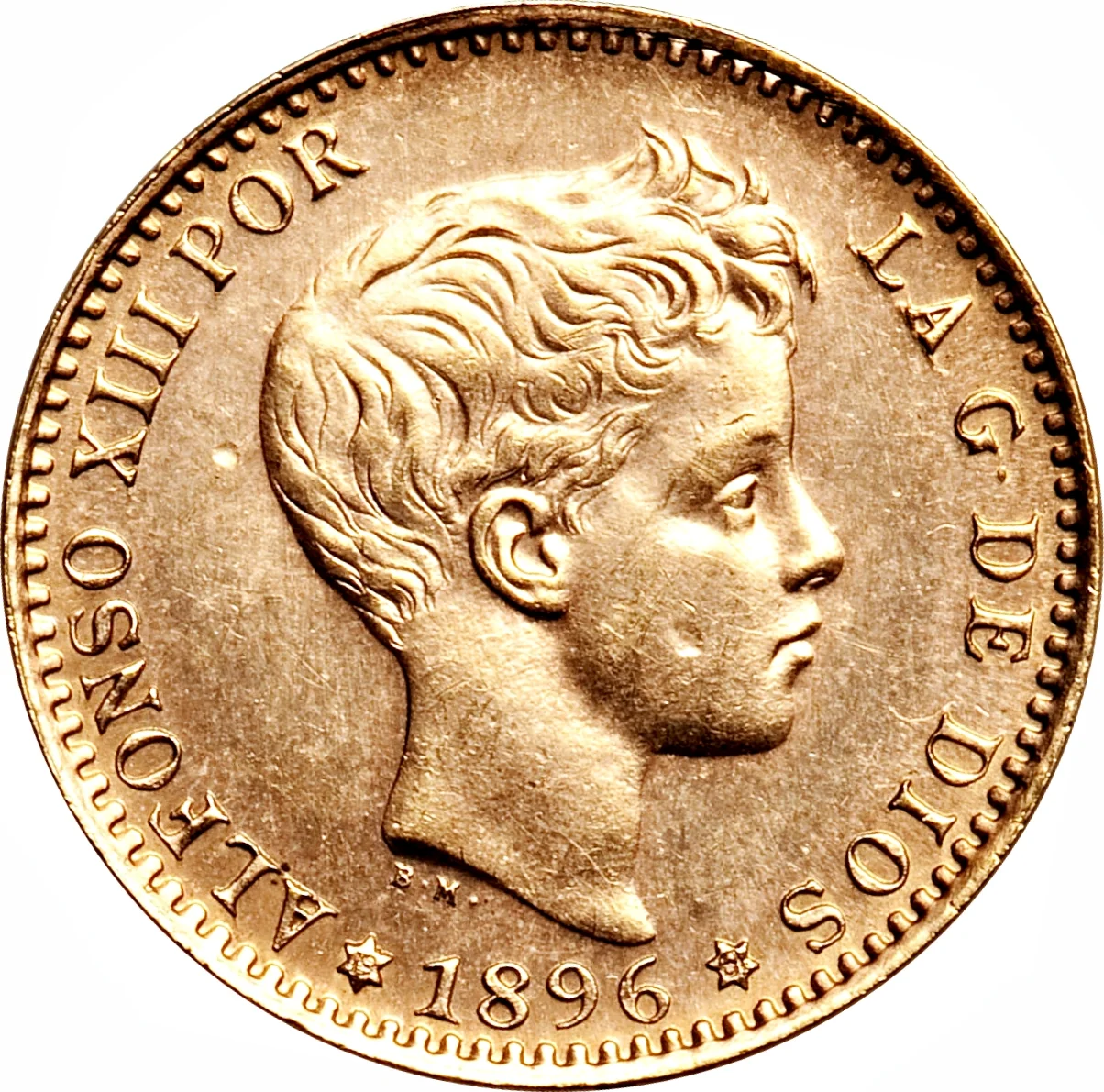
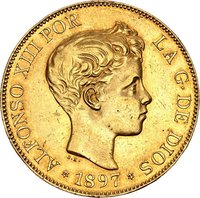
Childhood portrait of King Alfonso XIII facing right.
Inscription:
ALFONSO XIII POR LA G· DE DIOS
B· M·
🟌 1896 🟌
B· M·
🟌 1896 🟌
Translation:
ALFONSO XIII BY THE GRACE OF GOD
KING OF SPAIN
🟌 1896 🟌
KING OF SPAIN
🟌 1896 🟌
Script: Latin
Language: Spanish
Engraver: Bartolomé Maura Montaner
Reverse
Description:
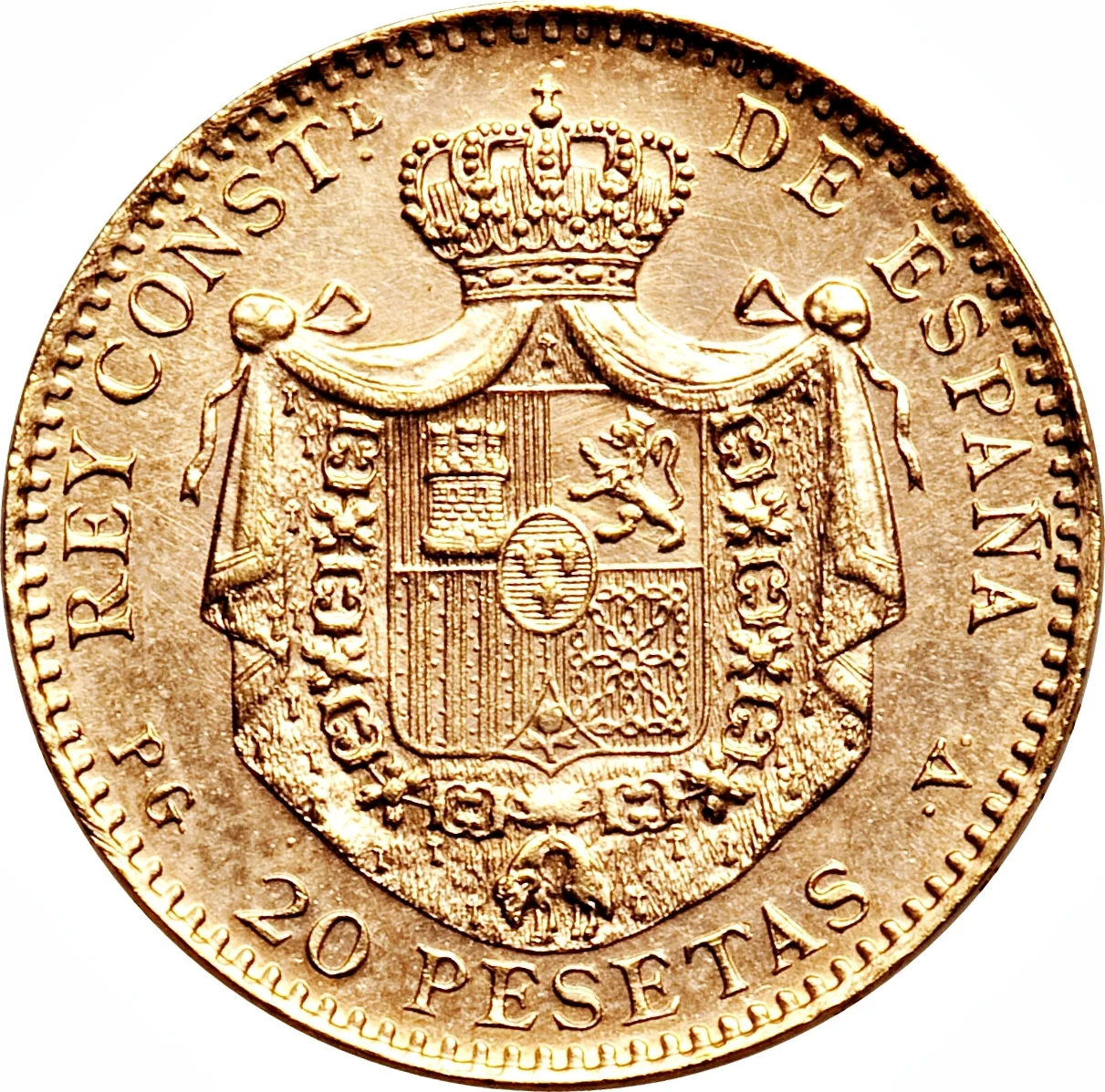
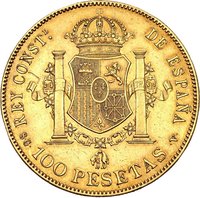
Draped and crowned Spanish coat of arms with the Golden Fleece.
Inscription:
REY CONSTL. DE ESPAÑA
P·G· 20 PESETAS ·V·
P·G· 20 PESETAS ·V·
Translation:
KING CONSTITUTIONAL OF SPAIN
P·G· 20 PESETAS ·V·
P·G· 20 PESETAS ·V·
Script: Latin
Language: Spanish
Engraver: Bartolomé Maura Montaner
Edge
Categories
| Person> Monarch |
| Symbols> Coat of Arms |
Mints
| Name | Mark |
|---|---|
| Royal Mint of Madrid | (🟌) |
Mintings
| Year | Mint Mark | Mintage | Quality | Collection |
|---|---|---|---|---|
| 1899 | 🟌 | 2,085,934 | ||
| 1961 | — | 900 | ||
| 1962 | — | 12,000 |
Historical background
By 1899, Spain was grappling with the severe and lingering consequences of the "Disaster of '98"—the loss of its final major colonies (Cuba, Puerto Rico, and the Philippines) after the Spanish-American War. This national trauma was not only psychological but also financial, as it severed crucial colonial trade revenues and triggered massive repatriation of capital. The government, already burdened by heavy debt from the Carlist Wars and colonial conflicts, faced a profound fiscal crisis. To cover its deficits, the Bank of Spain had been forced to engage in the unrestricted printing of paper money, the peseta, which was not backed by sufficient gold reserves.
This led to a classic currency crisis characterized by rampant inflation and a collapse in the peseta's value on international markets. The paper peseta had been declared inconvertible in 1883, and by 1899 its value had plummeted to just 35% of its nominal gold parity. This devaluation devastated real wages, eroded savings, and caused widespread social unrest, particularly among the working classes and fixed-income earners. The situation created a stark divide between the "hard" gold-based economy of international trade and creditors and the "soft" depreciated paper currency used in domestic life.
In response, the conservative government of Francisco Silvela, with his formidable Finance Minister Raimundo Fernández Villaverde, embarked on a drastic stabilization program known as the "Villaverde Reform." Implemented in 1899-1900, its core objective was to restore confidence by sharply curtailing public spending, increasing taxes, and, most critically, returning to budgetary balance. While not immediately restoring the gold standard, Villaverde's austerity measures successfully halted the printing press, stabilized the peseta, and laid the groundwork for eventual monetary recovery. Thus, 1899 stands as the crisis's peak and the pivotal turning point toward stringent fiscal orthodoxy in an attempt to salvage the Spanish economy.
This led to a classic currency crisis characterized by rampant inflation and a collapse in the peseta's value on international markets. The paper peseta had been declared inconvertible in 1883, and by 1899 its value had plummeted to just 35% of its nominal gold parity. This devaluation devastated real wages, eroded savings, and caused widespread social unrest, particularly among the working classes and fixed-income earners. The situation created a stark divide between the "hard" gold-based economy of international trade and creditors and the "soft" depreciated paper currency used in domestic life.
In response, the conservative government of Francisco Silvela, with his formidable Finance Minister Raimundo Fernández Villaverde, embarked on a drastic stabilization program known as the "Villaverde Reform." Implemented in 1899-1900, its core objective was to restore confidence by sharply curtailing public spending, increasing taxes, and, most critically, returning to budgetary balance. While not immediately restoring the gold standard, Villaverde's austerity measures successfully halted the printing press, stabilized the peseta, and laid the groundwork for eventual monetary recovery. Thus, 1899 stands as the crisis's peak and the pivotal turning point toward stringent fiscal orthodoxy in an attempt to salvage the Spanish economy.
⭐ Rare