

1 peseta – Spain
Add to wishlist
Spain
Context
Years: 1903–1905
Issuer: Spain
Ruler: Alfonso XIII
Currency:
(1868—2001)
Demonetization: 20 February 1939
Total mintage: 16,388,000
Material
References
KM: #
Numista: #9335
Value
Exchange value: 1 ESP
Bullion value: $10.64
Obverse
Description:
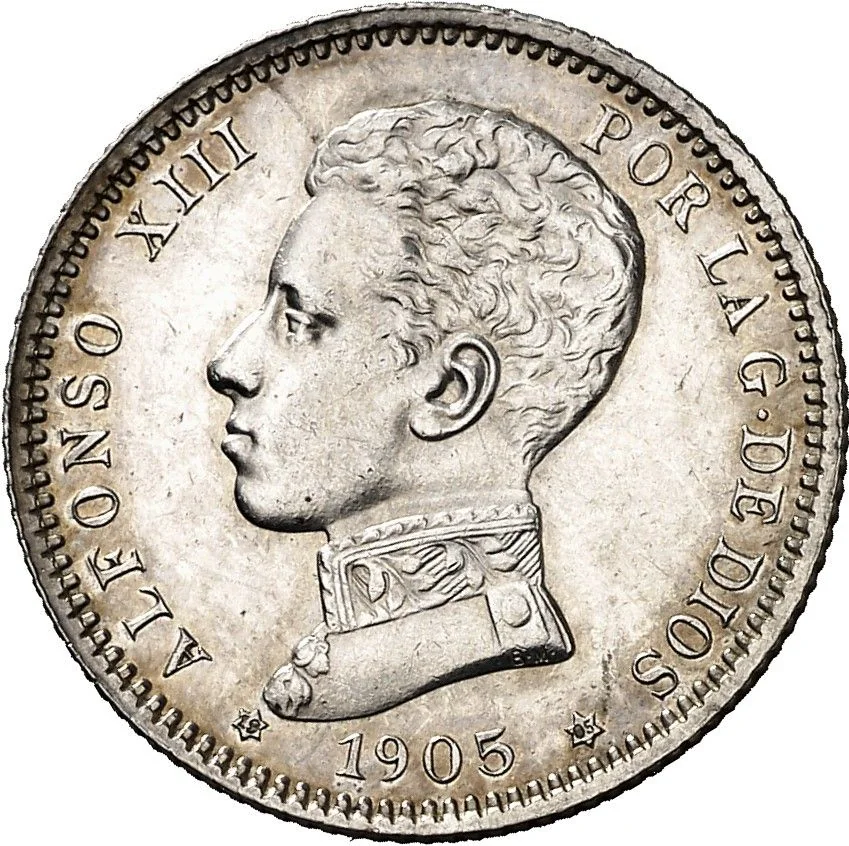
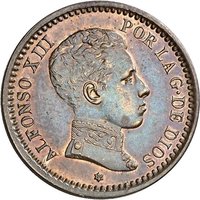
King Alfonso III facing left.
Inscription:
ALFONSO XIII POR LA G· DE DIOS
B· M·
🟌 1905 🟌
B· M·
🟌 1905 🟌
Translation:
By the Grace of God, Alfonso XIII
King and Emperor
🟌 1905 🟌
King and Emperor
🟌 1905 🟌
Script: Latin
Language: Spanish
Engraver: Bartolomé Maura Montaner
Reverse
Description:
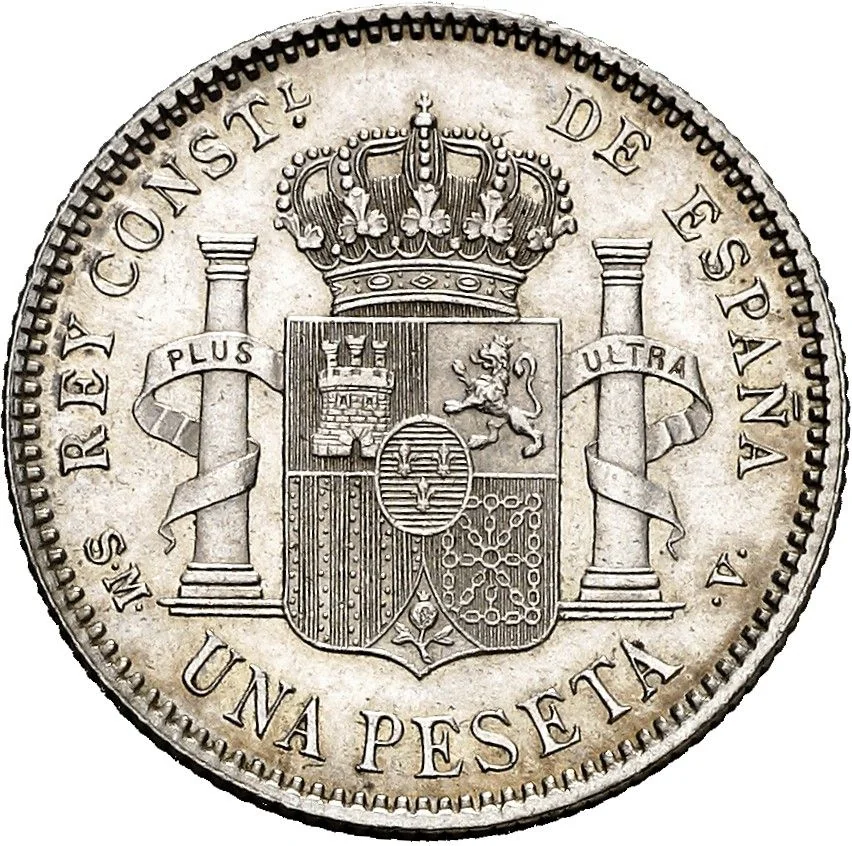
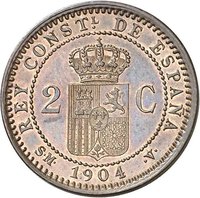
Spanish coat of arms with the Pillars of Hercules.
Inscription:
REY CONSTL. DE ESPAÑA
PLUS ULTRA
S·M· UNA PESETA ·V·
PLUS ULTRA
S·M· UNA PESETA ·V·
Translation:
KING CONSTITUTIONAL OF SPAIN
MORE BEYOND
H.M. ONE PESETA V.
MORE BEYOND
H.M. ONE PESETA V.
Script: Latin
Engraver: Bartolomé Maura Montaner
Edge
Reeded
Categories
| Person> Monarch |
| Symbols> Coat of Arms |
Mints
| Name | Mark |
|---|---|
| Royal Mint of Madrid | (🟌) |
Mintings
| Year | Mint Mark | Mintage | Quality | Collection |
|---|---|---|---|---|
| 1903 | 🟌 | 10,602,000 | ||
| 1904 | 🟌 | 5,294,000 | ||
| 1905 | 🟌 | 492,000 |
Historical background
In 1903, Spain's currency system was in a state of transition and vulnerability, anchored to the Bimetallic Standard of the Latin Monetary Union. Officially, the country operated on a system where both gold (the 25-peseta coin) and silver (the peseta coin) were legal tender, with their values fixed by law. However, in practice, the international fluctuation of precious metal prices had effectively driven full-bodied gold coins out of circulation, as they were worth more as bullion than as currency. This left a silver-based system that was under immense strain, with the silver peseta's value depreciating significantly against gold-backed currencies like the British pound and French franc, harming Spain's international trade and credit.
This monetary instability was a direct reflection of Spain's broader economic and political fragility following the loss of its last major colonies in 1898. The "Disaster of '98" had drained national reserves and confidence, leading to budget deficits and inflation. The government, led by the conservative Francisco Silvela, was grappling with a massive public debt. To protect its dwindling gold reserves and prevent a complete monetary collapse, Spain had suspended the convertibility of its banknotes into specie (gold or silver) in 1883, a measure that remained in effect. Consequently, the circulating medium was a mixture of undervalued silver coins, fractional coinage made of cheaper metals, and largely inconvertible paper notes issued by the Bank of Spain.
The situation created persistent debate between "metalistas" (advocates for a return to a strict metallic standard, preferably gold) and "papelistas" (those who accepted a managed, fiduciary paper system). While the government desired to join the international gold standard for stability and prestige, the nation's depleted treasury and lack of gold reserves made this impossible. Therefore, in 1903, Spain was effectively on a de facto silver-exchange and paper standard, with its currency's value fluctuating on foreign markets. This unstable foundation would persist until the reforms following the creation of the Bank of Spain's monopoly on note issuance in 1921.
This monetary instability was a direct reflection of Spain's broader economic and political fragility following the loss of its last major colonies in 1898. The "Disaster of '98" had drained national reserves and confidence, leading to budget deficits and inflation. The government, led by the conservative Francisco Silvela, was grappling with a massive public debt. To protect its dwindling gold reserves and prevent a complete monetary collapse, Spain had suspended the convertibility of its banknotes into specie (gold or silver) in 1883, a measure that remained in effect. Consequently, the circulating medium was a mixture of undervalued silver coins, fractional coinage made of cheaper metals, and largely inconvertible paper notes issued by the Bank of Spain.
The situation created persistent debate between "metalistas" (advocates for a return to a strict metallic standard, preferably gold) and "papelistas" (those who accepted a managed, fiduciary paper system). While the government desired to join the international gold standard for stability and prestige, the nation's depleted treasury and lack of gold reserves made this impossible. Therefore, in 1903, Spain was effectively on a de facto silver-exchange and paper standard, with its currency's value fluctuating on foreign markets. This unstable foundation would persist until the reforms following the creation of the Bank of Spain's monopoly on note issuance in 1921.
🌱 Common