

Spain
Context
Years: 1897–1962
Year: 1897
Issuer: Spain 
Ruler: Alfonso XIII
Currency:
(1868—2001)
Demonetized: Yes
Total mintage: 156,572
Material
References
KM: #Click to copy to clipboard708
Numista: #14834
Value
Exchange value: 100 ESP
Bullion value: $4849.15
Obverse
Description:
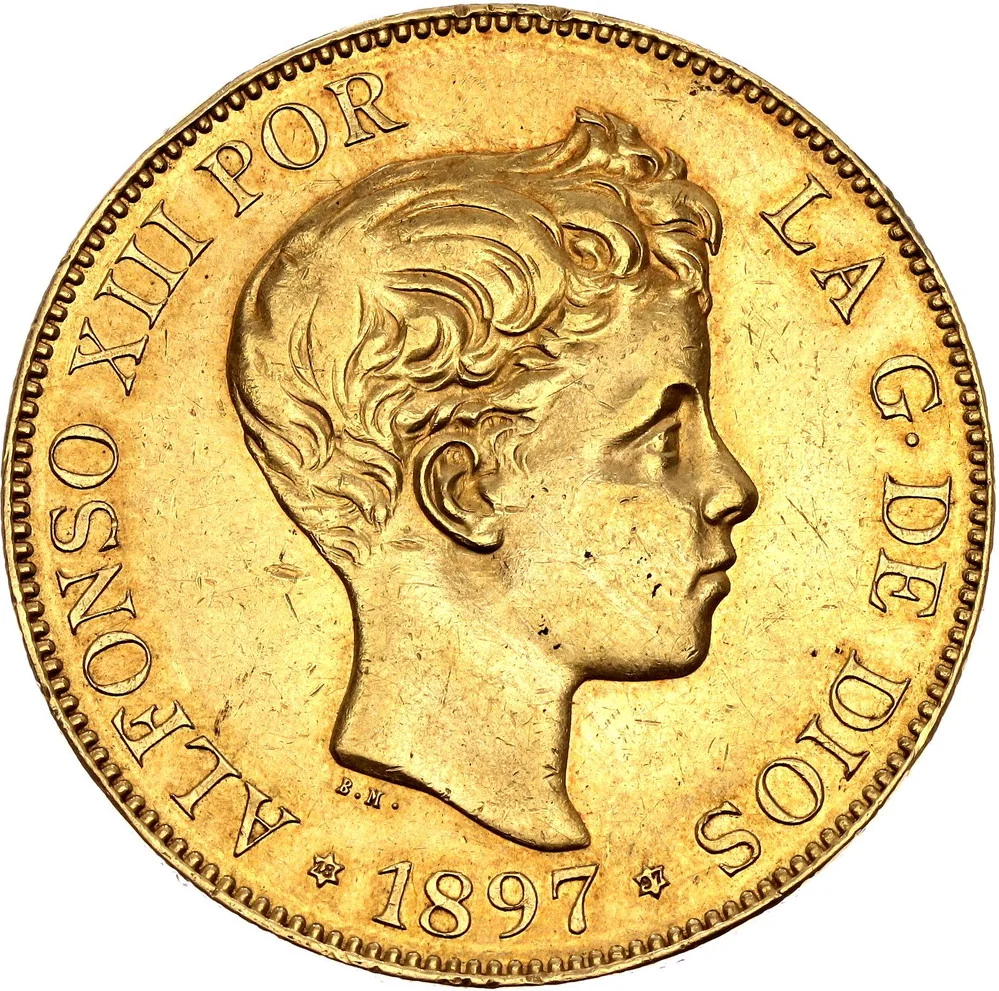
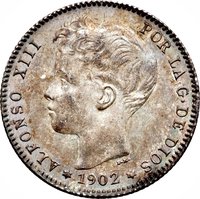
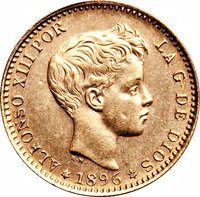
Childhood portrait of King Alfonso XIII facing right.
Inscription:
ALFONSO XIII POR LA G· DE DIOS
B· M·
🟌 1897 🟌
B· M·
🟌 1897 🟌
Translation:
By the Grace of God, Alfonso XIII
King and Emperor
🟌 1897 🟌
King and Emperor
🟌 1897 🟌
Script: Latin
Language: Spanish
Engraver: Bartolomé Maura Montaner
Reverse
Description:
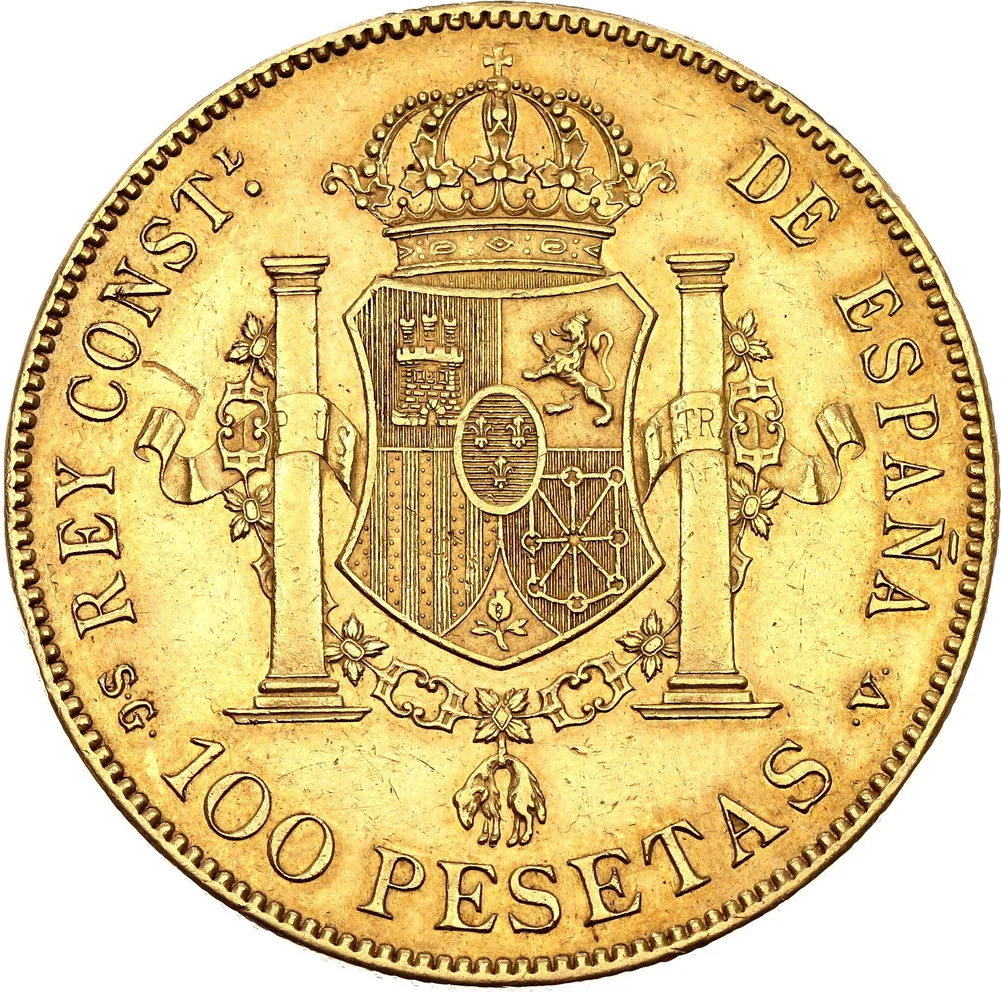
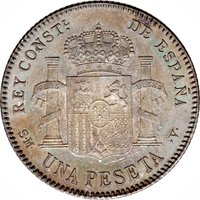
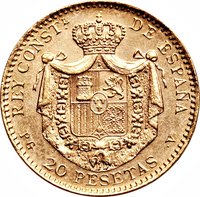
Spanish coat of arms with crown, Pillars of Hercules, and Golden Fleece collar.
Inscription:
REY CONSTL. DE ESPAÑA
PLUS ULTRA
S·G· 100 PESETAS ·V·
PLUS ULTRA
S·G· 100 PESETAS ·V·
Translation:
KING CONSTITUTIONAL OF SPAIN
MORE BEYOND
S·G· 100 PESETAS ·V·
MORE BEYOND
S·G· 100 PESETAS ·V·
Script: Latin
Engraver: Bartolomé Maura Montaner
Edge
Categories
| Person> Monarch |
| Symbols> Coat of Arms |
Mints
| Name | Mark |
|---|---|
| Royal Mint of Madrid | (🟌) |
Mintings
| Year | Mint Mark | Mintage | Quality | Collection |
|---|---|---|---|---|
| 1897 | 🟌 | 149,762 | ||
| 1961 | — | 810 | ||
| 1962 | — | 6,000 |
Historical background
In 1897, Spain’s currency system was defined by the Peseta, which had been established as the sole legal tender in 1868 following the Glorious Revolution, replacing the complex mosaic of regional and historical coins. The country operated on a bimetallic standard (gold and silver) in theory, but in practice it was part of the broader European shift towards a de facto gold standard. However, Spain’s political instability, military defeats, and economic stagnation throughout the late 19th century, particularly following the loss of most of its remaining American colonies, had strained public finances and eroded confidence. This led to a persistent budget deficit and a growing reliance on debt, placing pressure on the Bank of Spain's gold reserves and causing the peseta to fluctuate significantly against gold-backed currencies like the British pound and French franc.
The period was marked by a chronic currency depreciation. The peseta, while stable domestically, had lost substantial value on international exchange markets. This was exacerbated by the Cuban War of Independence (1895-1898), which was draining the Spanish treasury at an alarming rate in 1897. To finance the conflict, the government increasingly resorted to issuing debt and expanding the money supply, fueling inflation and further undermining the external value of the peseta. Consequently, a notable gap emerged between the face value of silver coins and their intrinsic metal worth, leading to the common practice of hoarding silver, which frequently caused a shortage of fractional coinage in everyday circulation.
Thus, on the eve of the catastrophic Spanish-American War in 1898, the currency situation was one of fragile instability. The monetary system was caught between the aspiration for the credibility of the gold standard and the reality of fiscal weakness driven by colonial conflict. The pressures of 1897 set the stage for the severe financial crisis that would follow Spain's defeat in 1898, which ultimately forced the country to officially abandon bimetallism and adopt a fiduciary system (paper money not fully convertible to gold) in the early 20th century to manage its depleted reserves and substantial debt.
The period was marked by a chronic currency depreciation. The peseta, while stable domestically, had lost substantial value on international exchange markets. This was exacerbated by the Cuban War of Independence (1895-1898), which was draining the Spanish treasury at an alarming rate in 1897. To finance the conflict, the government increasingly resorted to issuing debt and expanding the money supply, fueling inflation and further undermining the external value of the peseta. Consequently, a notable gap emerged between the face value of silver coins and their intrinsic metal worth, leading to the common practice of hoarding silver, which frequently caused a shortage of fractional coinage in everyday circulation.
Thus, on the eve of the catastrophic Spanish-American War in 1898, the currency situation was one of fragile instability. The monetary system was caught between the aspiration for the credibility of the gold standard and the reality of fiscal weakness driven by colonial conflict. The pressures of 1897 set the stage for the severe financial crisis that would follow Spain's defeat in 1898, which ultimately forced the country to officially abandon bimetallism and adopt a fiduciary system (paper money not fully convertible to gold) in the early 20th century to manage its depleted reserves and substantial debt.
💎 Very Rare