

5 Pesetas – Spain
Spain
Context
Years: 1888–1892
Issuer: Spain 
Ruler: Alfonso XIII
Currency:
(1868—2001)
Demonetized: Yes
Total mintage: 33,984,784
Material
References
KM: #Click to copy to clipboard689
Numista: #4009
Value
Exchange value: 5 ESP
Bullion value: $65.27
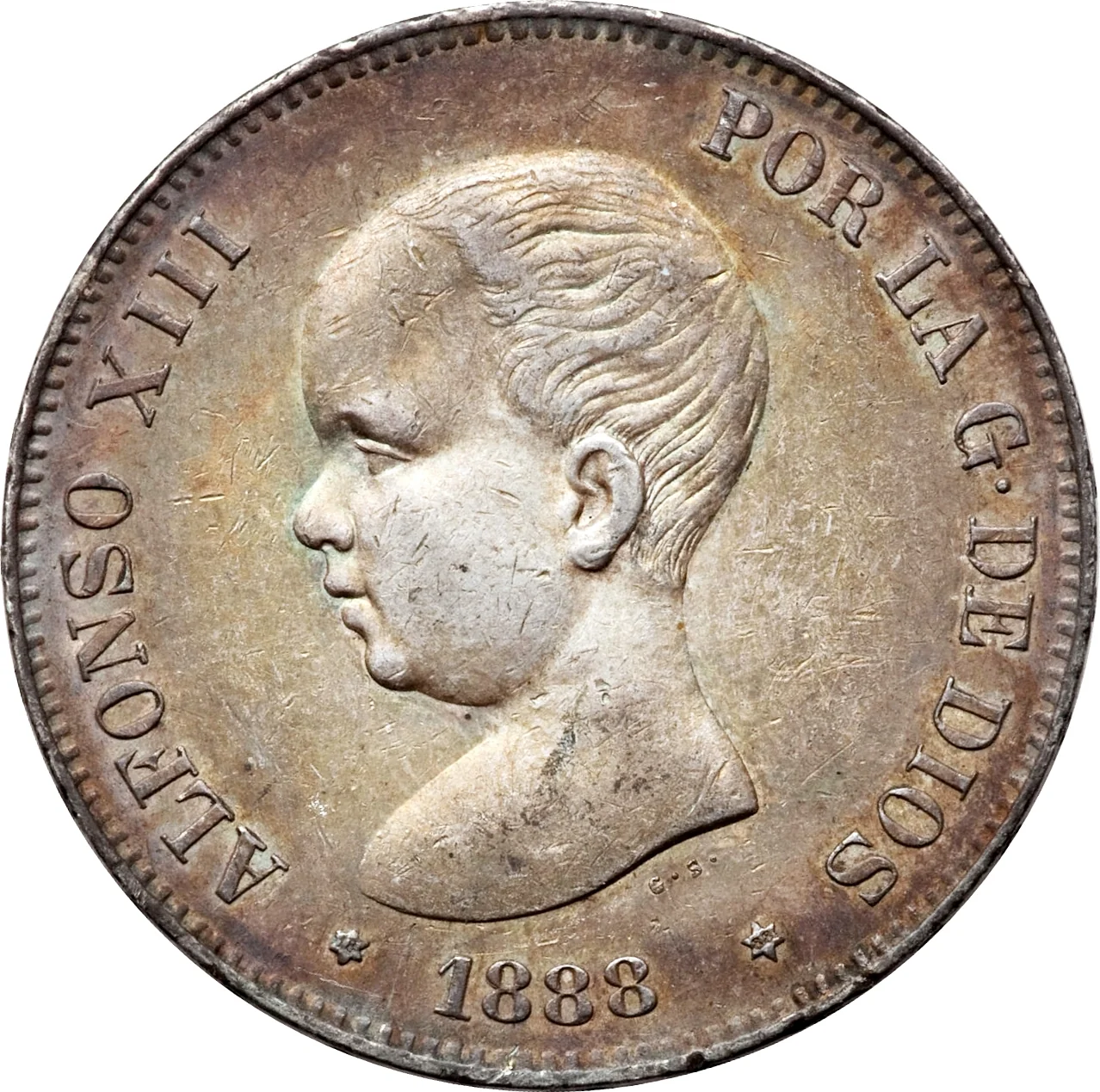
Obverse
Description:
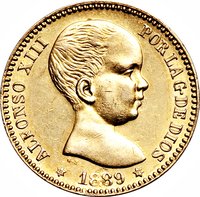
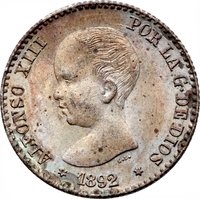
Toddler King Alfonso XIII facing left.
Inscription:
ALFONSO XIII POR LA G· DE DIOS
G· S·
🟌 1888 🟌
G· S·
🟌 1888 🟌
Translation:
By the grace of God, Alfonso XIII
King and Sovereign
🟌 1888 🟌
King and Sovereign
🟌 1888 🟌
Script: Latin
Language: Spanish
Engraver: Gregorio Sellán y González
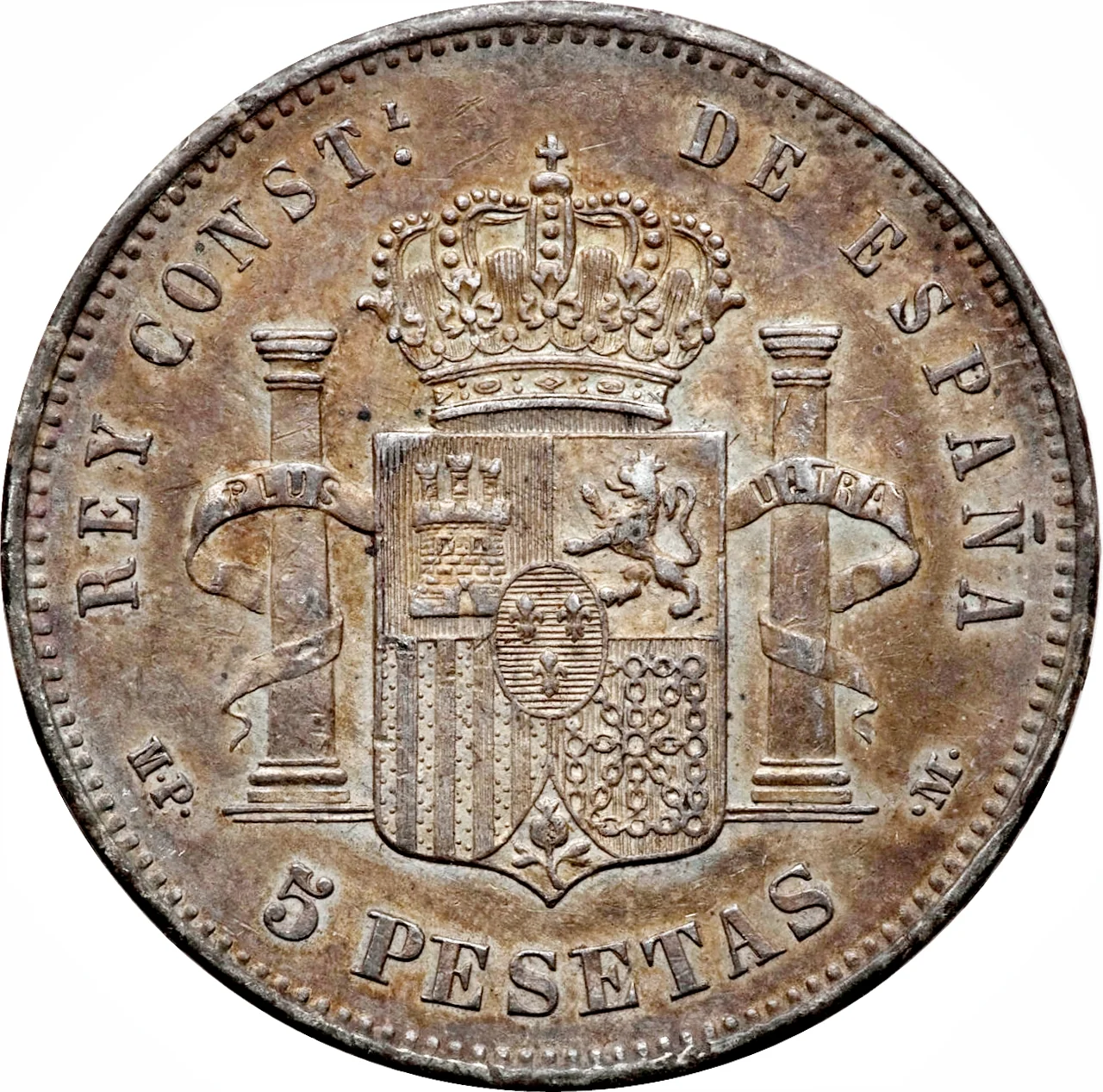
Reverse
Description:
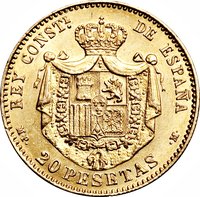
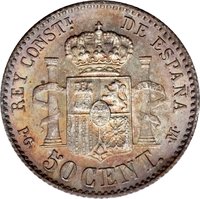
Spanish coat of arms with the Pillars of Hercules.
Inscription:
REY CONSTL. DE ESPAÑA
PLUS ULTRA
M·P· 5 PESETAS ·M·
PLUS ULTRA
M·P· 5 PESETAS ·M·
Translation:
KING CONSTITUTIONAL OF SPAIN
MORE BEYOND
M·P· 5 PESETAS ·M·
MORE BEYOND
M·P· 5 PESETAS ·M·
Script: Latin
Engraver: Gregorio Sellán y González
Edge
Continuous fleur-de-lys around edge
Categories
| Person> Monarch |
| Symbols> Coat of Arms |
Mints
| Name | Mark |
|---|---|
| Royal Mint of Madrid | (🟌) |
Mintings
| Year | Mint Mark | Mintage | Quality | Collection |
|---|---|---|---|---|
| 1888 | 🟌 | 10,643,900 | ||
| 1889 | 🟌 | 4,681,328 | ||
| 1890 | 🟌 | — | ||
| 1891 | 🟌 | 11,659,556 | ||
| 1892 | 🟌 | 7,000,000 |
Historical background
In 1888, Spain operated under the peseta, established as the sole national currency in 1868 following the Glorious Revolution. This decimal currency (1 peseta = 100 céntimos) replaced the complex system of reales and escudos, symbolizing a modern, unified nation. However, by the late 1880s, Spain was not part of the international Latin Monetary Union and had effectively been on a de facto gold standard since 1874. This meant the peseta's value was pegged to gold, aiming to provide stability and foster foreign investment, crucial for a country undergoing industrialization.
Despite this official stance, Spain's economic reality was fragile. The country grappled with significant budget deficits and a large public debt, partly stemming from colonial conflicts and political instability. These factors undermined full confidence in the peseta's convertibility. While gold and silver coins circulated, much of the domestic economy relied on fiduciary money—banknotes issued by the Bank of Spain and other private banks, which were not fully backed by gold reserves. This created an underlying tension between the official gold standard and the practical reliance on less secure paper money.
The year 1888 itself, highlighted by the Barcelona Universal Exposition, presented a facade of economic progress and modernity. Yet, the currency system was under latent strain. The costs of colonial engagements, particularly in Cuba and the Philippines, would soon precipitate a financial crisis in the 1890s, leading to the suspension of gold convertibility in 1898. Thus, the situation in 1888 was one of precarious stability, with a nominally strong currency masking the fiscal weaknesses that would soon force Spain off the gold standard and lead to a period of peseta depreciation.
Despite this official stance, Spain's economic reality was fragile. The country grappled with significant budget deficits and a large public debt, partly stemming from colonial conflicts and political instability. These factors undermined full confidence in the peseta's convertibility. While gold and silver coins circulated, much of the domestic economy relied on fiduciary money—banknotes issued by the Bank of Spain and other private banks, which were not fully backed by gold reserves. This created an underlying tension between the official gold standard and the practical reliance on less secure paper money.
The year 1888 itself, highlighted by the Barcelona Universal Exposition, presented a facade of economic progress and modernity. Yet, the currency system was under latent strain. The costs of colonial engagements, particularly in Cuba and the Philippines, would soon precipitate a financial crisis in the 1890s, leading to the suspension of gold convertibility in 1898. Thus, the situation in 1888 was one of precarious stability, with a nominally strong currency masking the fiscal weaknesses that would soon force Spain off the gold standard and lead to a period of peseta depreciation.
🌱 Very Common