

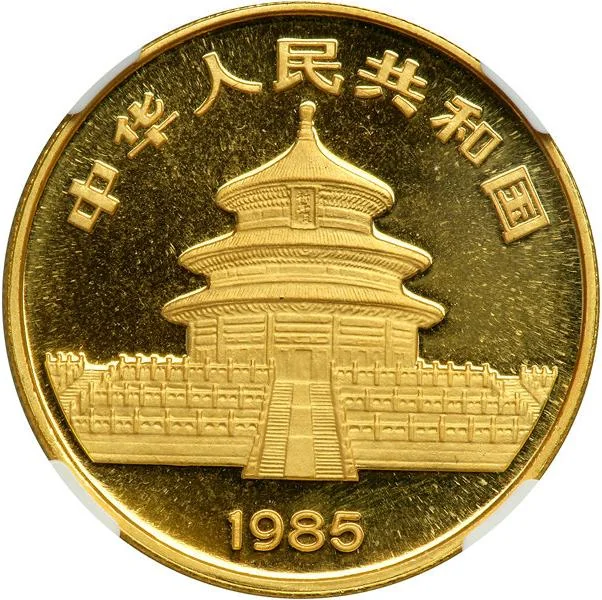
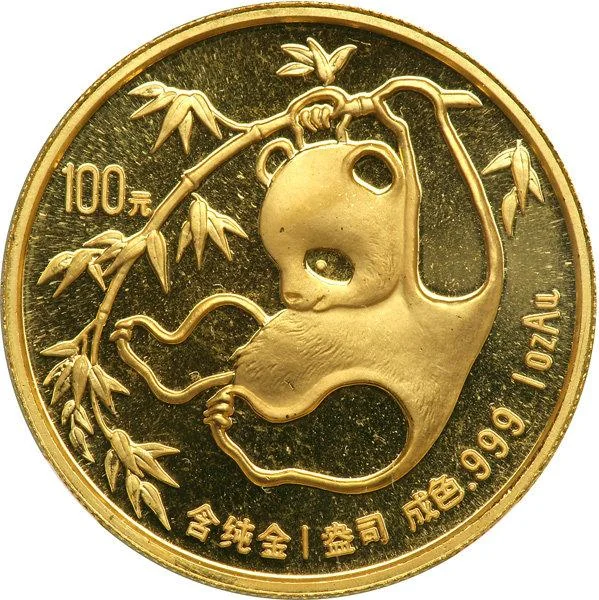
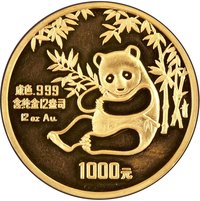
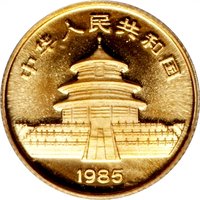
100 yuan – People's Republic of China
Add to wishlist
Non-circulating coins
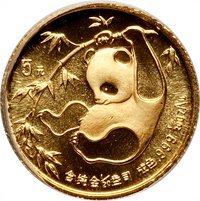
Series: Panda Bullion
China
Context
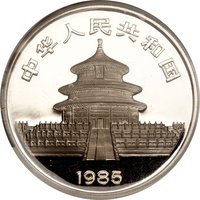
Year: 1985
Country: China
Issuer: People's Republic of China
Period:
(since 1949)
Currency:
(since 1955)
Total mintage: 55,539
Material
Diameter: 32 mm
Weight: 31.1 g
Gold Weight:: 31.07 g
Thickness: 2.7 mm
Shape: Round
Composition: 99.9% Gold
Standard: Silver ounce
Magnetic: No
Technique: Milled
Alignment: Medal alignment
flip
References
KM: #
Numista: #17581
Value
Exchange value: 100 CNY
Bullion value: $4792.46
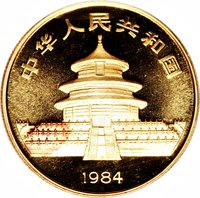
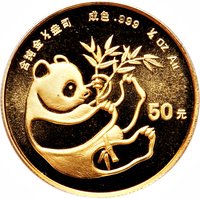
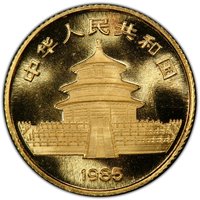
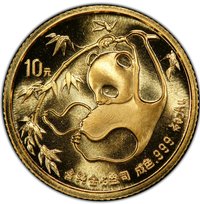
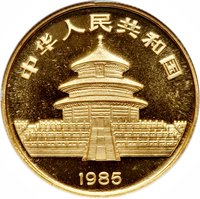
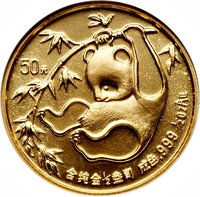
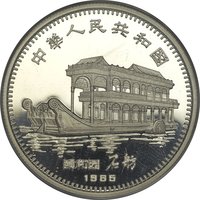
Obverse
Edge
Mintings
| Year | Mint Mark | Mintage | Quality | Collection |
|---|---|---|---|---|
| 1985 | — | 55,539 | BU |
Historical background
In 1985, the People's Republic of China was navigating a critical and complex phase of its currency and economic reform. The decade's earlier agricultural and industrial decollectivization had unleashed rapid growth but also created severe macroeconomic imbalances, including high inflation and a growing trade deficit. The core currency issue was the management of the dual-track price system and the exchange rate regime. The official exchange rate of the renminbi (RMB) was vastly overvalued, coexisting with a more market-based internal "swap rate" used in Special Economic Zones for trade. This created distortions, encouraged rent-seeking, and hampered the competitiveness of Chinese exports, as enterprises struggled to access foreign exchange through the state's strict allocation system.
The government's response in this period was a series of cautious but significant devaluations and policy adjustments aimed at moving toward a more unified and realistic exchange rate. A major step was the establishment of the "foreign exchange adjustment centers" (precursors to a formal swap market) in Shenzhen and later other cities, where enterprises could trade foreign exchange certificates at rates closer to market scarcity. While the official rate remained around 2.8 RMB to the US dollar, the swap market rate was much weaker, exceeding 3.0 RMB per dollar. This pragmatic dual-track approach sought to gradually introduce market forces without causing the shock of a sudden, full devaluation, which risked exacerbating imported inflation and social instability.
Overall, the currency situation in 1985 reflected the broader tensions of China's reform era: the push for market efficiency versus the need for state control, the drive for international integration against the fear of external vulnerability, and the battle against inflationary pressures stemming from liberalization. The incremental adjustments of this period laid the essential groundwork for the more decisive devaluation of 1994, which unified the exchange rates and established the framework for the managed float system that followed. The challenges of 1985 underscored that currency reform was not an isolated technical issue but a central pillar in China's tumultuous transition from a planned to a "socialist market economy."
The government's response in this period was a series of cautious but significant devaluations and policy adjustments aimed at moving toward a more unified and realistic exchange rate. A major step was the establishment of the "foreign exchange adjustment centers" (precursors to a formal swap market) in Shenzhen and later other cities, where enterprises could trade foreign exchange certificates at rates closer to market scarcity. While the official rate remained around 2.8 RMB to the US dollar, the swap market rate was much weaker, exceeding 3.0 RMB per dollar. This pragmatic dual-track approach sought to gradually introduce market forces without causing the shock of a sudden, full devaluation, which risked exacerbating imported inflation and social instability.
Overall, the currency situation in 1985 reflected the broader tensions of China's reform era: the push for market efficiency versus the need for state control, the drive for international integration against the fear of external vulnerability, and the battle against inflationary pressures stemming from liberalization. The incremental adjustments of this period laid the essential groundwork for the more decisive devaluation of 1994, which unified the exchange rates and established the framework for the managed float system that followed. The challenges of 1985 underscored that currency reform was not an isolated technical issue but a central pillar in China's tumultuous transition from a planned to a "socialist market economy."
Series: Panda Bullion


💎 Extremely Rare