

5 cents – Rhodesia
Add to wishlist
Zimbabwe
Context
Material
Diameter: 19.3 mm
Weight: 2.8 g
Shape: Round
Composition: Copper-nickel
Technique: Milled
Alignment: Medal alignment
flip
References
KM: #
Numista: #10509
Value
Exchange value: 0.05 RHD
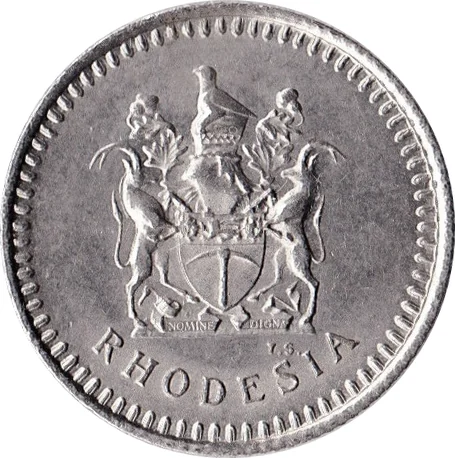
Obverse
Description:
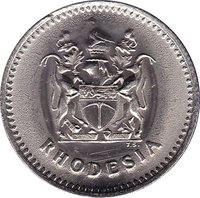
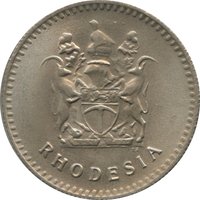
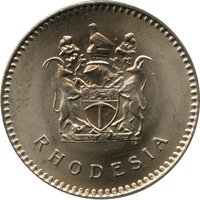
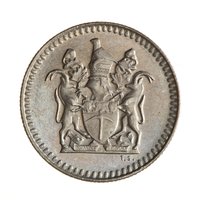
Rhodesian coat of arms with name.
Inscription:
SIT NOMINE DIGNA
T.S.
RHODESIA
T.S.
RHODESIA
Translation:
May she be worthy of the name
Rhodesia
Rhodesia
Script: Latin
Language: Latin
Engraver: Tommy Sasseen
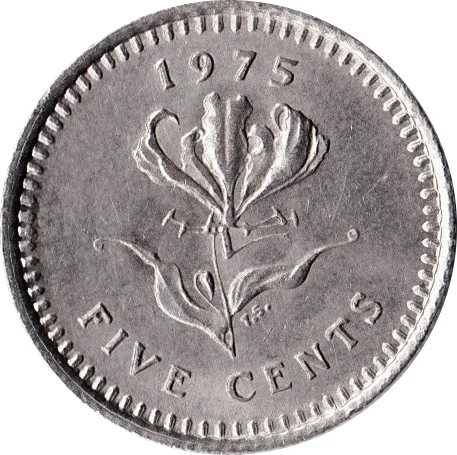
Reverse
Description:
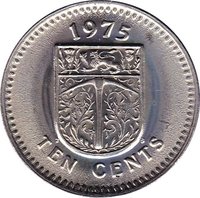
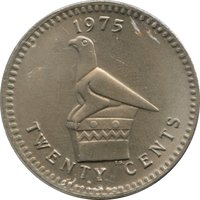
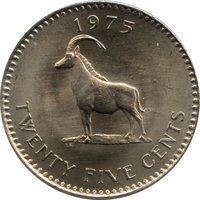
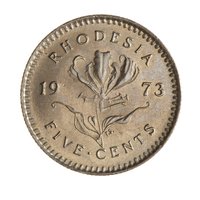
Date/Name above, denomination below.
Inscription:
1975
T.S.
FIVE CENTS
T.S.
FIVE CENTS
Script: Latin
Engraver: Tommy Sasseen
Edge
Milled
Mints
| Name | Mark |
|---|---|
| Pretoria | — |
Mintings
| Year | Mint Mark | Mintage | Quality | Collection |
|---|---|---|---|---|
| 1975 | — | 3,500,000 | ||
| 1975 | — | 10 | Proof | |
| 1976 | — | 8,038,000 | ||
| 1977 | — | 3,015,000 |
Historical background
By 1975, Rhodesia's currency situation was a direct reflection of its nine-year-old Unilateral Declaration of Independence (UDI) and the resulting international sanctions regime. The Rhodesian pound, and later the Rhodesian dollar introduced in 1970, existed in a state of artificial isolation. Cut off from the International Monetary Fund and global financial markets, the country's currency was managed by the Reserve Bank of Rhodesia, which maintained strict exchange controls to prevent capital flight and prop up the currency's value. This created an official exchange rate that was widely divorced from economic reality, while a thriving black market for foreign currency operated on the sidelines.
Economically, the currency was under severe pressure from the combined weight of sanctions and the escalating cost of the Bush War against nationalist guerrilla forces. Military spending consumed over 30% of the national budget, fueling inflation and diverting resources from productive sectors. While the regime initially fostered a siege economy with surprising resilience through import substitution and trade with sympathetic nations like South Africa and Portugal, the 1974 collapse of the Portuguese empire removed a critical economic conduit, tightening the sanctions noose further and increasing Rhodesia's dependency on South Africa.
Consequently, 1975 was a pivotal year of mounting strain. Inflation was rising sharply, eroding public confidence. The government, led by Ian Smith, was forced into significant currency devaluations against the South African rand—its most important linked currency—in both February and September, a clear signal of deteriorating economic fundamentals. These devaluations, aimed at boosting exports and conserving scarce foreign reserves, effectively acknowledged that the regime's financial defenses were weakening under the relentless pressures of war, isolation, and a shifting regional political landscape.
Economically, the currency was under severe pressure from the combined weight of sanctions and the escalating cost of the Bush War against nationalist guerrilla forces. Military spending consumed over 30% of the national budget, fueling inflation and diverting resources from productive sectors. While the regime initially fostered a siege economy with surprising resilience through import substitution and trade with sympathetic nations like South Africa and Portugal, the 1974 collapse of the Portuguese empire removed a critical economic conduit, tightening the sanctions noose further and increasing Rhodesia's dependency on South Africa.
Consequently, 1975 was a pivotal year of mounting strain. Inflation was rising sharply, eroding public confidence. The government, led by Ian Smith, was forced into significant currency devaluations against the South African rand—its most important linked currency—in both February and September, a clear signal of deteriorating economic fundamentals. These devaluations, aimed at boosting exports and conserving scarce foreign reserves, effectively acknowledged that the regime's financial defenses were weakening under the relentless pressures of war, isolation, and a shifting regional political landscape.
Series: 1975 Rhodesia circulation coins
🌱 Common