

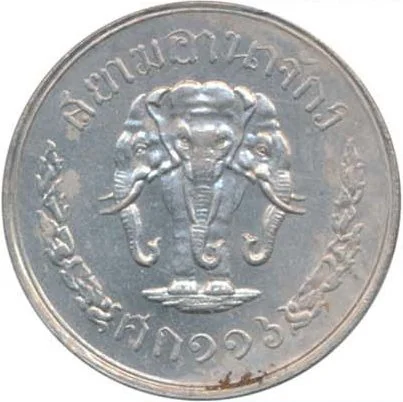
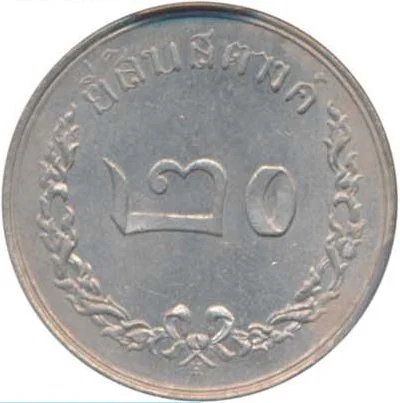
20 Satangs – Thailand
Thailand
Context
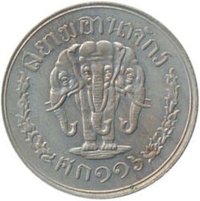
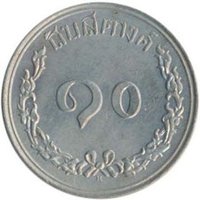
Year: 1897
Thailand - Rama era Year: 116
Issuer: Thailand 
Ruler: Phra Chula Chom Klao
Currency:
(since 1897)
Demonetization: 17 May 1909
Total mintage: 3,126,000
Material
Diameter: 25 mm
Weight: 6.45 g
Thickness: 1.8 mm
Shape: Round
Composition: Copper-nickel
Technique: Milled
Alignment: Medal alignment
flip
References
Y: #Click to copy to clipboard27
Numista: #17200
Value
Exchange value: 0.20 THB = $0.01
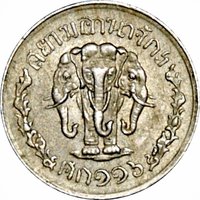
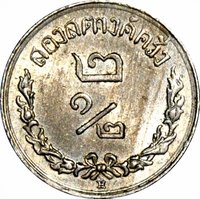
Obverse
Edge
Plain
Mints
| Name | Mark |
|---|---|
| Heaton and Sons / The Mint Birmingham | H |
Mintings
| Year | Mint Mark | Mintage | Quality | Collection |
|---|---|---|---|---|
| 1897 | — | 3,126,000 |
Historical background
In 1897, Thailand (then Siam) was in a period of significant monetary transition, moving away from a traditional bimetal system and towards a modern, standardized currency under the absolute monarchy of King Chulalongkorn (Rama V). The nation's economy was not yet fully monetized, with barter persisting in rural areas, while international trade relied on a complex mix of foreign silver coins (like Mexican and Spanish dollars), bullet-shaped silver baht, and a variety of tin, copper, and cowrie shells for smaller transactions. This lack of a unified system created confusion, hindered commerce, and was seen as an impediment to modernization and sovereignty amidst colonial pressures in Southeast Asia.
The key development of this era was the establishment of the first modern mint, the "Royal Thai Mint" in Bangkok, which began operations in 1860 but whose reforms were still consolidating decades later. Its most important output was the flat, machine-struck silver "baht" coin, which was gradually replacing the old bullet money. Furthermore, the government had introduced paper banknotes in 1853, issued by the Royal Treasury, though public trust in them was initially low and their circulation remained limited compared to silver. The value of the baht was officially pegged to silver, but the global decline in silver prices in the late 19th century caused economic instability and strained the kingdom's finances.
Therefore, the currency situation in 1897 was one of controlled duality and impending change. The state was actively promoting a decimal-based national system (1 baht = 100 satang), yet older forms of money remained in circulation. This transitional phase set the stage for the critical monetary reforms that would follow, culminating in the creation of the "tical" (baht) as a gold-exchange standard in 1902 and the founding of the Bank of Thailand decades later. The efforts in 1897 were fundamentally about centralizing economic authority, simplifying taxation and trade, and projecting a modern, independent state to the world.
The key development of this era was the establishment of the first modern mint, the "Royal Thai Mint" in Bangkok, which began operations in 1860 but whose reforms were still consolidating decades later. Its most important output was the flat, machine-struck silver "baht" coin, which was gradually replacing the old bullet money. Furthermore, the government had introduced paper banknotes in 1853, issued by the Royal Treasury, though public trust in them was initially low and their circulation remained limited compared to silver. The value of the baht was officially pegged to silver, but the global decline in silver prices in the late 19th century caused economic instability and strained the kingdom's finances.
Therefore, the currency situation in 1897 was one of controlled duality and impending change. The state was actively promoting a decimal-based national system (1 baht = 100 satang), yet older forms of money remained in circulation. This transitional phase set the stage for the critical monetary reforms that would follow, culminating in the creation of the "tical" (baht) as a gold-exchange standard in 1902 and the founding of the Bank of Thailand decades later. The efforts in 1897 were fundamentally about centralizing economic authority, simplifying taxation and trade, and projecting a modern, independent state to the world.
💎 Extremely Rare