

10 Pyas – Myanmar
Circulating commemorative coins
Commemoration: F.A.O.
Myanmar

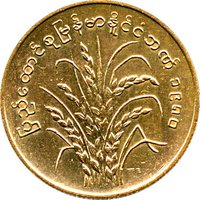
Obverse
Description:
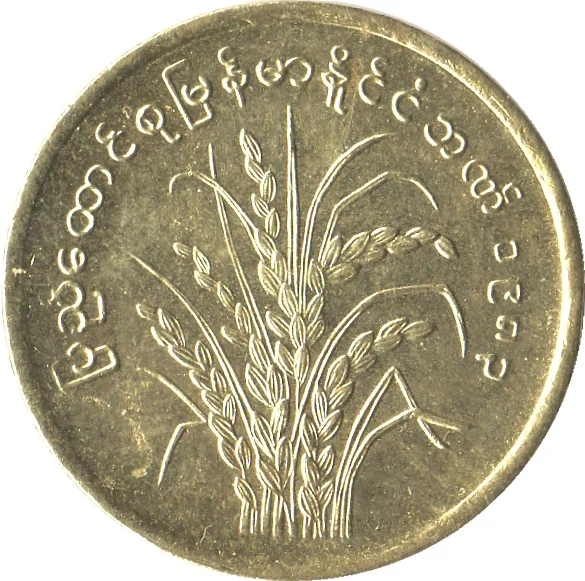
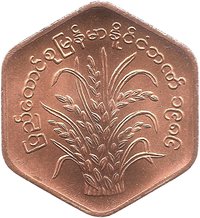
Rice plant with issuer name left of date.
Inscription:
ပြည်ထောင်စု မြန်မာ နိုင်ငံဘဏ် ၁၉၈၃
Translation:
Union of Myanmar Bank 1983
Language: Burmese
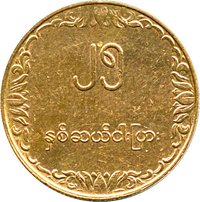
Reverse
Description:
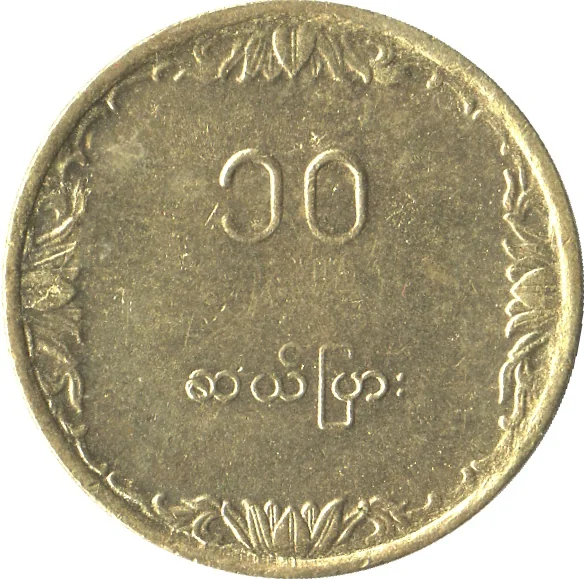
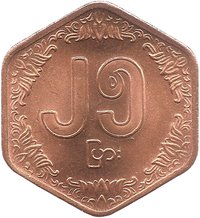
Central square's border defines its denomination.
Inscription:
၁၀
ဆယ်ပြား
ဆယ်ပြား
Translation:
Ten pyas
Language: Burmese
Edge
Plain
Categories
| Organization> FAO |
Mintings
| Year | Mint Mark | Mintage | Quality | Collection |
|---|---|---|---|---|
| 1983 | — | — |
Historical background
In 1983, Myanmar's currency situation was characterized by the rigid control of the socialist government under the Burma Socialist Programme Party (BSPP). The official currency, the kyat, operated within a complex multi-tiered exchange rate system designed to isolate the domestic economy and channel foreign exchange to the state. The most significant divide was between the official fixed rate—set at approximately 6 to 7 kyat per US dollar—and a vastly depreciated black-market rate, which traded at over 30 kyat per dollar. This disparity created severe economic distortions, discouraging legal exports and encouraging widespread smuggling and corruption as individuals and businesses sought hard currency.
The government maintained this system through strict regulations, including mandatory surrender of foreign exchange earnings by state enterprises and limited access to foreign currency for imports, which were prioritized for government projects. This control was part of a broader policy of autarky, intended to foster economic self-reliance but which instead led to chronic trade deficits, a scarcity of essential imported goods, and stagnant growth. The kyat was effectively non-convertible internationally, isolating Myanmar from global financial markets and limiting foreign investment to a few state-sanctioned ventures.
Consequently, the currency situation in 1983 reflected and exacerbated the country's broader economic malaise. The vast gap between official and black-market rates acted as a de facto tax on the formal economy, while a thriving informal sector operated on the margins. This unsustainable structure, combined with falling commodity prices for key exports like rice and teak, placed increasing strain on the regime's finances, foreshadowing the deeper economic crises that would culminate in the pro-democracy uprising of 1988 and the eventual abandonment of the "Burmese Way to Socialism."
The government maintained this system through strict regulations, including mandatory surrender of foreign exchange earnings by state enterprises and limited access to foreign currency for imports, which were prioritized for government projects. This control was part of a broader policy of autarky, intended to foster economic self-reliance but which instead led to chronic trade deficits, a scarcity of essential imported goods, and stagnant growth. The kyat was effectively non-convertible internationally, isolating Myanmar from global financial markets and limiting foreign investment to a few state-sanctioned ventures.
Consequently, the currency situation in 1983 reflected and exacerbated the country's broader economic malaise. The vast gap between official and black-market rates acted as a de facto tax on the formal economy, while a thriving informal sector operated on the margins. This unsustainable structure, combined with falling commodity prices for key exports like rice and teak, placed increasing strain on the regime's finances, foreshadowing the deeper economic crises that would culminate in the pro-democracy uprising of 1988 and the eventual abandonment of the "Burmese Way to Socialism."
🌱 Very Common