

Obverse
Description:
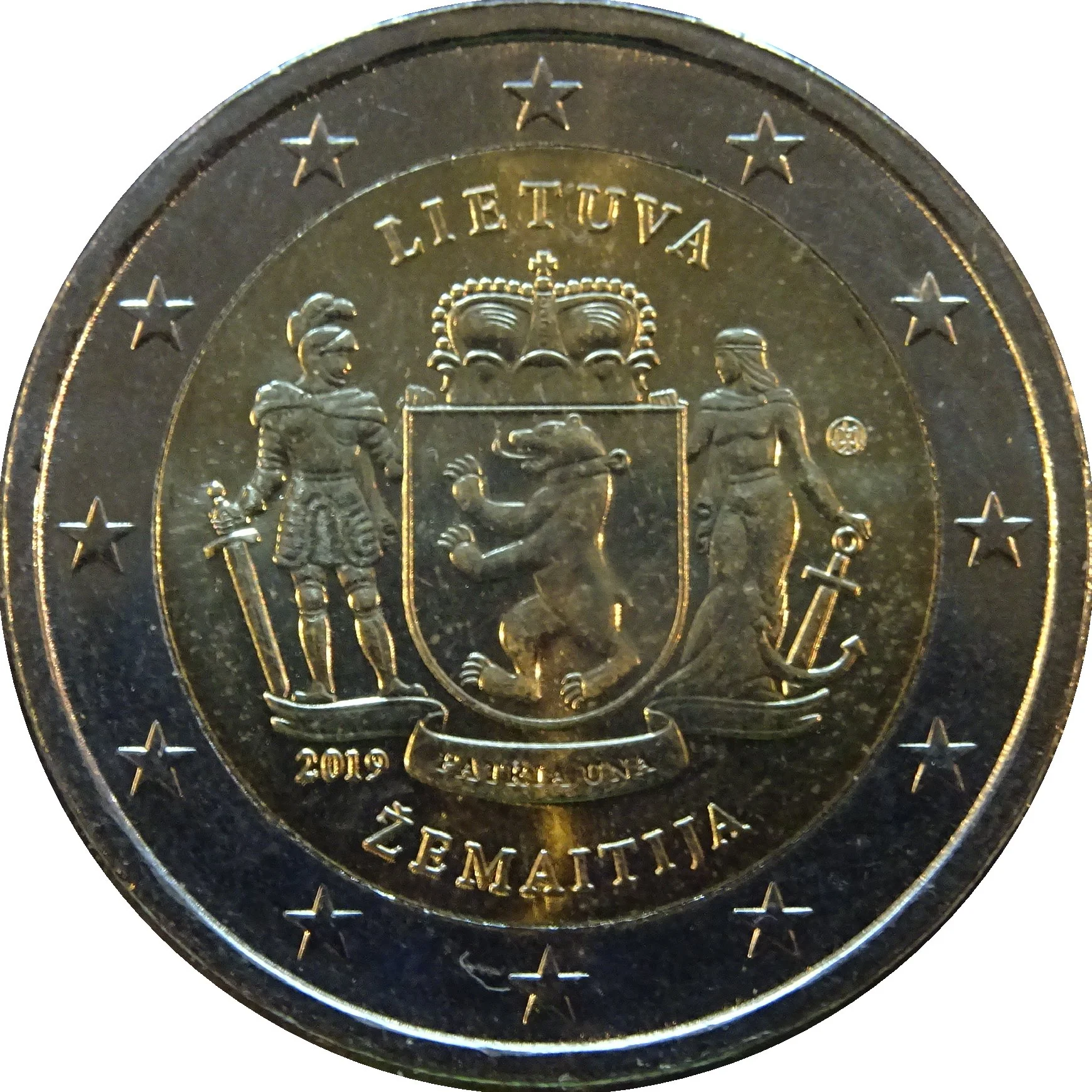
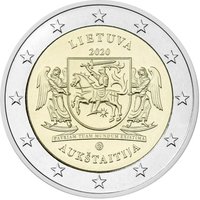
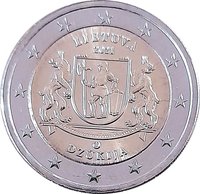
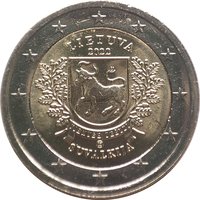
The coin's center depicts Samogitia's historic bear within a crowned shield, held by a soldier (symbolizing courage) and a goddess with an anchor (symbolizing hope). Below is the Latin inscription PATRIA UNA. Surrounding are the inscriptions LIETUVA, ŽEMAITIJA, the year 2019, and the mintmark. The outer ring features the 12 stars of the EU flag.
Inscription:
LIETUVA
PATRIA UNA
2019
ŽEMAITIJA
PATRIA UNA
2019
ŽEMAITIJA
Translation:
Lithuania
One Fatherland
2019
Samogitia
One Fatherland
2019
Samogitia
Script: Latin
Designer: Rolandas Rimkūnas
Reverse
Edge
Reeded with inscription
Legend:
LAISVĖ * VIENYBĖ * GEROVĖ
Translation:
Freedom * Unity * Prosperity
Language: Lithuanian
Mints
| Name | Mark |
|---|---|
| Lithuanian Mint | (LMK) |
Mintings
| Year | Mint Mark | Mintage | Quality | Collection |
|---|---|---|---|---|
| 2019 | LMK | 495,000 | ||
| 2019 | LMK | 5,000 | BU |
Historical background
In 2019, Lithuania was a well-established member of the eurozone, having adopted the euro as its official currency on January 1, 2015. This transition from the litas was a strategic political and economic decision aimed at deepening integration with the European Union and ensuring monetary stability. By 2019, the euro was fully embedded in the domestic economy, with public support for the currency remaining consistently high and the initial transition period long complete. The country's financial system was fully aligned with the Eurosystem, governed by the European Central Bank's monetary policy.
The primary monetary context for Lithuania in 2019 was therefore defined by its participation in the single currency. The country benefited from low interest rates, eliminated exchange rate risk with its main trading partners, and enjoyed enhanced investor confidence. However, as a small open economy, it also had to accept a one-size-fits-all monetary policy from the ECB, which was not specifically tailored to Lithuania's economic cycle. At the time, this meant accommodating policy despite Lithuania's GDP growth, which at approximately 3.9% for the year, was among the fastest in the EU and potentially risked inflationary pressures that national authorities could no longer address through interest rate adjustments.
Domestically, the key currency-related discussions in 2019 were not about the euro itself, but about its management and economic effects. Policy debates focused on fiscal discipline, structural reforms to maintain competitiveness within the eurozone, and the use of macroprudential tools to manage financial stability. Furthermore, there was ongoing public and expert discussion about the tangible benefits of euro adoption, such as reduced transaction costs and greater trade integration, balanced against concerns like perceived contributions to higher price levels in certain sectors since the 2015 changeover.
The primary monetary context for Lithuania in 2019 was therefore defined by its participation in the single currency. The country benefited from low interest rates, eliminated exchange rate risk with its main trading partners, and enjoyed enhanced investor confidence. However, as a small open economy, it also had to accept a one-size-fits-all monetary policy from the ECB, which was not specifically tailored to Lithuania's economic cycle. At the time, this meant accommodating policy despite Lithuania's GDP growth, which at approximately 3.9% for the year, was among the fastest in the EU and potentially risked inflationary pressures that national authorities could no longer address through interest rate adjustments.
Domestically, the key currency-related discussions in 2019 were not about the euro itself, but about its management and economic effects. Policy debates focused on fiscal discipline, structural reforms to maintain competitiveness within the eurozone, and the use of macroprudential tools to manage financial stability. Furthermore, there was ongoing public and expert discussion about the tangible benefits of euro adoption, such as reduced transaction costs and greater trade integration, balanced against concerns like perceived contributions to higher price levels in certain sectors since the 2015 changeover.

Series: Lithuania 2 euro commemoratives
🌱 Very Common