

2 Euro – Lithuania
Circulating commemorative coins
Commemoration: The Lithuania Minor region
Series: Lithuanian Ethnographic Regions
Lithuania


Obverse
Description:
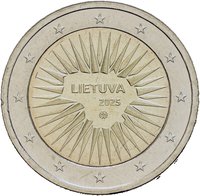
The national side features the coat of arms shield with a moose holding a spear and a lighthouse above, flanked by kurenkahns. Below is the Vydūnas quote “Spindulys esmi begalinės šviesos.” Surrounding inscriptions include “Lietuva,” “Mažoji Lietuva,” the year 2025, and the mintmark. The outer ring displays the 12 stars of the EU.
Inscription:
LIETUVA
2025 LMK
SPINDULYS ESMI BEGALINĖS ŠVIESOS
MAŽOJI LIETUVA
2025 LMK
SPINDULYS ESMI BEGALINĖS ŠVIESOS
MAŽOJI LIETUVA
Script: Latin
Designer: Rolandas Rimkūnas
Reverse
Edge
Reeded with inscription 'Freedom, Unity, Prosperity' in Lithuanian
Legend:
LAISVĖ ★ VIENYBĖ ★ GEROVĖ ★
Categories
| Map |
| Geography> Region |
| Symbols> Coat of Arms |
Mints
| Name | Mark |
|---|---|
| Lithuanian Mint | (LMK) |
Mintings
| Year | Mint Mark | Mintage | Quality | Collection |
|---|---|---|---|---|
| 2025 | LMK | 495,000 | ||
| 2025 | LMK | 5,000 | BU |
Historical background
### Lithuania's Currency Landscape in 2025: Stability and Digital Innovation
In 2025, Lithuania remains a fully integrated member of the Eurozone, having adopted the euro as its official currency in 2015. This decade-long membership continues to provide significant macroeconomic stability, anchoring inflation closer to the European Central Bank's target and ensuring seamless trade and investment flows within the EU's single market. The euro's status shields the Lithuanian economy from the currency volatility seen in some neighboring non-Eurozone states, providing a predictable environment for businesses and reinforcing the country's deep economic and political alignment with core European institutions.
The most dynamic aspect of Lithuania's currency situation in 2025 is its established role as a European hub for financial technology and digital assets. Building on the pioneering launch of the LBChain sandbox and the world's first digital collector coin (LBCoin) in 2020, Lithuania maintains a robust regulatory framework for licensed fintech companies and Electronic Money Institutions (EMIs). While the digital euro project, spearheaded by the ECB, is in its advanced testing phase, Lithuanian institutions and fintechs are actively preparing for its potential integration, exploring how a central bank digital currency (CBDC) could coexist with and enhance the private digital payments ecosystem.
Looking ahead, the primary currency-related discussions in Lithuania focus not on any return to a national currency, but on leveraging the stability of the euro to drive further economic convergence with Western Europe. Key policy debates center on fiscal discipline under EU frameworks, managing the long-term implications of an aging population on public finances, and ensuring that the nation's innovative fintech sector continues to thrive within the evolving EU-wide regulations for digital finance and anti-money laundering. Thus, Lithuania's currency narrative in 2025 is one of consolidated stability paired with a forward-looking embrace of digital financial innovation.
In 2025, Lithuania remains a fully integrated member of the Eurozone, having adopted the euro as its official currency in 2015. This decade-long membership continues to provide significant macroeconomic stability, anchoring inflation closer to the European Central Bank's target and ensuring seamless trade and investment flows within the EU's single market. The euro's status shields the Lithuanian economy from the currency volatility seen in some neighboring non-Eurozone states, providing a predictable environment for businesses and reinforcing the country's deep economic and political alignment with core European institutions.
The most dynamic aspect of Lithuania's currency situation in 2025 is its established role as a European hub for financial technology and digital assets. Building on the pioneering launch of the LBChain sandbox and the world's first digital collector coin (LBCoin) in 2020, Lithuania maintains a robust regulatory framework for licensed fintech companies and Electronic Money Institutions (EMIs). While the digital euro project, spearheaded by the ECB, is in its advanced testing phase, Lithuanian institutions and fintechs are actively preparing for its potential integration, exploring how a central bank digital currency (CBDC) could coexist with and enhance the private digital payments ecosystem.
Looking ahead, the primary currency-related discussions in Lithuania focus not on any return to a national currency, but on leveraging the stability of the euro to drive further economic convergence with Western Europe. Key policy debates center on fiscal discipline under EU frameworks, managing the long-term implications of an aging population on public finances, and ensuring that the nation's innovative fintech sector continues to thrive within the evolving EU-wide regulations for digital finance and anti-money laundering. Thus, Lithuania's currency narrative in 2025 is one of consolidated stability paired with a forward-looking embrace of digital financial innovation.
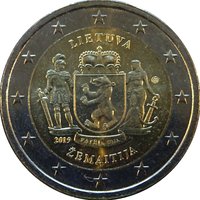
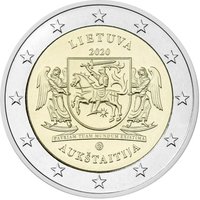
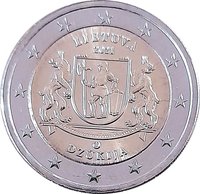
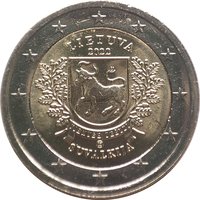

Series: Lithuania 2 euro commemoratives
💎 Extremely Rare