

20 centavos – Chile
Add to wishlist
Chile
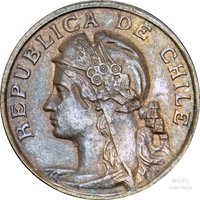
Obverse
Description:
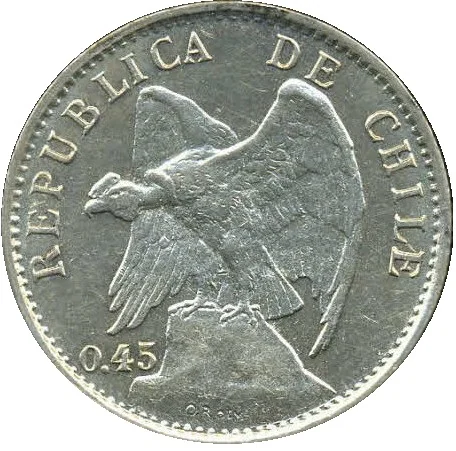
Defiant condor perched left.
Inscription:
REPUBLICA DE CHILE
0.45
O. Roty
0.45
O. Roty
Translation:
REPUBLIC OF CHILE
0.45
O. Roty
0.45
O. Roty
Script: Latin
Engraver: Louis-Oscar Roty
Reverse
Edge
Reeded
Mints
| Name | Mark |
|---|---|
| Casa de Moneda de Chile | (So) |
Mintings
| Year | Mint Mark | Mintage | Quality | Collection |
|---|---|---|---|---|
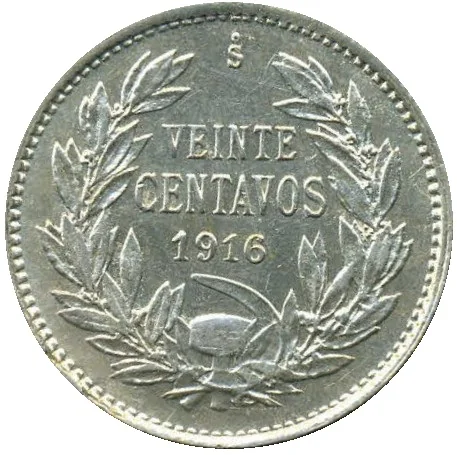
| 1916 | So | 3,377,000 |
Historical background
In 1916, Chile's currency situation was defined by the gold standard and the dominance of the Chilean peso, which was pegged to the British pound sterling. This monetary regime, established in the late 19th century, provided a period of notable stability and facilitated international trade, particularly for Chile's vital nitrate and copper exports. The country's fiscal health was heavily dependent on nitrate revenues, which provided substantial government income and helped maintain confidence in the peso's convertibility. Banks issued their own banknotes, but these were backed by gold reserves held by the government, creating a system perceived as secure and modern.
However, this stability was increasingly fragile and externally vulnerable. The outbreak of the First World War in 1914 had caused a profound shock, severing critical financial links with Europe and causing a sharp decline in nitrate exports as key markets were disrupted. While the war initially brought a boom in copper prices, the nitrate industry—the backbone of the economy—began a severe and permanent decline due to the invention of synthetic alternatives. This put significant pressure on state finances and the balance of payments, testing the gold standard's rigidity.
Consequently, by 1916, Chile was in a transitional and strained position. The government, under President Juan Luis Sanfuentes, maintained the official gold peg, but in practice, exchange controls had been implemented and the free export of gold was suspended. This created a divergence between the official and market exchange rates, leading to inflationary pressures and a premium on foreign currency. The era of automatic monetary adjustment under the classical gold standard was effectively over, and Chile was navigating a managed, defensive monetary policy, laying the groundwork for the eventual abandonment of the gold standard in the early 1920s.
However, this stability was increasingly fragile and externally vulnerable. The outbreak of the First World War in 1914 had caused a profound shock, severing critical financial links with Europe and causing a sharp decline in nitrate exports as key markets were disrupted. While the war initially brought a boom in copper prices, the nitrate industry—the backbone of the economy—began a severe and permanent decline due to the invention of synthetic alternatives. This put significant pressure on state finances and the balance of payments, testing the gold standard's rigidity.
Consequently, by 1916, Chile was in a transitional and strained position. The government, under President Juan Luis Sanfuentes, maintained the official gold peg, but in practice, exchange controls had been implemented and the free export of gold was suspended. This created a divergence between the official and market exchange rates, leading to inflationary pressures and a premium on foreign currency. The era of automatic monetary adjustment under the classical gold standard was effectively over, and Chile was navigating a managed, defensive monetary policy, laying the groundwork for the eventual abandonment of the gold standard in the early 1920s.
🌱 Fairly Common