

4 Pence – United Kingdom
United Kingdom
Context
Years: 1836–1837
Issuer: United Kingdom 
Ruler: William IV
Currency:
(1158—1970)
Demonetized: Yes
Total mintage: 5,215,200
Material
References
KM: #Click to copy to clipboard723
Numista: #10563
Value
Bullion value: $5.06
Obverse
Description:
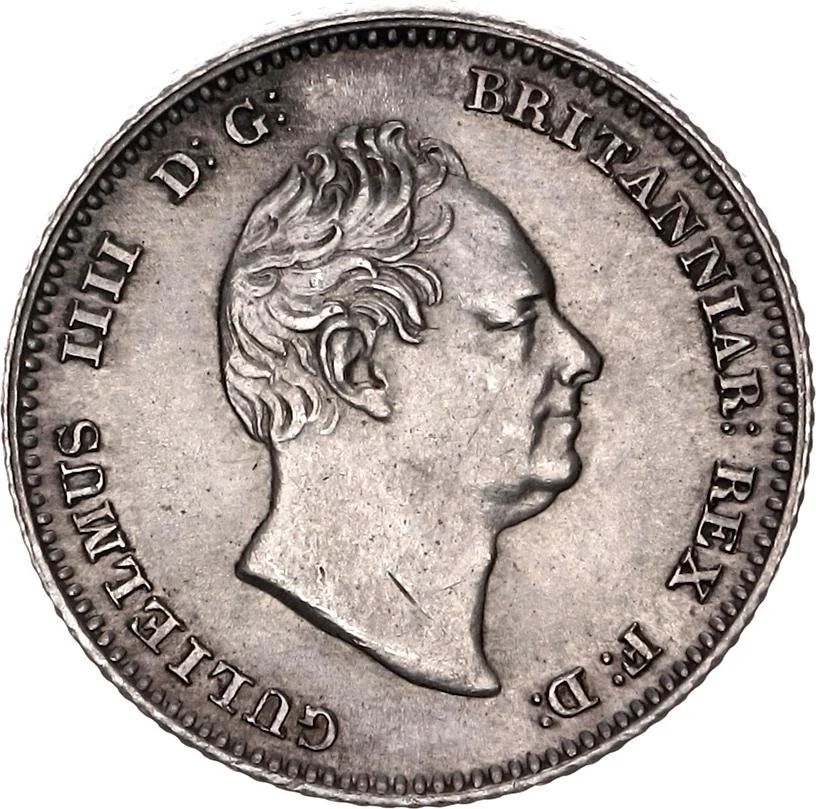
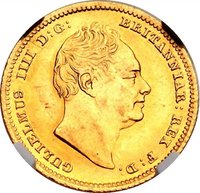
King William IV, bare head right, legend surrounding.
Inscription:
GULIELMUS IIII D:G: BRITANNIAR REX F:D:
Translation:
William IV, by the Grace of God, King of the Britains, Defender of the Faith.
Script: Latin
Language: Latin
Engraver: William Wyon
Reverse
Description:
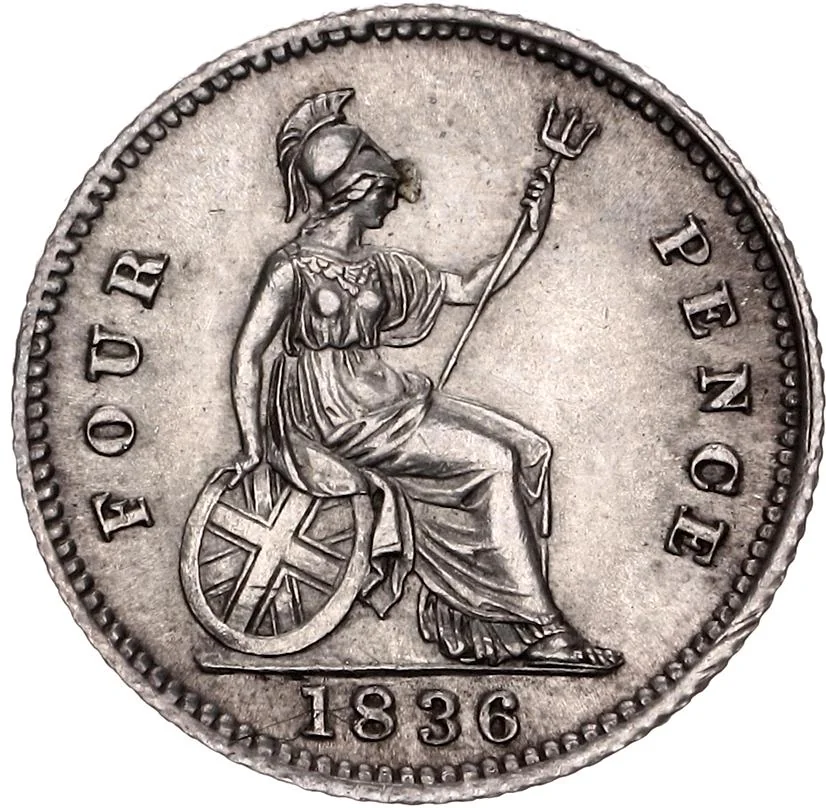
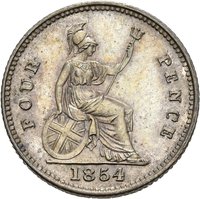
Britannia seated right, holding trident and shield, denomination around, date below.
Inscription:
FOUR PENCE
1836
1836
Script: Latin
Engraver: William Wyon
Edge
ReededNote: plain varieties exist
Mints
| Name | Mark |
|---|---|
| Royal Mint (Tower Hill) | — |
Mintings
| Year | Mint Mark | Mintage | Quality | Collection |
|---|---|---|---|---|
| 1836 | — | 4,253,000 | ||
| 1836 | — | — | Proof | |
| 1837 | — | 962,200 | ||
| 1837 | — | — | Proof |
Historical background
In 1836, the United Kingdom operated under a bimetallic system, legally defined by the recoinage of 1816 which established the gold sovereign as the principal monetary unit. While gold was the effective standard for large transactions and international trade, silver and copper coins circulated for everyday use. However, the system was strained; the official mint ratio between gold and silver undervalued silver, causing full-weight silver coins to be melted down or exported. Consequently, much of the silver in circulation was worn, lightweight, or token coinage, creating a chronic shortage of reliable small change for the public and for wage payments.
This period was also marked by a complex landscape of paper money. The Bank of England held a monopoly on joint-stock banking within a 65-mile radius of London, but outside this area, hundreds of private and provincial joint-stock banks issued their own banknotes. These notes were theoretically convertible into gold on demand, but their value and security were highly dependent on the solvency of the issuing bank. The system was inherently unstable, with periodic banking crises—like the one in 1825—triggering waves of bankruptcies when public confidence faltered and noteholders rushed to convert paper into precious metal.
The year 1836 itself fell within a decade of significant financial scrutiny and reform. The Bank Charter Act of 1833 had recently renewed the Bank of England's charter, confirmed the legal tender status of its notes, and aimed to curb small-note issues by country banks. However, the economy was entering a downturn, and a financial crisis originating in Anglo-American trade would erupt in 1837, putting the entire currency system under severe pressure. Thus, the monetary background of 1836 was one of transition, underpinned by gold but fragmented in practice, and on the cusp of further upheaval that would eventually lead to the pivotal Bank Charter Act of 1844.
This period was also marked by a complex landscape of paper money. The Bank of England held a monopoly on joint-stock banking within a 65-mile radius of London, but outside this area, hundreds of private and provincial joint-stock banks issued their own banknotes. These notes were theoretically convertible into gold on demand, but their value and security were highly dependent on the solvency of the issuing bank. The system was inherently unstable, with periodic banking crises—like the one in 1825—triggering waves of bankruptcies when public confidence faltered and noteholders rushed to convert paper into precious metal.
The year 1836 itself fell within a decade of significant financial scrutiny and reform. The Bank Charter Act of 1833 had recently renewed the Bank of England's charter, confirmed the legal tender status of its notes, and aimed to curb small-note issues by country banks. However, the economy was entering a downturn, and a financial crisis originating in Anglo-American trade would erupt in 1837, putting the entire currency system under severe pressure. Thus, the monetary background of 1836 was one of transition, underpinned by gold but fragmented in practice, and on the cusp of further upheaval that would eventually lead to the pivotal Bank Charter Act of 1844.
🌱 Common