

4 Pence – United Kingdom
United Kingdom
Context
Years: 1837–1862
Issuer: United Kingdom 
Ruler: Victoria
Currency:
(1158—1970)
Demonetized: Yes
Total mintage: 14,829,700
Material
References
KM: #Click to copy to clipboard731
Numista: #13209
Value
Bullion value: $4.97
Obverse
Description:
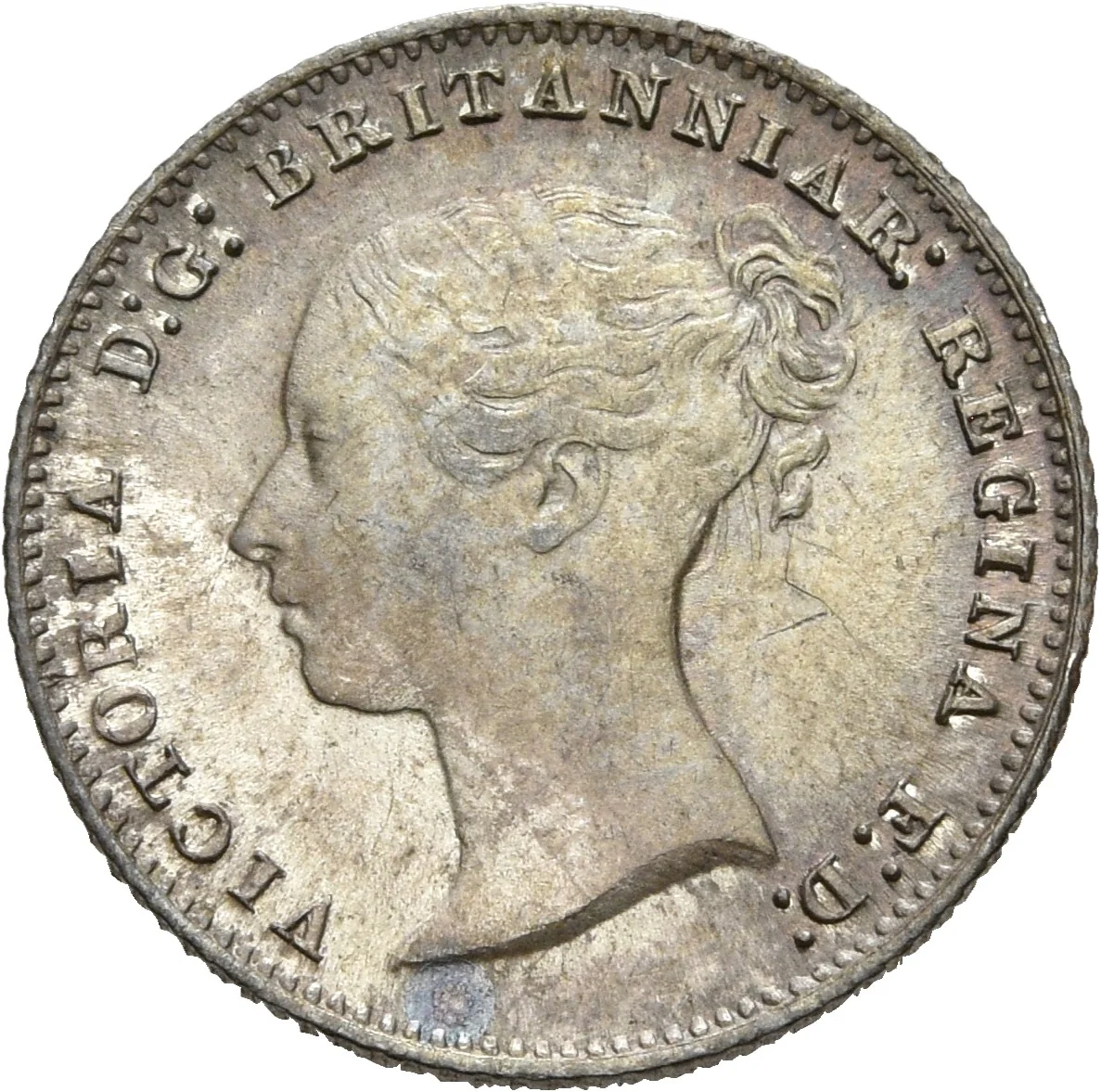
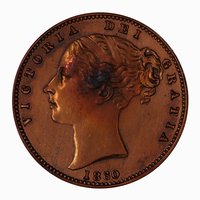
Young Victoria left, hair in bun, uncrowned, legend around.
Inscription:
VICTORIA D:G: BRITANNIAR: REGINA F:D:
Translation:
Victoria by the Grace of God, Queen of the Britains, Defender of the Faith.
Script: Latin
Language: Latin
Engraver: William Wyon
Reverse
Description:
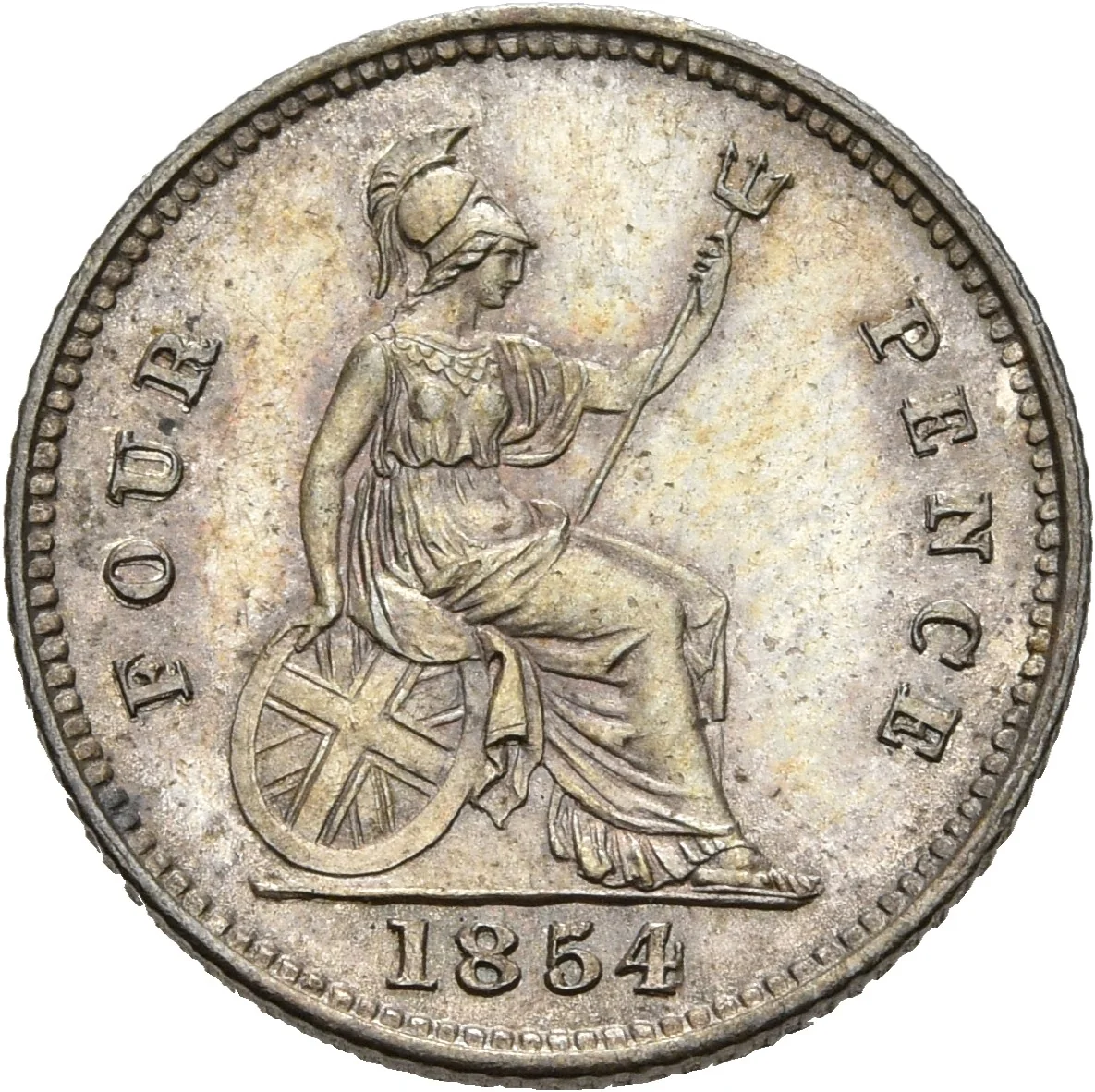
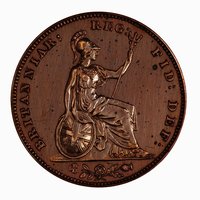
Britannia seated right, holding trident and shield with Union flag, denomination around, date below.
Inscription:
FOUR PENCE
1848
1848
Script: Latin
Edge
Reeded (plain edge varieties exist)
Categories
| Object> Armour |
| Object> Cold weapons |
Mints
| Name | Mark |
|---|---|
| Royal Mint (Tower Hill) | — |
Mintings
| Year | Mint Mark | Mintage | Quality | Collection |
|---|---|---|---|---|
| 1837 | — | — | Proof | |
| 1838 | — | — | Proof | |
| 1838 | — | 2,150,200 | ||
| 1839 | — | — | Proof | |
| 1839 | — | 1,461,200 | ||
| 1840 | — | 1,496,800 | ||
| 1841 | — | 344,500 | ||
| 1842 | — | — | Proof | |
| 1842 | — | 724,600 | ||
| 1843 | — | 1,817,600 | ||
| 1844 | — | 855,300 | ||
| 1845 | — | 914,700 | ||
| 1846 | — | 1,366,200 | ||
| 1847 | — | 226,000 | ||
| 1848 | — | 712,800 | ||
| 1849 | — | 380,100 | ||
| 1851 | — | 594,000 | ||
| 1852 | — | 31,300 | ||
| 1853 | — | 11,800 | ||
| 1853 | — | — | Proof | |
| 1854 | — | 1,096,600 | ||
| 1855 | — | 646,000 | ||
| 1857 | — | — | Proof | |
| 1862 | — | — | Proof |
Historical background
In 1837, the United Kingdom operated under a bimetallic currency system, legally defined by the 1816 Coinage Act which established the gold sovereign as the principal monetary unit. While the official standard was gold, silver coins remained in widespread circulation for everyday transactions. However, a critical problem was the chronic shortage of small-denomination coinage for public use, as the Royal Mint produced insufficient quantities of silver and copper coins. This scarcity led to widespread use of private token coinage issued by merchants and even worn Spanish dollars, creating a chaotic and inconvenient monetary environment for the working classes and for commerce.
The period was also defined by the foundational role of the Bank of England, which, following the resumption of cash payments in 1821, held a monopoly on joint-stock banking within a 65-mile radius of London. Its notes, theoretically convertible to gold on demand, were the cornerstone of the paper money system. Outside this radius, a proliferating number of provincial private and joint-stock banks issued their own banknotes, leading to a complex and sometimes unstable patchwork of paper currency. The stability of this entire structure was wholly dependent on the convertibility of these notes into gold, a principle that was sacrosanct but would be severely tested in future financial crises.
Furthermore, the decade leading to 1837 was one of financial turbulence, culminating in a major crisis in 1836-37 triggered by speculative booms, poor harvests, and a drain of gold reserves to America. This exposed the fragility of the country banking system and prompted a parliamentary inquiry that would lead to the landmark Bank Charter Act of 1844. Thus, the currency situation in 1837 was one of transition: it was a system anchored by gold but functionally reliant on a messy mix of metal and paper, straining under the pressures of industrialisation and awaiting the legislative discipline that would define the Victorian financial era.
The period was also defined by the foundational role of the Bank of England, which, following the resumption of cash payments in 1821, held a monopoly on joint-stock banking within a 65-mile radius of London. Its notes, theoretically convertible to gold on demand, were the cornerstone of the paper money system. Outside this radius, a proliferating number of provincial private and joint-stock banks issued their own banknotes, leading to a complex and sometimes unstable patchwork of paper currency. The stability of this entire structure was wholly dependent on the convertibility of these notes into gold, a principle that was sacrosanct but would be severely tested in future financial crises.
Furthermore, the decade leading to 1837 was one of financial turbulence, culminating in a major crisis in 1836-37 triggered by speculative booms, poor harvests, and a drain of gold reserves to America. This exposed the fragility of the country banking system and prompted a parliamentary inquiry that would lead to the landmark Bank Charter Act of 1844. Thus, the currency situation in 1837 was one of transition: it was a system anchored by gold but functionally reliant on a messy mix of metal and paper, straining under the pressures of industrialisation and awaiting the legislative discipline that would define the Victorian financial era.
🌱 Common