

4 pesos – Philippines
Add to wishlist
Philippines
Context
Years: 1861–1868
Issuer: Philippines
Ruler: Isabella II
Currency:
(1857—1967)
Demonetized: Yes
Total mintage: 1,948,530
Material
References
KM: #
Numista: #15893
Value
Bullion value: $913.75
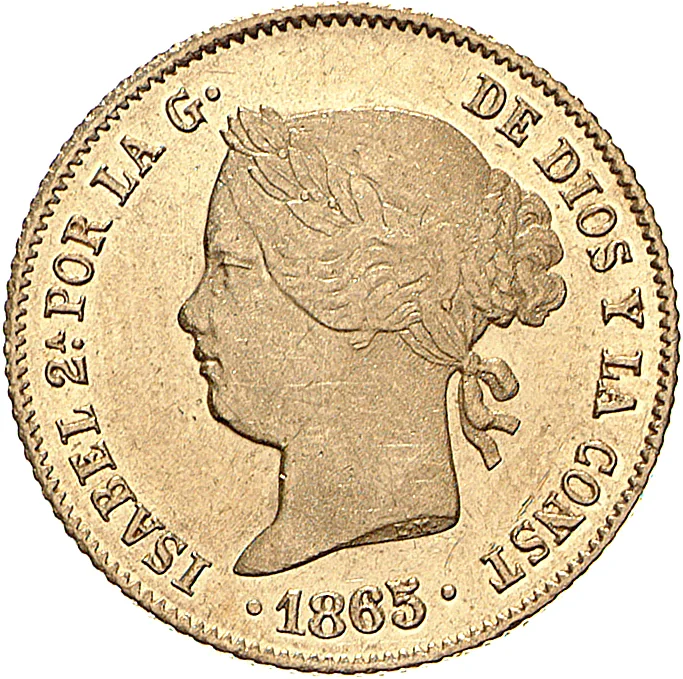
Obverse
Description:
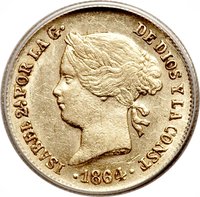
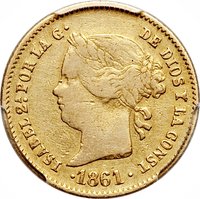
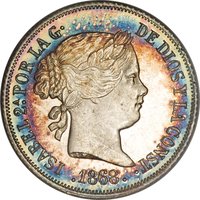
Queen Isabella II facing left.
Inscription:
ISABEL 2A POR LA G· DE DIOS Y LA CONST
L.M.
· 1868 ·
L.M.
· 1868 ·
Translation:
Isabel 2nd by the Grace of God and the Constitution
L.M.
· 1868 ·
L.M.
· 1868 ·
Script: Latin
Language: Spanish
Designer: Luis Marchionni y Hombrón
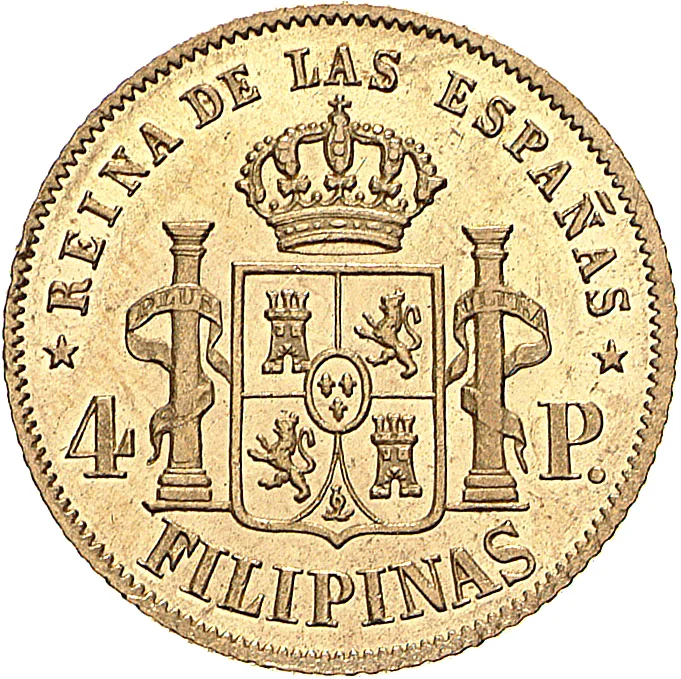
Reverse
Edge
Categories
| Person> Monarch |
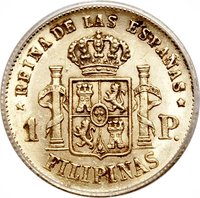
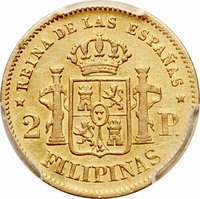
| Symbols> Coat of Arms |
Mints
| Name | Mark |
|---|---|
| Manila | — |
Mintings
| Year | Mint Mark | Mintage | Quality | Collection |
|---|---|---|---|---|
| 1861 | — | 183,000 | ||
| 1862 | — | 507,000 | ||
| 1863 | — | 475,000 | ||
| 1864 | — | 461,000 | ||
| 1865 | — | 241,000 | ||
| 1866 | — | 44,000 | ||
| 1867 | — | 1,530 | ||
| 1868 | — | 36,000 |
Historical background
In 1861, the Philippines operated under a complex and strained monetary system, a legacy of its colonial history under Spain. The official currency was the Spanish-Filipino peso (or peso fuerte), a silver coin theoretically equivalent to the Spanish dollar. However, the reality was a chaotic mix of circulating coinage. Alongside these pesos, a multitude of foreign silver coins—primarily Mexican, Peruvian, and Bolivian—circulated freely, their value determined by weight and fineness rather than face value. This reliance on physical silver made the economy vulnerable to global bullion flows and the frequent clipping or debasement of coins.
The system faced a critical shortage of small-denomination currency for everyday transactions. To fill this void, a unique and problematic local solution had emerged: the peso fuertes were often physically cut into smaller pieces, creating reales and even cuartos (quarter-reales). These "cut coins" or "monedas de necesidad" were irregularly shaped fragments, accepted by trust and weight, leading to constant friction in commerce. Concurrently, the first paper money, in the form of vales or promissory notes issued by merchant houses and religious orders, began to circulate, but these were not universally trusted and added another layer of inconsistency.
This fragmented and inefficient currency landscape existed within a broader context of economic pressure. The colonial government in Manila had long sought authorization from Madrid to establish a formal bank and issue standardized banknotes to unify the system, but these efforts faced delays. The year 1861 fell within a period of transition, immediately preceding the founding of the country's first bank, El Banco Español Filipino de Isabel II (now Bank of the Philippine Islands) in 1851, which only began issuing official banknotes several years later. Thus, 1861 represents the tail end of an archaic, commodity-based monetary era, characterized by physical silver, cut coins, and growing recognition of the urgent need for a modern, centralized currency system to facilitate trade and governance.
The system faced a critical shortage of small-denomination currency for everyday transactions. To fill this void, a unique and problematic local solution had emerged: the peso fuertes were often physically cut into smaller pieces, creating reales and even cuartos (quarter-reales). These "cut coins" or "monedas de necesidad" were irregularly shaped fragments, accepted by trust and weight, leading to constant friction in commerce. Concurrently, the first paper money, in the form of vales or promissory notes issued by merchant houses and religious orders, began to circulate, but these were not universally trusted and added another layer of inconsistency.
This fragmented and inefficient currency landscape existed within a broader context of economic pressure. The colonial government in Manila had long sought authorization from Madrid to establish a formal bank and issue standardized banknotes to unify the system, but these efforts faced delays. The year 1861 fell within a period of transition, immediately preceding the founding of the country's first bank, El Banco Español Filipino de Isabel II (now Bank of the Philippine Islands) in 1851, which only began issuing official banknotes several years later. Thus, 1861 represents the tail end of an archaic, commodity-based monetary era, characterized by physical silver, cut coins, and growing recognition of the urgent need for a modern, centralized currency system to facilitate trade and governance.
⭐ Rare