

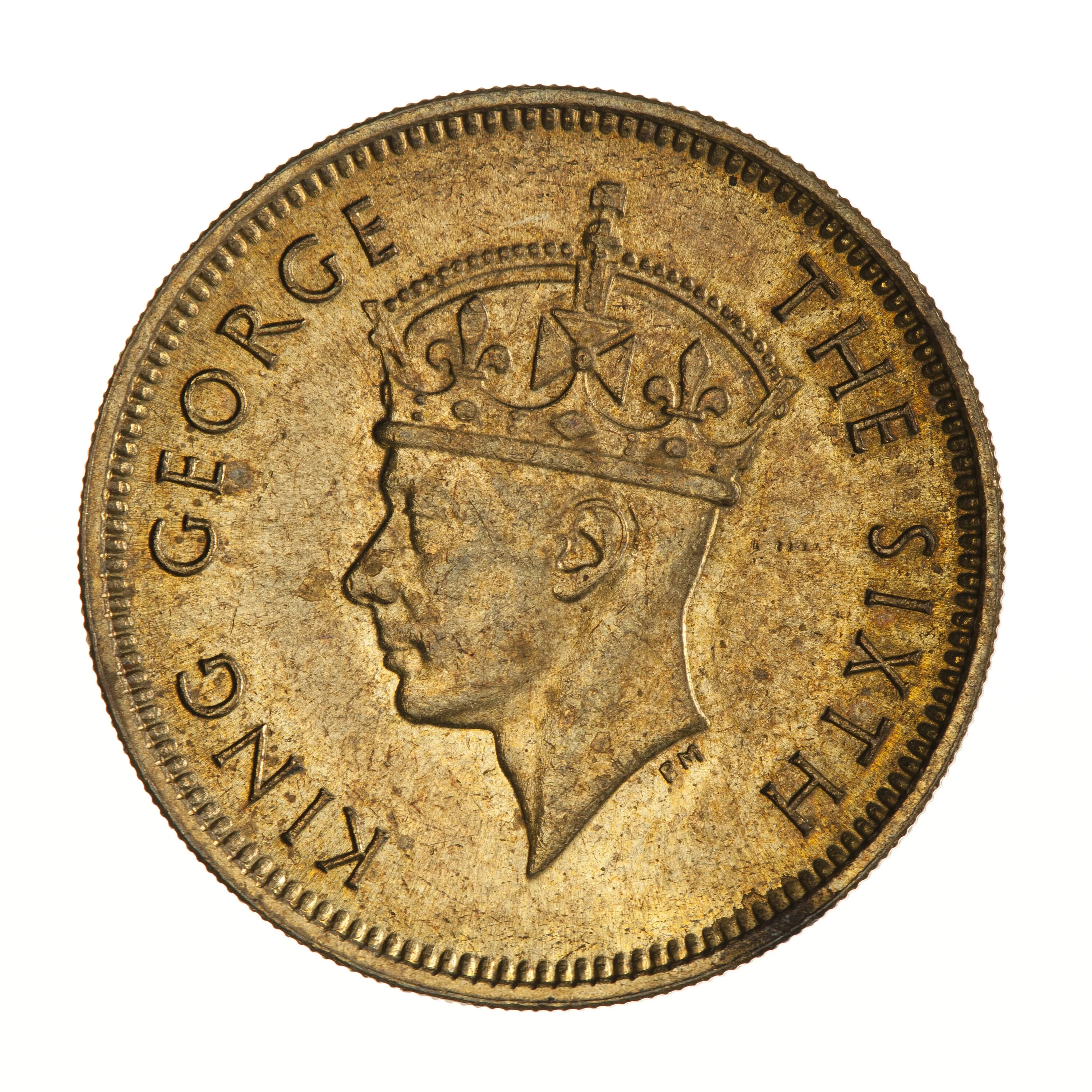
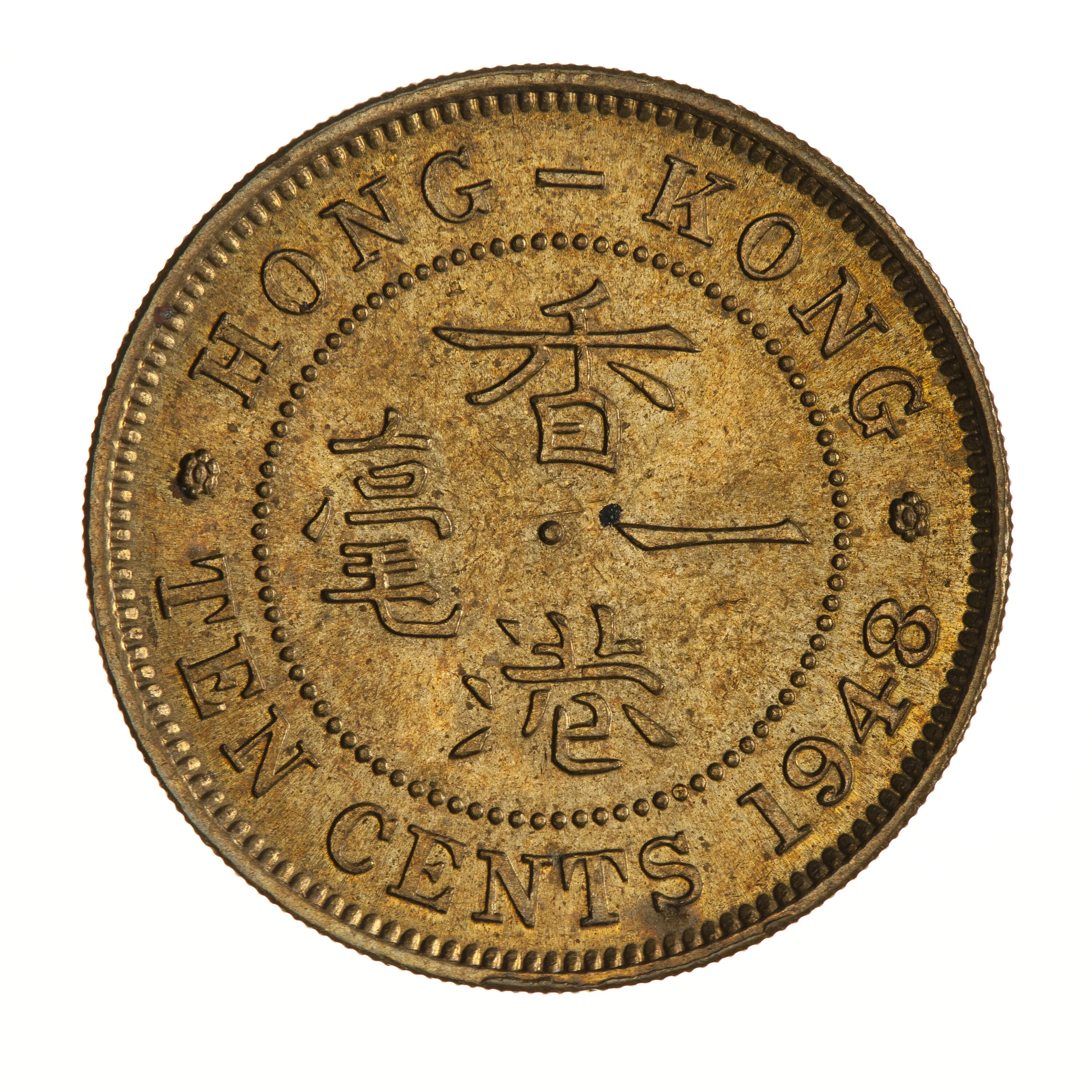

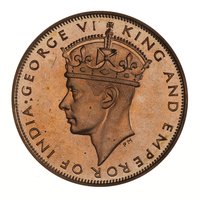
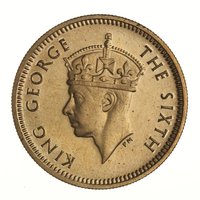
Obverse
Description:
Crowned left-facing bust.
Inscription:
KING GEORGE THE SIXTH
Translation:
KING GEORGE THE SIXTH
Script: Latin
Language: English
Engraver: Percy Metcalfe
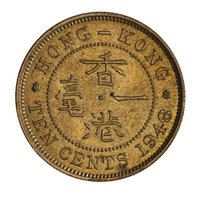
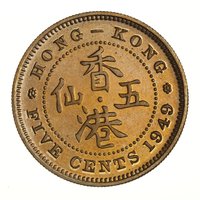
Reverse
Edge
Security edge
Mints
| Name | Mark |
|---|---|
| Royal Mint (Tower Hill) | — |
Mintings
| Year | Mint Mark | Mintage | Quality | Collection |
|---|---|---|---|---|
| 1948 | — | 30,000,000 | ||
| 1948 | — | — | Proof | |
| 1949 | — | — | Proof | |
| 1949 | — | 35,000,000 | ||
| 1950 | — | — | Proof | |
| 1950 | — | 20,000,000 | ||
| 1951 | — | 5,000,000 | ||
| 1951 | — | — | Proof |
Historical background
In 1948, Hong Kong's currency situation was defined by instability and transition, emerging from the devastation of World War II. The Japanese military yen, imposed during the 1941-1945 occupation, had been declared worthless, forcing a return to the pre-war standard. The Hong Kong dollar was reinstated and repegged to the Pound Sterling at the old rate of 16 HKD = £1. However, this stability was more formal than real, as the colony was flooded with a chaotic mix of currencies: Chinese Nationalist gold yuan, US dollars, and even silver coins circulated alongside the official issue, reflecting regional uncertainty.
This monetary turbulence was directly fueled by the escalating Chinese Civil War on the mainland. As hyperinflation ravaged the Nationalist government's currency, vast amounts of capital and refugees poured into Hong Kong, bringing with them unstable mainland money. The Hong Kong government struggled to manage this influx and control speculation, which put severe pressure on the sterling peg. The primary concern was maintaining Hong Kong's viability as a trading port, requiring a credible currency amidst the surrounding economic collapse.
Consequently, 1948 was a pivotal year of institutional response. The government moved to formalize and strengthen the currency system, leading directly to the establishment of the Hong Kong Foreign Exchange and Trade Control in early 1949. This set the stage for more stringent regulations and the eventual creation of a two-tier banking system, with note-issuing powers consolidated among a few designated commercial banks. Thus, the crisis of 1948 acted as a catalyst, pushing the colonial administration toward the more controlled and resilient financial architecture that would underpin Hong Kong's post-war economic rise.
This monetary turbulence was directly fueled by the escalating Chinese Civil War on the mainland. As hyperinflation ravaged the Nationalist government's currency, vast amounts of capital and refugees poured into Hong Kong, bringing with them unstable mainland money. The Hong Kong government struggled to manage this influx and control speculation, which put severe pressure on the sterling peg. The primary concern was maintaining Hong Kong's viability as a trading port, requiring a credible currency amidst the surrounding economic collapse.
Consequently, 1948 was a pivotal year of institutional response. The government moved to formalize and strengthen the currency system, leading directly to the establishment of the Hong Kong Foreign Exchange and Trade Control in early 1949. This set the stage for more stringent regulations and the eventual creation of a two-tier banking system, with note-issuing powers consolidated among a few designated commercial banks. Thus, the crisis of 1948 acted as a catalyst, pushing the colonial administration toward the more controlled and resilient financial architecture that would underpin Hong Kong's post-war economic rise.
🌱 Very Common