

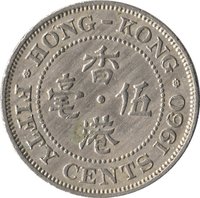
50 Cents – Hong Kong
China
Context
Years: 1958–1970
Country: China 
Issuer: Hong Kong 
Ruler: Elizabeth II
Currency:
(since 1863)
Demonetized: Yes
Total mintage: 70,600,000
Material
References
KM: #Click to copy to clipboard30
Numista: #1572
Value
Exchange value: 0.50 HKD = $0.06
Obverse
Description:
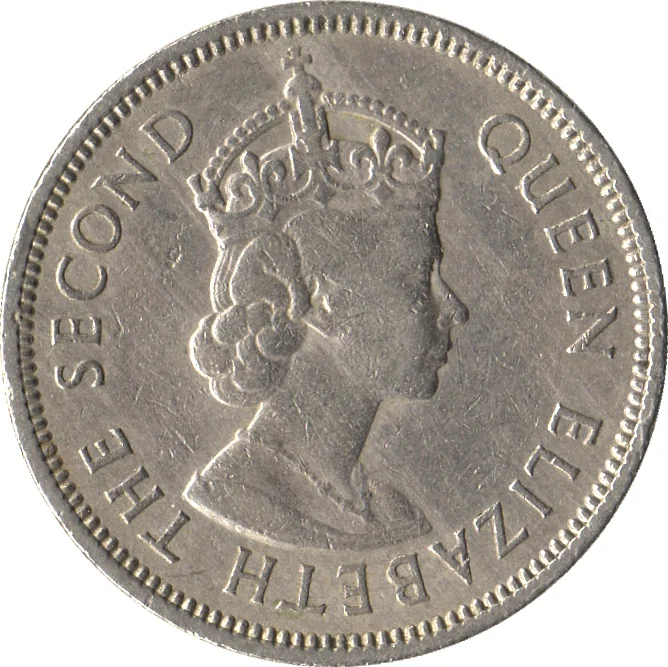
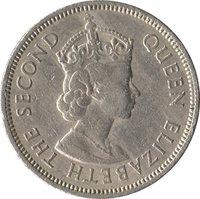
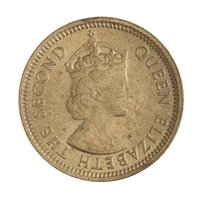
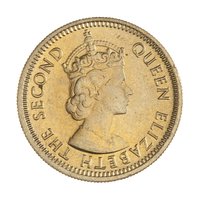
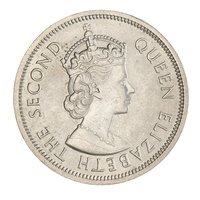
Queen Elizabeth II crowned, facing right.
Inscription:
QUEEN ELIZABETH THE SECOND
Script: Latin
Engraver: Cecil Thomas
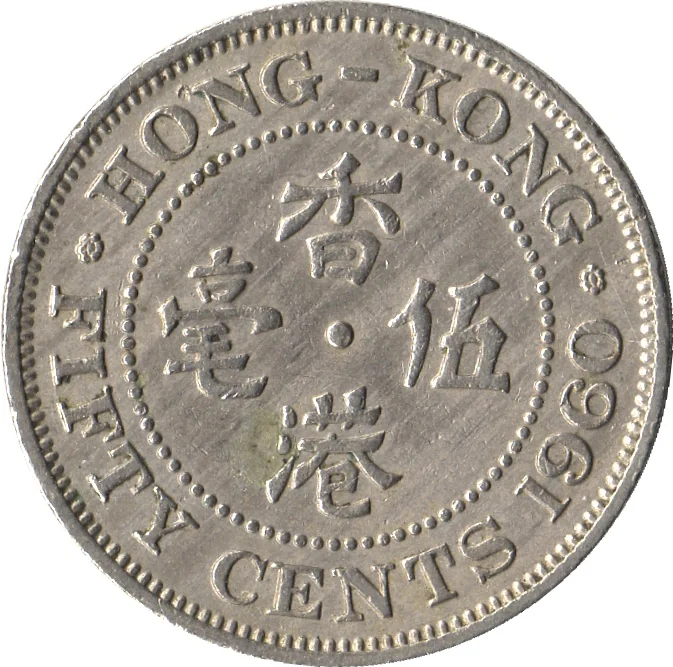
Reverse
Edge
Security edge (different from KM#34 with a reeded edge)
Mints
| Name | Mark |
|---|---|
| Royal Mint (Tower Hill) | — |
| Heaton and Sons / The Mint Birmingham | H |
| Kings Norton Metal Company | KN |
Mintings
Historical background
In 1958, Hong Kong operated under a colonial currency board system, with the Hong Kong dollar pegged to sterling at a fixed rate of HK$16 = £1. This arrangement, established in 1935, provided stability by requiring the note-issuing banks (The Hongkong and Shanghai Banking Corporation, Chartered Bank, and Mercantile Bank) to hold sterling reserves for all currency issued. This linkage firmly integrated Hong Kong's monetary system and trade finances with the United Kingdom, making the colony's currency a de facto sterling proxy in the region. The economy was in a phase of transition, beginning its shift from an entrepôt trade hub toward light industrialization, a process accelerated by the United Nations' trade embargo on China during the Korean War.
The currency situation was notably stable but externally dependent. Hong Kong held substantial sterling reserves in the "Exchange Fund," managed by the government, which guaranteed the convertibility of the Hong Kong dollar. This full sterling backing meant Hong Kong imported its monetary policy from Britain, with interest rates and money supply largely dictated by the Bank of England's decisions. While this provided credibility and facilitated international trade, it also meant Hong Kong had no independent monetary tools to address local economic conditions, tying its financial fate directly to the stability of the pound sterling.
By the late 1950s, this system faced no immediate crisis, but underlying pressures were building. Hong Kong's growing industrial exports and its increasing economic interactions with non-sterling areas, particularly the United States and Japan, began to highlight the constraints of a sterling-centric system. Furthermore, the first rumblings of future sterling devaluations (which would materialize in 1967) were on the horizon, posing a risk to the value of Hong Kong's substantial reserves. Thus, 1958 represents a point of calm within a rigid colonial framework, preceding the economic transformations and monetary debates that would define the following decades.
The currency situation was notably stable but externally dependent. Hong Kong held substantial sterling reserves in the "Exchange Fund," managed by the government, which guaranteed the convertibility of the Hong Kong dollar. This full sterling backing meant Hong Kong imported its monetary policy from Britain, with interest rates and money supply largely dictated by the Bank of England's decisions. While this provided credibility and facilitated international trade, it also meant Hong Kong had no independent monetary tools to address local economic conditions, tying its financial fate directly to the stability of the pound sterling.
By the late 1950s, this system faced no immediate crisis, but underlying pressures were building. Hong Kong's growing industrial exports and its increasing economic interactions with non-sterling areas, particularly the United States and Japan, began to highlight the constraints of a sterling-centric system. Furthermore, the first rumblings of future sterling devaluations (which would materialize in 1967) were on the horizon, posing a risk to the value of Hong Kong's substantial reserves. Thus, 1958 represents a point of calm within a rigid colonial framework, preceding the economic transformations and monetary debates that would define the following decades.
🌱 Very Common