

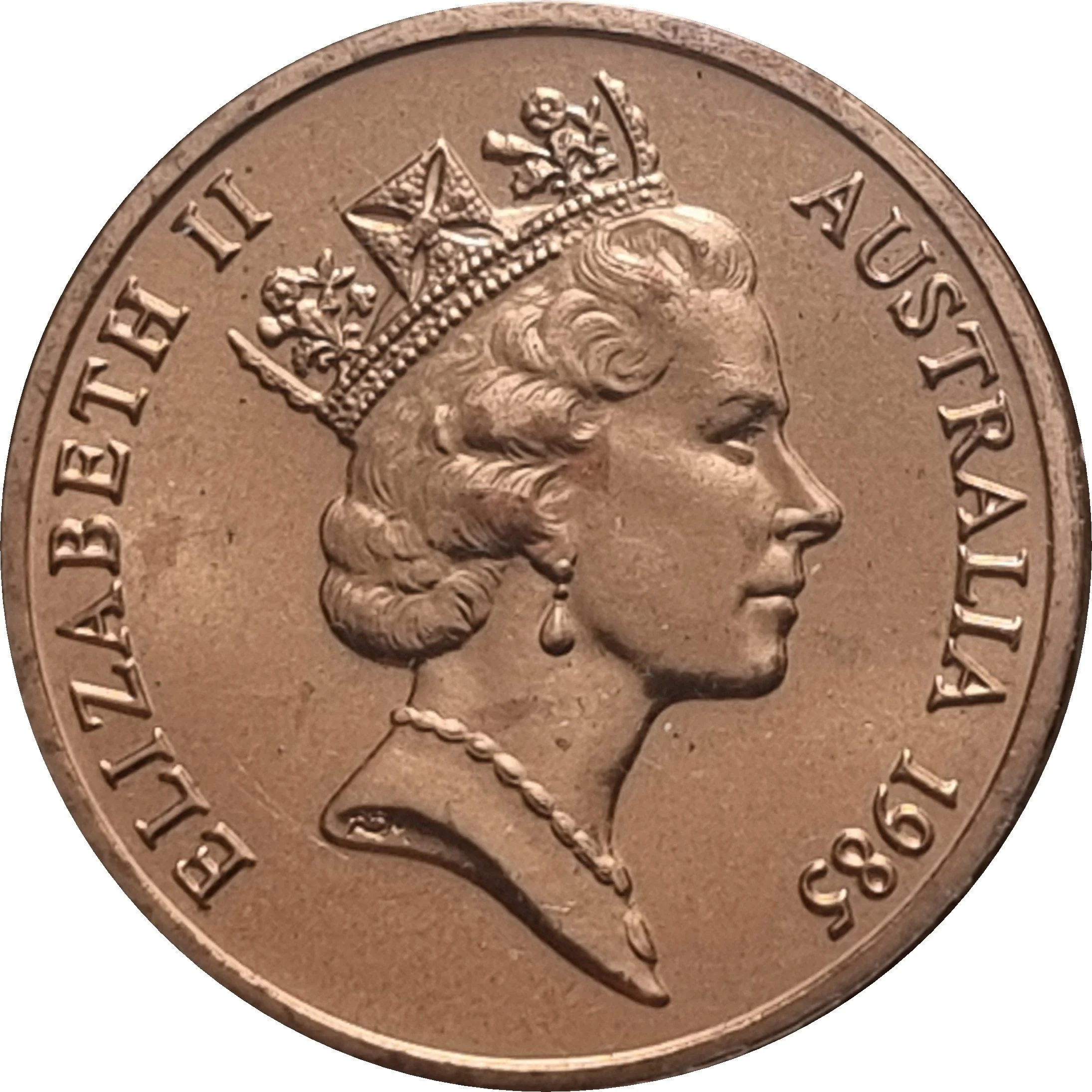

1 cent – Australia
Add to wishlist
Australia
Context
Years: 1985–1991
Issuer: Australia
Ruler: Elizabeth II
Currency:
(since 1966)
Total mintage: 488,229,326
Material

References
KM: #
Numista: #1562
Value
Exchange value: 0.01 AUD
Inflation-adjusted value: 0.04 AUD
Obverse
Description:
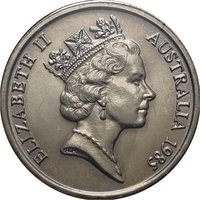
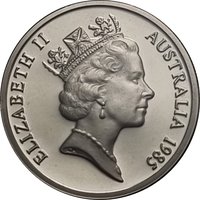
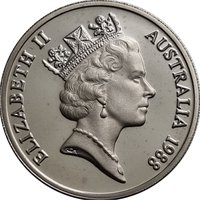
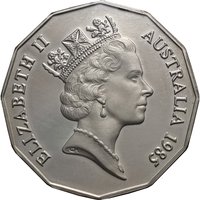
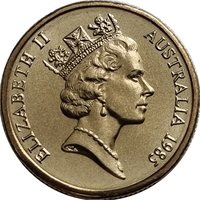
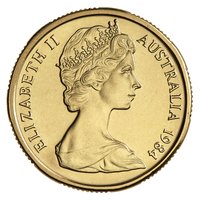
Queen Elizabeth III facing right in the King George IV State Diadem.
Inscription:
ELIZABETH II
AUSTRALIA 1985
RDM
AUSTRALIA 1985
RDM
Script: Latin
Designer: Raphael David Maklouf
Reverse
Edge
Plain
Mints
| Name | Mark |
|---|---|
| Royal Australian Mint | — |
Mintings
| Year | Mint Mark | Mintage | Quality | Collection |
|---|---|---|---|---|
| 1985 | — | 170,000 | BU | |
| 1985 | — | 38,300,000 | ||
| 1985 | — | 74,089 | Proof | |
| 1986 | — | 180,000 | BU | |
| 1986 | — | 67,000 | Proof | |
| 1987 | — | 122,000,000 | ||
| 1987 | — | 69,684 | Proof | |
| 1987 | — | 200,000 | BU | |
| 1988 | — | 3,000 | Proof | |
| 1988 | — | 10,000 | BU | |
| 1988 | — | 105,900,000 | ||
| 1989 | — | 150,602 | BU | |
| 1989 | — | 168,000,000 | ||
| 1989 | — | 5,000 | Proof | |
| 1990 | — | 103,766 | BU | |
| 1990 | — | 52,993,000 | ||
| 1990 | — | 1,985 | Proof | |
| 1991 | — | 200 | BU | |
| 1991 | — | 1,000 | Proof |
Historical background
In 1985, Australia’s currency situation was defined by a pivotal and transformative event: the floating of the Australian dollar in December 1983. This decision, implemented by the Hawke-Keating Labor government, marked a decisive break from the post-war Bretton Woods system of fixed exchange rates. Prior to the float, the Australian dollar’s value was set by the Reserve Bank of Australia (RBA) and adjusted periodically, a system that had become increasingly difficult to manage amid volatile global capital flows and terms of trade shocks. The float liberated monetary policy, allowing the RBA to focus on domestic inflation rather than expending reserves to defend a specific exchange rate peg.
The immediate years following the float, including 1985, were a period of significant adjustment and volatility for the currency, nicknamed the "Aussie." Freed from official control, its value was now determined by market forces of supply and demand, influenced by commodity prices (especially for key exports like coal and wool), interest rate differentials, and investor sentiment. In 1985 specifically, the currency experienced substantial depreciation, losing roughly 20% of its value against the US dollar during the year. This decline was largely driven by a worsening terms of trade, as commodity prices fell while the prices of imports rose, and by a general flight to the US dollar’s strength globally.
This depreciation had profound mixed consequences for the Australian economy. On one hand, it provided a much-needed stimulus to export-oriented and import-competing industries, making Australian goods cheaper on world markets. On the other hand, it contributed to imported inflation pressures during a period when the government was already grappling with high domestic inflation and a large current account deficit. Thus, in 1985, the floating Australian dollar was both a crucial new shock absorber for the economy and a source of new policy challenges, firmly embedding exchange rate risk into the nation’s financial and corporate landscape.
The immediate years following the float, including 1985, were a period of significant adjustment and volatility for the currency, nicknamed the "Aussie." Freed from official control, its value was now determined by market forces of supply and demand, influenced by commodity prices (especially for key exports like coal and wool), interest rate differentials, and investor sentiment. In 1985 specifically, the currency experienced substantial depreciation, losing roughly 20% of its value against the US dollar during the year. This decline was largely driven by a worsening terms of trade, as commodity prices fell while the prices of imports rose, and by a general flight to the US dollar’s strength globally.
This depreciation had profound mixed consequences for the Australian economy. On one hand, it provided a much-needed stimulus to export-oriented and import-competing industries, making Australian goods cheaper on world markets. On the other hand, it contributed to imported inflation pressures during a period when the government was already grappling with high domestic inflation and a large current account deficit. Thus, in 1985, the floating Australian dollar was both a crucial new shock absorber for the economy and a source of new policy challenges, firmly embedding exchange rate risk into the nation’s financial and corporate landscape.
Series: 1985 Australia circulation coins


🌱 Very Common