

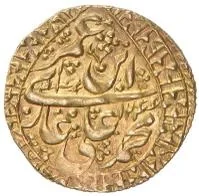
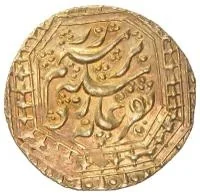
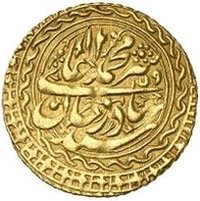
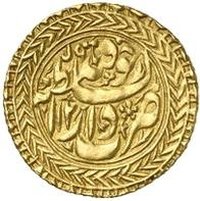
1 Tilla – Khoqand Khanate
Context
Years: 1831–1832
Country: Central Asia
Issuer: Khoqand Khanate
Ruler: Muhammad Ali Khan
Currency:
(1796—1876)
Demonetized: Yes
Material
Diameter: 21 mm
Weight: 4.51 g
Gold weight: 4.51 g
Shape: Irregular round
Composition: Gold
Magnetic: No
References
Numista: #155950
Value
Bullion value: $751.97
Mintings
| Year | Mint Mark | Mintage | Quality | Collection |
|---|---|---|---|---|
| 1831 | — | — | ||
| 1832 | — | — |
Historical background
In 1831, the Khoqand Khanate's currency system was under significant strain, reflecting both its ambitious regional expansion and underlying economic vulnerabilities. The state, having rapidly expanded to control key trade routes and fertile valleys across Central Asia, required a robust monetary system to finance its military and administrative apparatus. The primary circulating coin was the silver tanga (or tilla), but its quality and value were inconsistent due to periodic debasement. The Khanate's mints, particularly in Khoqand and Tashkent, often reduced the silver content in new coinage to increase seigniorage revenue, a short-term fix that eroded public trust and complicated commerce.
This monetary instability was exacerbated by the Khanate's complex trade relations and internal diversity. Khoqand was a crucial hub on the Silk Road, where Russian silver rubles, Chinese yamboos, Bukharan tengas, and even Persian coins circulated alongside local issues. The resulting multiplicity of currencies, each with fluctuating intrinsic values, created a chaotic exchange environment for merchants. Furthermore, the economy remained partially pastoral and subsistence-based, with taxes often collected in kind, reducing the state's ability to centralize and control a uniform monetary system.
The situation in 1831 fell within the reign of Muhammad Ali (Madali) Khan, a period marked by internal consolidation but also by growing external pressures. While the currency debasement provided immediate funds for the court and military campaigns against rivals like Bukhara, it stored up long-term problems. Inflationary pressures began to burden the populace, and the unreliable currency risked alienating the merchant class vital to the Khanate's prosperity. This fragile financial backdrop coincided with the height of Khoqand's territorial reach, masking the economic weaknesses that would later contribute to its instability as the "Great Game" between the Russian and British Empires began to encroach upon the region.
This monetary instability was exacerbated by the Khanate's complex trade relations and internal diversity. Khoqand was a crucial hub on the Silk Road, where Russian silver rubles, Chinese yamboos, Bukharan tengas, and even Persian coins circulated alongside local issues. The resulting multiplicity of currencies, each with fluctuating intrinsic values, created a chaotic exchange environment for merchants. Furthermore, the economy remained partially pastoral and subsistence-based, with taxes often collected in kind, reducing the state's ability to centralize and control a uniform monetary system.
The situation in 1831 fell within the reign of Muhammad Ali (Madali) Khan, a period marked by internal consolidation but also by growing external pressures. While the currency debasement provided immediate funds for the court and military campaigns against rivals like Bukhara, it stored up long-term problems. Inflationary pressures began to burden the populace, and the unreliable currency risked alienating the merchant class vital to the Khanate's prosperity. This fragile financial backdrop coincided with the height of Khoqand's territorial reach, masking the economic weaknesses that would later contribute to its instability as the "Great Game" between the Russian and British Empires began to encroach upon the region.
✨ Legendary