

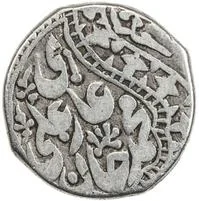
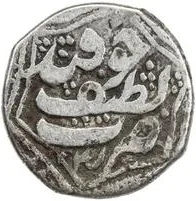
1 tenga – Khoqand Khanate
Add to wishlist
Context
Years: 1826–1830
Country: Central Asia
Issuer: Khoqand Khanate
Ruler: Muhammad Ali Khan
Currency:
(1796—1876)
Demonetized: Yes
Material
References
Numista: #155827
Value
Bullion value: $7.44
Obverse
Reverse
Edge
Mintings
| Year | Mint Mark | Mintage | Quality | Collection |
|---|---|---|---|---|
| 1826 | — | — | ||
| 1828 | — | — | ||
| 1829 | — | — | ||
| 1830 | — | — |
Historical background
In 1826, the Khoqand Khanate, a powerful Central Asian state controlling the Fergana Valley and key Silk Road cities, faced a complex and deteriorating currency situation. The state's economy relied on a bimetallic system of silver tangas and copper puls, but chronic shortages of precious metals, particularly silver, plagued the mint. This scarcity was exacerbated by the Khanate's relative isolation from major silver sources and the ongoing military costs of expansion and conflict with the Emirate of Bukhara and the Qing Empire. Consequently, the state treasury, under Khan Muhammad Ali (Madali Khan), increasingly resorted to debasement, reducing the silver content in coins to stretch supplies and fund expenditures.
The practice of debasement led to severe inflation and a loss of public confidence in the currency. As the intrinsic value of the silver tanga fell, its exchange rate against the copper pul became unstable, disrupting daily trade and market transactions. This monetary instability was compounded by the circulation of older, full-value coins alongside the new, inferior issues, creating a chaotic multi-tiered currency market where merchants and peasants struggled to assess real worth. The problem was particularly acute in urban centers like Khoqand and Margilan, where market prices became volatile.
This financial crisis was both a symptom and a cause of broader political weakness. The debased currency eroded state credibility, while the inflation fueled social discontent among the population and the military, whose salaries were paid in devalued coin. The currency instability of 1826 thus reflected the Khanate's deeper structural problems—fiscal overextension and resource constraints—which would contribute to the internal turmoil and succession crises that marked the later years of Muhammad Ali's rule, ultimately weakening Khoqand in the face of future external threats.
The practice of debasement led to severe inflation and a loss of public confidence in the currency. As the intrinsic value of the silver tanga fell, its exchange rate against the copper pul became unstable, disrupting daily trade and market transactions. This monetary instability was compounded by the circulation of older, full-value coins alongside the new, inferior issues, creating a chaotic multi-tiered currency market where merchants and peasants struggled to assess real worth. The problem was particularly acute in urban centers like Khoqand and Margilan, where market prices became volatile.
This financial crisis was both a symptom and a cause of broader political weakness. The debased currency eroded state credibility, while the inflation fueled social discontent among the population and the military, whose salaries were paid in devalued coin. The currency instability of 1826 thus reflected the Khanate's deeper structural problems—fiscal overextension and resource constraints—which would contribute to the internal turmoil and succession crises that marked the later years of Muhammad Ali's rule, ultimately weakening Khoqand in the face of future external threats.

✨ Legendary