

100 Krónur – Iceland
Iceland
Context
Material
References
KM: #Click to copy to clipboard35
Numista: #1547
Value
Exchange value: 100 ISK = $0.82
Inflation-adjusted value: 376.82 ISK
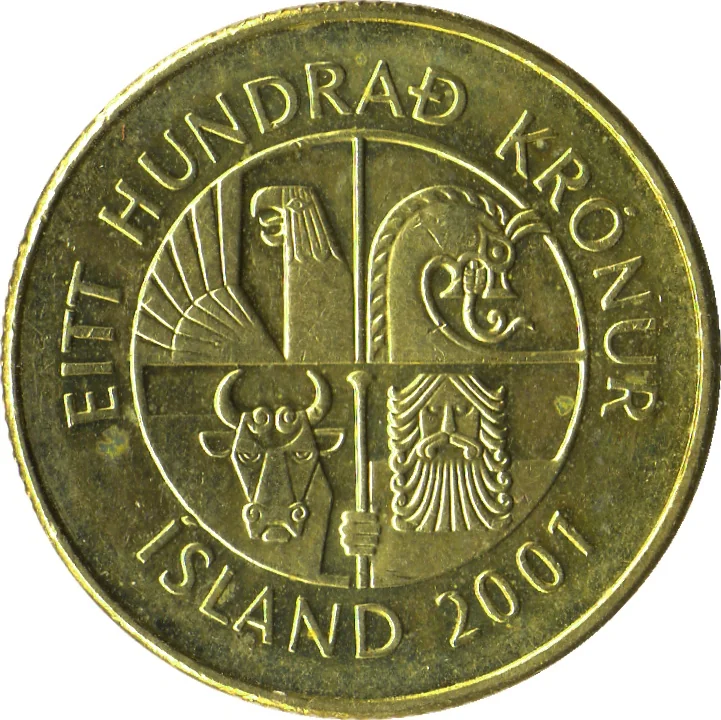
Obverse
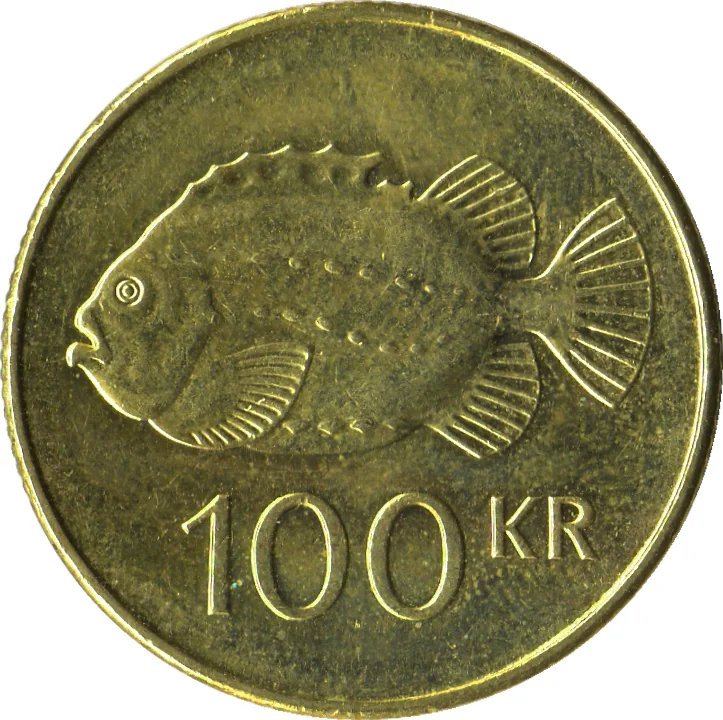
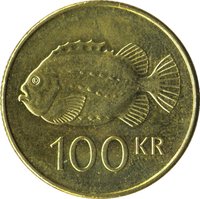
Reverse
Edge
Smooth and reeded alternately.
Mints
| Name | Mark |
|---|---|
| Royal Mint | — |
Mintings
| Year | Mint Mark | Mintage | Quality | Collection |
|---|---|---|---|---|
| 1995 | — | 6,000,000 | ||
| 2000 | — | 10,000 | BU | |
| 2000 | — | 10,000 | In sets | |
| 2001 | — | 2,140,000 | ||
| 2004 | — | 2,400,000 | ||
| 2006 | — | 2,000,000 | ||
| 2007 | — | 3,000,000 | ||
| 2011 | — | 3,000,000 |
Historical background
In 1995, Iceland was in the midst of a pivotal transition toward financial liberalization and economic modernization. Following decades of strict currency controls and a heavily regulated financial system, the government had begun a deliberate process of deregulation in the early 1990s. This included lifting restrictions on foreign exchange and capital movements, which fundamentally changed the role of the Icelandic króna (ISK). The currency was now more exposed to international market forces, though it remained a managed float with the Central Bank of Iceland actively intervening to maintain stability.
The economic context of 1995 was one of recovery and growth after a period of hardship. Inflation, which had plagued Iceland for years, was being brought under control through tight monetary policy, falling from double digits in the 1980s to around 1.7% by the end of 1995. This period of low inflation and rising foreign currency reserves provided a sense of stability for the króna. However, the liberalized environment also set the stage for future vulnerabilities, as domestic banks began to expand aggressively and both corporations and households gained easier access to foreign-denominated loans, particularly in euros and dollars.
Overall, the currency situation in 1995 was characterized by cautious optimism. The króna was stable, benefiting from improved economic fundamentals and a controlled liberalization process. Yet, the policy shifts of this era—especially the removal of capital controls and the integration into global financial markets—planted the seeds for the excessive risk-taking and foreign debt accumulation that would culminate in Iceland's severe banking crisis just over a decade later. The year 1995 thus represents a calm before the storm, a point where the benefits of liberalization were visible but its profound risks were not yet fully apparent.
The economic context of 1995 was one of recovery and growth after a period of hardship. Inflation, which had plagued Iceland for years, was being brought under control through tight monetary policy, falling from double digits in the 1980s to around 1.7% by the end of 1995. This period of low inflation and rising foreign currency reserves provided a sense of stability for the króna. However, the liberalized environment also set the stage for future vulnerabilities, as domestic banks began to expand aggressively and both corporations and households gained easier access to foreign-denominated loans, particularly in euros and dollars.
Overall, the currency situation in 1995 was characterized by cautious optimism. The króna was stable, benefiting from improved economic fundamentals and a controlled liberalization process. Yet, the policy shifts of this era—especially the removal of capital controls and the integration into global financial markets—planted the seeds for the excessive risk-taking and foreign debt accumulation that would culminate in Iceland's severe banking crisis just over a decade later. The year 1995 thus represents a calm before the storm, a point where the benefits of liberalization were visible but its profound risks were not yet fully apparent.
🌱 Very Common