

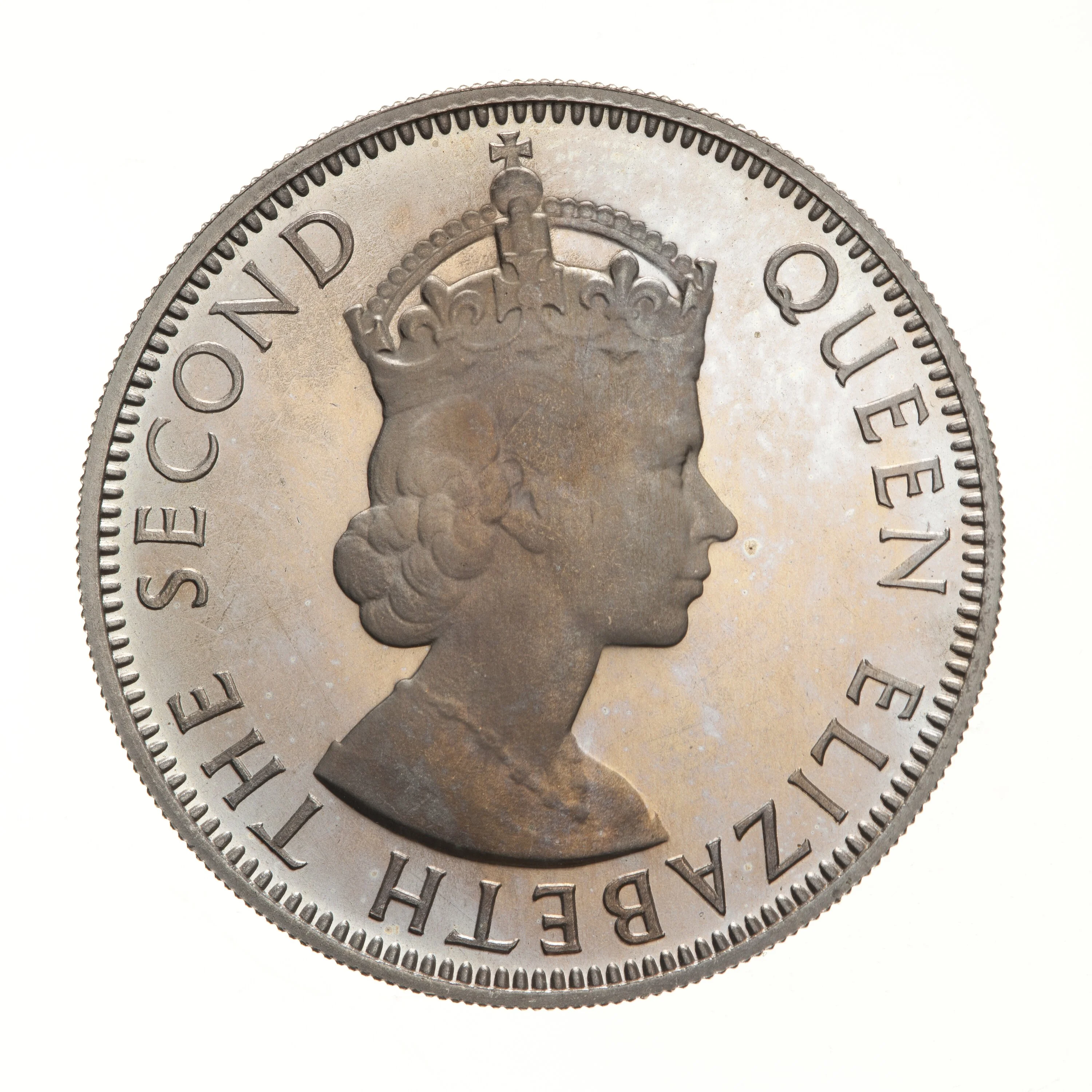
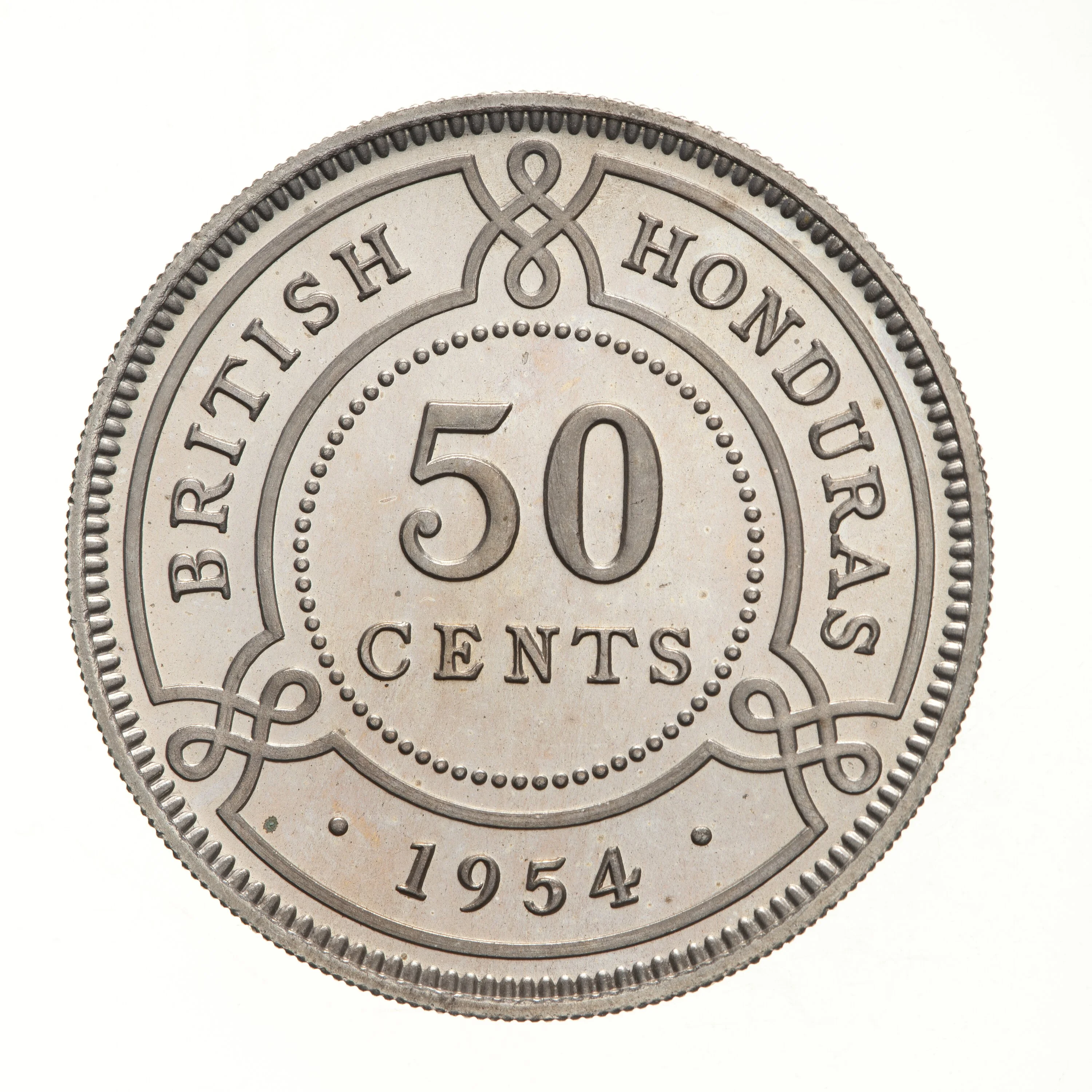
50 Cents – British Honduras
Belize
Context
Years: 1954–1971
Country: Belize 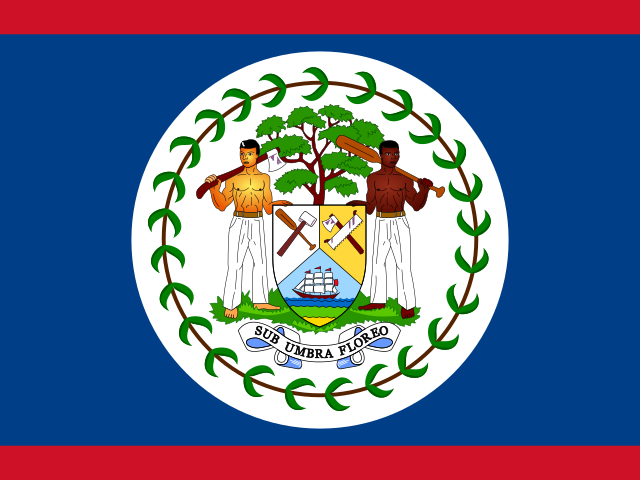
Issuer: British Honduras
Ruler: Elizabeth II
Currency:
(1885—1973)
Total mintage: 255,000
Material
References
KM: #Click to copy to clipboard28
Numista: #15390
Obverse
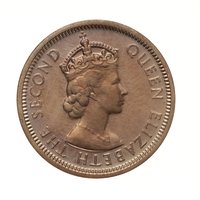
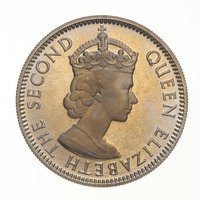
Description:
Crowned right-facing portrait of Elizabeth II, toothed rim.
Inscription:
QUEEN ELIZABETH THE SECOND
Script: Latin
Engraver: Cecil Thomas
Reverse
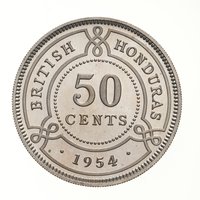
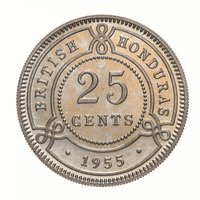
Description:
Central beaded circle, toothed rim.
Inscription:
BRITISH HONDURAS
50
CENTS
· 1971 ·
50
CENTS
· 1971 ·
Script: Latin
Edge
Milled
Mints
| Name | Mark |
|---|---|
| Royal Mint (Tower Hill) | — |
Mintings
| Year | Mint Mark | Mintage | Quality | Collection |
|---|---|---|---|---|
| 1954 | — | 75,000 | ||
| 1954 | — | — | Proof | |
| 1962 | — | 50,000 | ||
| 1962 | — | — | Proof | |
| 1964 | — | 50,000 | ||
| 1965 | — | 25,000 | ||
| 1966 | — | 25,000 | ||
| 1971 | — | 30,000 |
Historical background
In 1954, British Honduras (modern-day Belize) operated under a distinctive currency system that reflected its colonial status and economic ties. The official currency was the British Honduras dollar, which had been pegged at a fixed rate of 4 shillings 2 pence sterling since 1949. This peg provided stability but also firmly anchored the local economy to the British pound sterling, making the colony's monetary policy dependent on decisions made in London. Notably, the physical currency in circulation consisted of unique local banknotes issued by the British Honduras Currency Board, established in 1894, which held sterling reserves to fully back the currency—a classic colonial "currency board" arrangement designed to ensure convertibility and fiscal discipline.
The economic context of 1954 was one of post-war reconstruction and gradual development, heavily reliant on primary exports like timber, chicle, and, increasingly, sugar. The currency's sterling peg facilitated trade within the Sterling Area, a bloc of countries that conducted commerce in pounds and held their reserves in London. This was crucial for a small, open economy dependent on exporting to Commonwealth markets. However, this system also meant that British Honduras had little independent monetary leverage to respond to local economic conditions, as the money supply was directly tied to its holdings of foreign reserves, primarily sterling.
This period preceded significant monetary changes. The fixed colonial system of 1954 would persist until 1976, when Belize (having gained self-government) introduced a new decimalized Belize dollar and broke the direct peg to sterling, choosing instead to peg to the U.S. dollar—a shift reflecting changing regional trade patterns. Thus, the currency situation in 1954 represents the tail end of a classic colonial monetary model, characterized by stability and external control, just before the winds of decolonization and economic realignment began to prompt future reform.
The economic context of 1954 was one of post-war reconstruction and gradual development, heavily reliant on primary exports like timber, chicle, and, increasingly, sugar. The currency's sterling peg facilitated trade within the Sterling Area, a bloc of countries that conducted commerce in pounds and held their reserves in London. This was crucial for a small, open economy dependent on exporting to Commonwealth markets. However, this system also meant that British Honduras had little independent monetary leverage to respond to local economic conditions, as the money supply was directly tied to its holdings of foreign reserves, primarily sterling.
This period preceded significant monetary changes. The fixed colonial system of 1954 would persist until 1976, when Belize (having gained self-government) introduced a new decimalized Belize dollar and broke the direct peg to sterling, choosing instead to peg to the U.S. dollar—a shift reflecting changing regional trade patterns. Thus, the currency situation in 1954 represents the tail end of a classic colonial monetary model, characterized by stability and external control, just before the winds of decolonization and economic realignment began to prompt future reform.
🌱 Common