

1 Króna – Iceland
Iceland
Context
Material
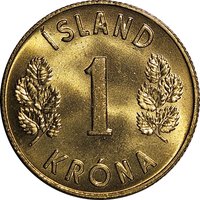
Diameter: 22.5 mm
Weight: 4.75 g
Thickness: 1.5 mm
Shape: Round
Composition: Nickel brass
Magnetic: No
Technique: Milled
Alignment: Medal alignment
flip
References
KM: #Click to copy to clipboard12a
Numista: #1535
Value
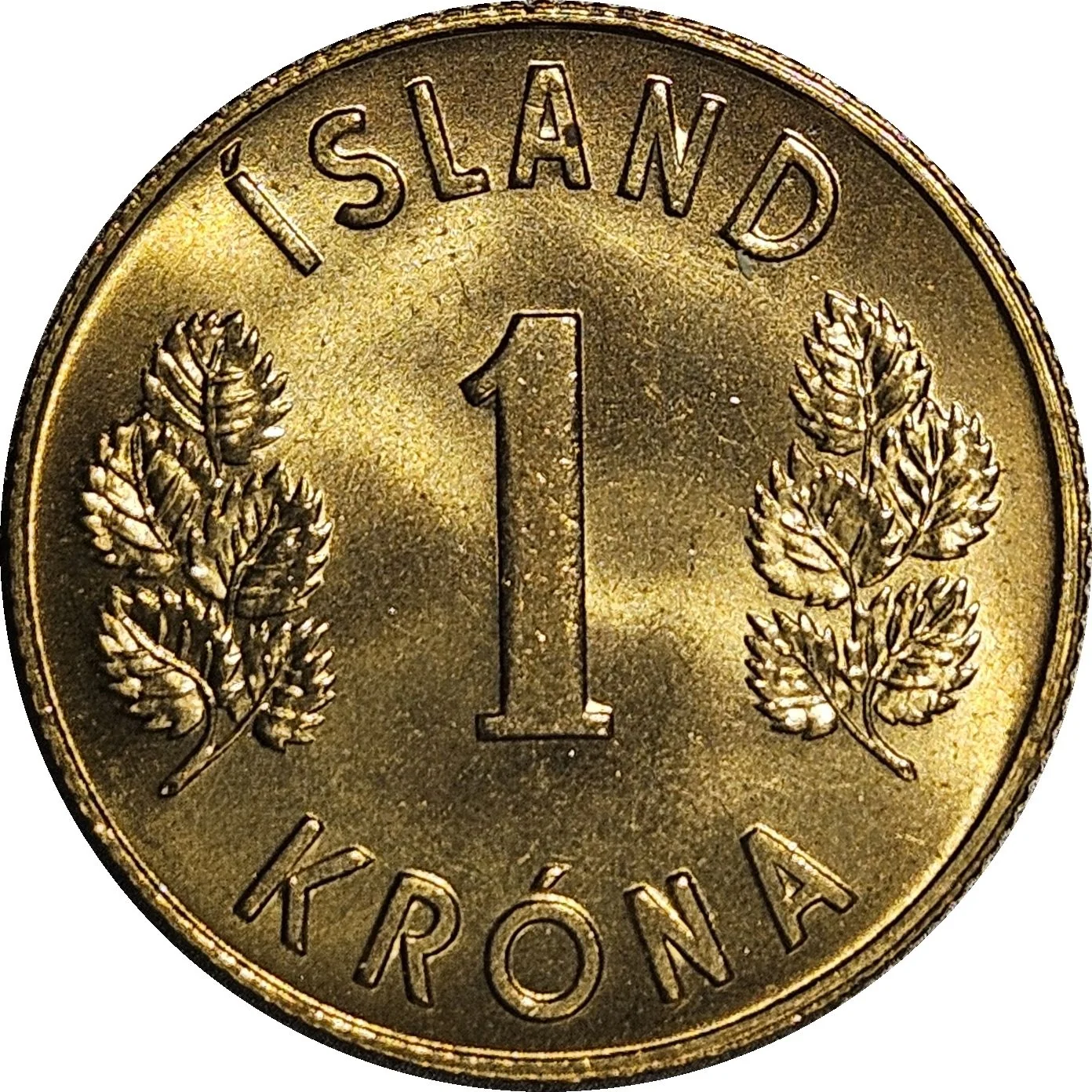
Exchange value: 1 ISJ
Inflation-adjusted value: 4834.62 ISJ
Obverse
Description:
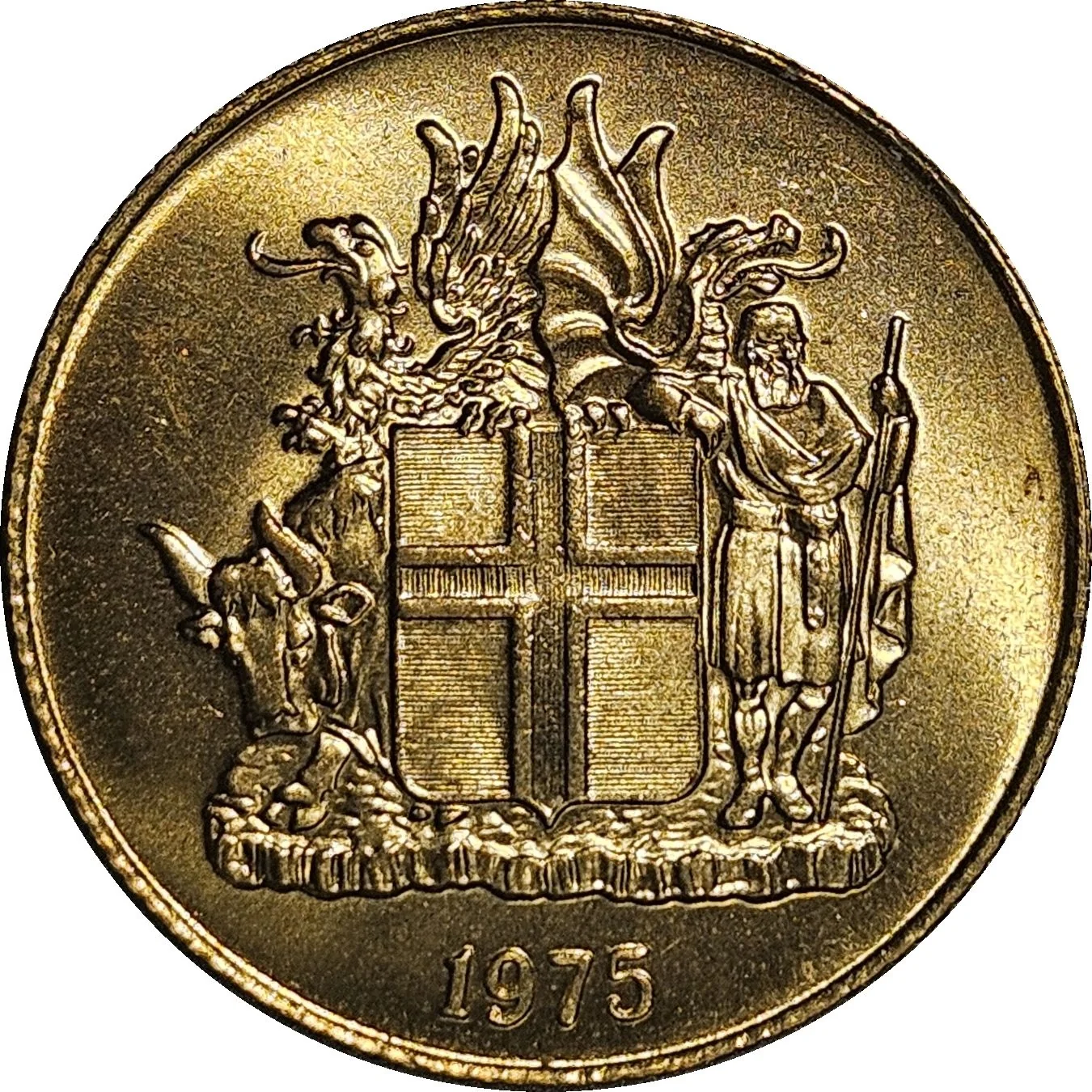
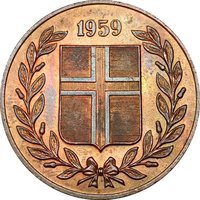
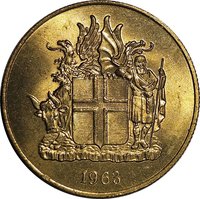
Iceland's coat of arms encircled by its four guardian spirits (Landvættir): the bull, eagle, dragon, and giant.
Inscription:
1975
Script: Latin
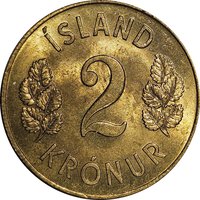
Reverse
Edge
Reeded
Categories
| Animal> Bird |
| Animal> Cow |
| Mythology> Fantastic animal |
| Symbols> Coat of Arms |
Mints
| Name | Mark |
|---|---|
| Royal Canadian Mint of Ottawa | — |
| Royal Mint (Tower Hill) | — |
Mintings
| Year | Mint Mark | Mintage | Quality | Collection |
|---|---|---|---|---|
| 1957 | — | 1,000,000 | ||
| 1957 | — | — | Proof | |
| 1959 | — | 500,000 | ||
| 1959 | — | — | Proof | |
| 1961 | — | 500,000 | ||
| 1961 | — | — | Proof | |
| 1962 | — | 1,000,000 | ||
| 1962 | — | — | Proof | |
| 1963 | — | 1,500,000 | ||
| 1963 | — | — | Proof | |
| 1965 | — | 2,000,000 | ||
| 1966 | — | 2,000,000 | ||
| 1969 | — | 2,000,000 | ||
| 1970 | — | 3,000,000 | ||
| 1971 | — | 2,500,000 | ||
| 1973 | — | — | ||
| 1974 | — | 5,000,000 | ||
| 1975 | — | 10,500,000 | ||
| 1975 | — | 15,000 | Proof |
Historical background
In 1957, Iceland was navigating a challenging post-war economic landscape characterized by persistent inflation and a complex currency system. The country's currency, the króna, had been devalued several times since the 1930s, and strict exchange controls were in place to manage foreign reserves and protect the value of the currency. These controls, a legacy of World War II and the early Cold War, meant that the króna was not freely convertible, and its exchange rate was managed by the Central Bank of Iceland within a framework set by the government, heavily influenced by the needs of the vital fishing export sector.
Economically, the period was marked by high inflation, driven by rapid modernization, infrastructure investments, and rising wages that often outpaced productivity gains. This inflationary pressure created a constant tension between maintaining a competitive exchange rate for fish exports—the nation's primary source of foreign income—and controlling the domestic cost of living. The currency regime was therefore a key tool for economic management, used to shield the developing economy while facilitating the import of essential goods and machinery for reconstruction and industrialization.
The situation in 1957 was a precursor to more significant changes. While not a crisis year itself, the underlying pressures set the stage for a major devaluation in 1960, when the króna was devalued by 57% against the US dollar. This move underscored the ongoing struggle to balance internal stability with external competitiveness, a defining feature of Iceland's monetary policy throughout the mid-20th century as it transformed from a poor, agrarian society into a modern industrialized state.
Economically, the period was marked by high inflation, driven by rapid modernization, infrastructure investments, and rising wages that often outpaced productivity gains. This inflationary pressure created a constant tension between maintaining a competitive exchange rate for fish exports—the nation's primary source of foreign income—and controlling the domestic cost of living. The currency regime was therefore a key tool for economic management, used to shield the developing economy while facilitating the import of essential goods and machinery for reconstruction and industrialization.
The situation in 1957 was a precursor to more significant changes. While not a crisis year itself, the underlying pressures set the stage for a major devaluation in 1960, when the króna was devalued by 57% against the US dollar. This move underscored the ongoing struggle to balance internal stability with external competitiveness, a defining feature of Iceland's monetary policy throughout the mid-20th century as it transformed from a poor, agrarian society into a modern industrialized state.
🌱 Very Common