

5 nuevos pesos (Revolutionary Movement) – Uruguay
Add to wishlist
Circulating commemorative coins
Commemoration: 150th Anniversary - Revolutionary Movement
Uruguay
Context
Year: 1975
Issuer: Uruguay
Period:
(since 1825)
Currency:
(1975—1993)
Demonetization: 1 July 1981
Total mintage: 10,000,000
Material
Diameter: 33 mm
Weight: 14.5 g
Thickness: 2.5 mm
Shape: Round
Composition: Aluminium bronze
Magnetic: No
Technique: Milled
Alignment: Medal alignment
flip
References
KM: #
Numista: #10143
Value
Exchange value: 5 UYN
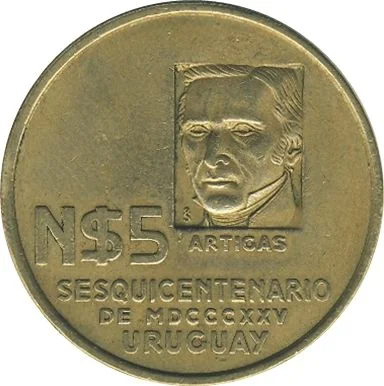
Obverse
Description:
Artigas facing left in square above text; value at left.
Inscription:
N$ 5 ARTIGAS So
SESQUICENTENARIO
DE MDCCCXXV
URUGUAY
SESQUICENTENARIO
DE MDCCCXXV
URUGUAY
Translation:
5 ARTIGAS
SESQUICENTENARY
OF 1825
URUGUAY
SESQUICENTENARY
OF 1825
URUGUAY
Script: Latin
Engraver: Carlos Alberto Saavedra
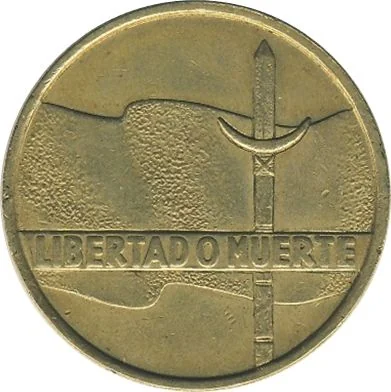
Reverse
Description:
Revolutionary emblem: flag and spear.
Inscription:
LIBERTAD O MUERTE
Translation:
Liberty or Death
Script: Latin
Language: Spanish
Engraver: Carlos Alberto Saavedra
Edge
Reeded
Categories
| Event> Independence |
| Event> Revolution |
| Person> Military leader |
| Person> Politician |
| Symbol> Flag |
| Object> Cold weapons |
Mints
| Name | Mark |
|---|---|
| Casa de Moneda de Chile | (So) |
Mintings
| Year | Mint Mark | Mintage | Quality | Collection |
|---|---|---|---|---|
| 1975 | So | 10,000,000 |
Historical background
In 1975, Uruguay was under the repressive civic-military dictatorship that had seized power in 1973. The economic policy of the period, led by Minister of Economy and Finance Alejandro Végh Villegas, was characterized by a neoliberal orientation focused on opening the economy, attracting foreign investment, and controlling inflation. A central pillar of this strategy was a crawling peg exchange rate system, where the Uruguayan peso was subjected to frequent, small devaluations (known as "la tablita") to maintain export competitiveness and manage inflationary expectations in a controlled manner.
This monetary regime existed within a context of severe financial repression and economic contraction. The dictatorship prioritized financial liberalization, leading to high real interest rates that attracted capital but also stifled domestic productive investment and exacerbated a deep industrial crisis. Consequently, the currency policy was not aimed at a traditional fixed parity but at a predictable, gradual depreciation to prevent a sudden loss of reserves and to provide a nominal anchor for an inflation rate that, while high by developed world standards, was being brought down from the extreme levels of the early 1970s.
The overall situation was one of contradictions: relative macroeconomic stability in terms of reduced inflation and a stable exchange rate path was artificially maintained within a closed political system and at the cost of soaring foreign debt, a dramatic increase in unemployment, and a sharp decline in real wages. The currency regime of 1975 thus served as a technical instrument for the regime's broader economic project, which sought modernization and stability but entrenched a model that deepened social inequality and set the stage for the profound debt crisis that would engulf Uruguay in the early 1980s.
This monetary regime existed within a context of severe financial repression and economic contraction. The dictatorship prioritized financial liberalization, leading to high real interest rates that attracted capital but also stifled domestic productive investment and exacerbated a deep industrial crisis. Consequently, the currency policy was not aimed at a traditional fixed parity but at a predictable, gradual depreciation to prevent a sudden loss of reserves and to provide a nominal anchor for an inflation rate that, while high by developed world standards, was being brought down from the extreme levels of the early 1970s.
The overall situation was one of contradictions: relative macroeconomic stability in terms of reduced inflation and a stable exchange rate path was artificially maintained within a closed political system and at the cost of soaring foreign debt, a dramatic increase in unemployment, and a sharp decline in real wages. The currency regime of 1975 thus served as a technical instrument for the regime's broader economic project, which sought modernization and stability but entrenched a model that deepened social inequality and set the stage for the profound debt crisis that would engulf Uruguay in the early 1980s.
🌱 Common