

5 nuevos pesos (Founding of Montevideo) – Uruguay
Add to wishlist
Circulating commemorative coins
Commemoration: 250th Anniversary of the Founding of Montevideo
Uruguay
Context
Year: 1976
Issuer: Uruguay
Period:
(since 1825)
Currency:
(1975—1993)
Demonetization: 1 July 1981
Total mintage: 300,000
Material
Diameter: 33 mm
Weight: 14.5 g
Shape: Round
Composition: Aluminium bronze
Magnetic: No
Technique: Milled
Alignment: Medal alignment
flip
References
KM: #
Numista: #14536
Value
Exchange value: 5 UYN
Obverse
Description:
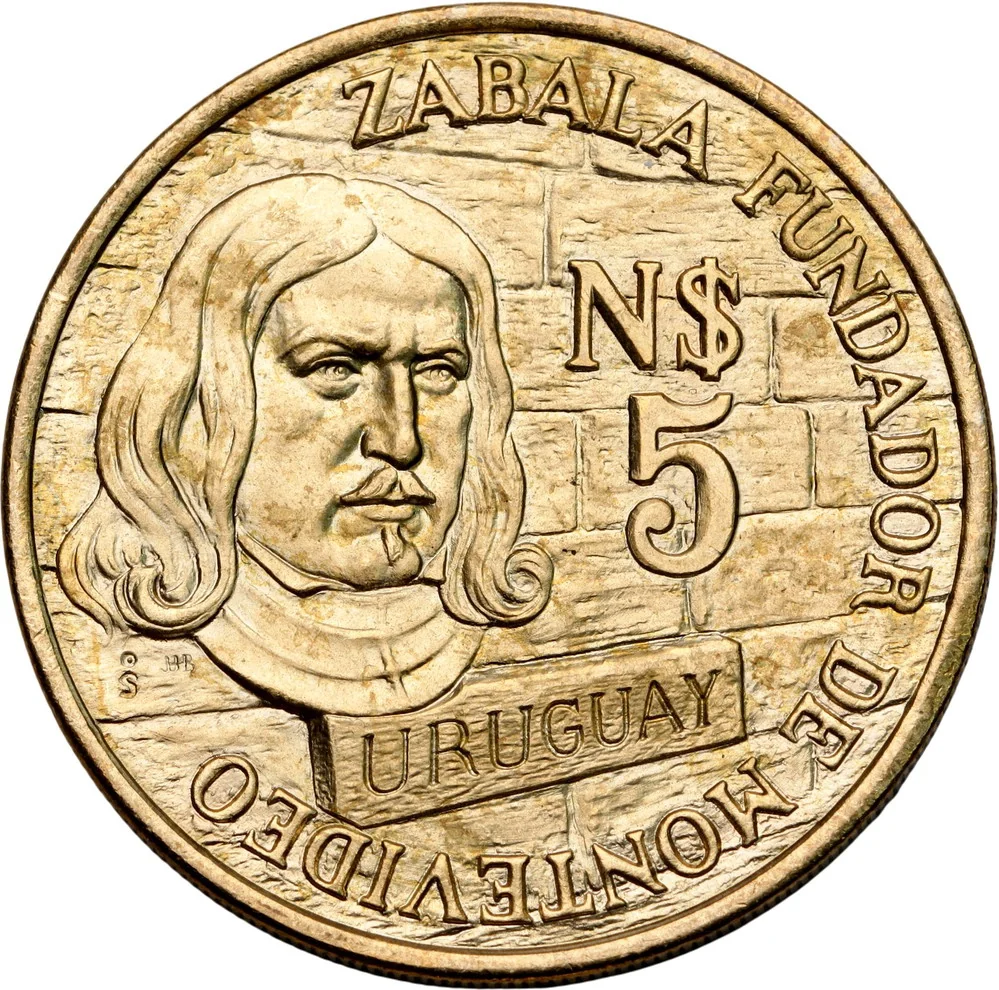
Portrait of Montevideo founder Bruno Mauricio de Zabala, facing right. Background of fortified stone wall with country name and value engraved in a block.
Inscription:
ZABALA FUNDADOR DE MONTEVIDEO
N$
5
URUGUAY
N$
5
URUGUAY
Script: Latin
Engraver: Juan Ulrico Habegger Balparda
Reverse
Description:
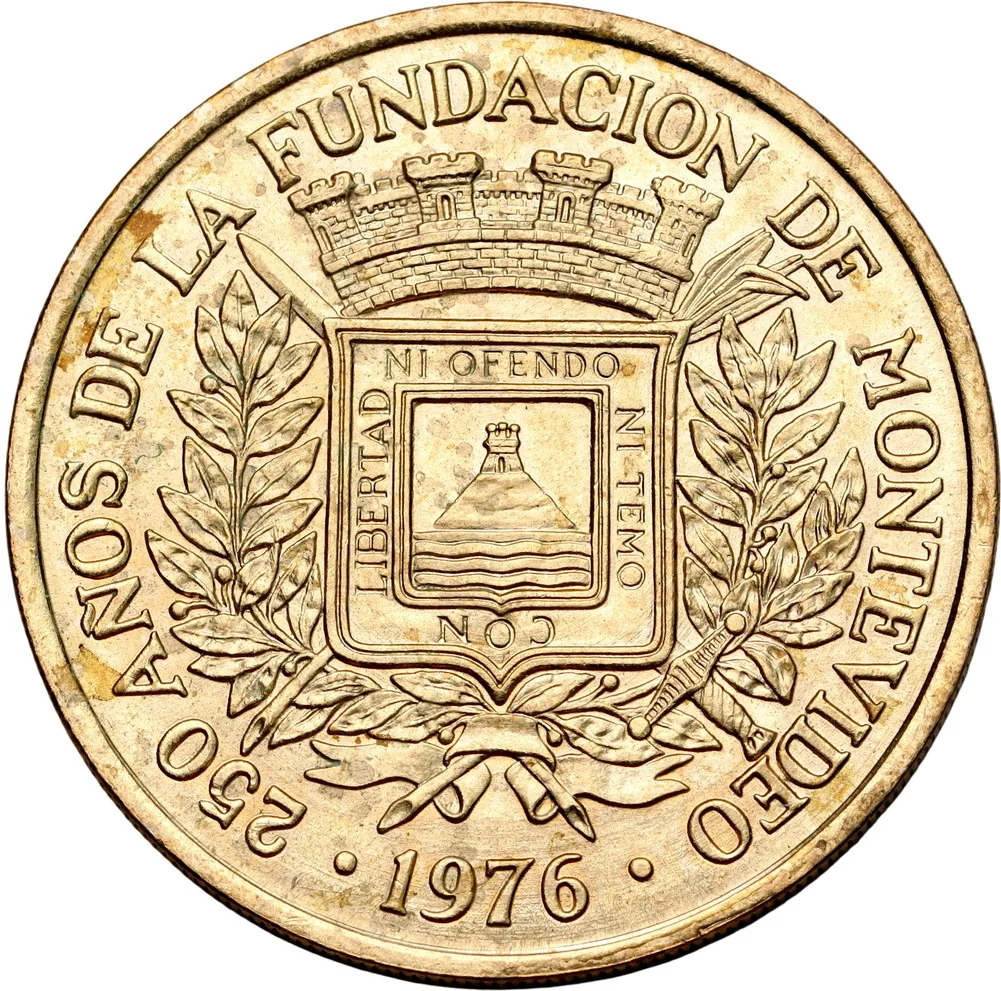
Montevideo department coat of arms, dated in exergue. Inscription: "WITH FREEDOM, I NEITHER OFFEND NOR FEAR".
Inscription:
250 AÑOS DE LA FUNDACION DE MONTEVIDEO
CON LIBERTAD NI OFENDO NI TEMO
· 1976 ·
CON LIBERTAD NI OFENDO NI TEMO
· 1976 ·
Translation:
250 Years of the Foundation of Montevideo
With Liberty I Neither Offend Nor Fear
· 1976 ·
With Liberty I Neither Offend Nor Fear
· 1976 ·
Script: Latin
Language: Spanish
Engraver: Juan Ulrico Habegger Balparda
Edge
Reeded.
Categories
| Mustache/Beard |
| Symbols> Coat of Arms |
| Symbol> Wreath |
Mints
| Name | Mark |
|---|---|
| Casa de Moneda de Chile | (So) |
Mintings
| Year | Mint Mark | Mintage | Quality | Collection |
|---|---|---|---|---|
| 1976 | So | 300,000 |
Historical background
In 1976, Uruguay's currency situation was characterized by severe instability and economic distress, a direct consequence of the broader crisis under the civil-military dictatorship that had seized power in 1973. The regime, prioritizing political control and a neoliberal economic restructuring, implemented policies that led to rampant inflation, which soared to approximately 50% annually. This hyperinflationary environment severely eroded the purchasing power of the Uruguayan peso, creating widespread hardship for the population as wages failed to keep pace with soaring prices.
The government's economic strategy, advised by figures like Alejandro Végh Villegas, involved a dual approach of opening the financial market while maintaining heavy state intervention in other sectors. A significant policy was the practice of a "tablita cambiaria" (a pre-announced, crawling peg exchange rate system), introduced more formally in 1978. In 1976, however, the groundwork was being laid, with the peso undergoing periodic devaluations in an attempt to manage the balance of payments and control inflation, but these measures often proved insufficient and reactive. The financial liberalization also led to a surge in foreign debt, both public and private, as banks borrowed cheaply abroad, storing up future vulnerabilities.
Overall, the currency situation in 1976 reflected an economy in profound transition and turmoil. The dictatorship's policies suppressed immediate social unrest but created deep structural imbalances, including a overvalued currency, massive external debt, and a crippling inflation that would culminate in a severe financial crisis in the early 1980s. The period is remembered as one of significant economic contraction and declining living standards, where monetary instability was a central feature of national life under authoritarian rule.
The government's economic strategy, advised by figures like Alejandro Végh Villegas, involved a dual approach of opening the financial market while maintaining heavy state intervention in other sectors. A significant policy was the practice of a "tablita cambiaria" (a pre-announced, crawling peg exchange rate system), introduced more formally in 1978. In 1976, however, the groundwork was being laid, with the peso undergoing periodic devaluations in an attempt to manage the balance of payments and control inflation, but these measures often proved insufficient and reactive. The financial liberalization also led to a surge in foreign debt, both public and private, as banks borrowed cheaply abroad, storing up future vulnerabilities.
Overall, the currency situation in 1976 reflected an economy in profound transition and turmoil. The dictatorship's policies suppressed immediate social unrest but created deep structural imbalances, including a overvalued currency, massive external debt, and a crippling inflation that would culminate in a severe financial crisis in the early 1980s. The period is remembered as one of significant economic contraction and declining living standards, where monetary instability was a central feature of national life under authoritarian rule.
🌱 Common