

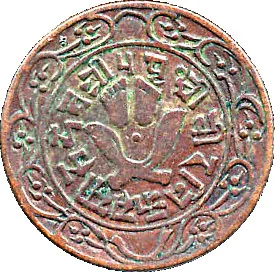
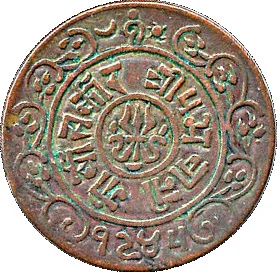
1 paisa – Nepal
Add to wishlist
Nepal
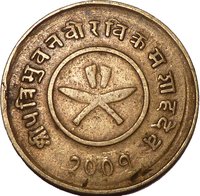
Obverse
Description:
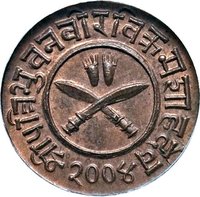
Crossed khukris over footprints
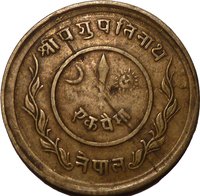
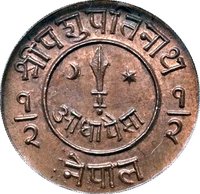
Reverse
Edge
Mintings
| Year | Mint Mark | Mintage | Quality | Collection |
|---|---|---|---|---|
| 1945 | — | — | ||
| 1948 | — | — |
Historical background
In 1945, Nepal's currency situation was fundamentally defined by its dual monetary system and its economic subordination to British India. The Nepalese rupee, introduced in 1932, circulated alongside the Indian rupee, which held significant influence due to the entrenched economic and trade links between the two countries. The exchange rate was fixed, with the Nepalese rupee valued at a slight discount to its Indian counterpart (approximately 1 Indian rupee = 1 Nepalese rupee and 4 annas). This peg was essential as India was Nepal's almost exclusive trading partner, and Indian currency was widely accepted, if not dominant, within Nepal's border regions.
The period was one of strict control under the autocratic Rana regime. The Nepal Rastra Bank, the country's central bank, would not be established until 1956, so currency issuance and monetary policy were managed directly by the government, specifically the Sadar Muluki Khana (State Treasury). Coinage (Mohar and Rupee) was minted in Kathmandu, while notes were printed in India, reflecting the technical dependency. The money supply was conservative, primarily backing trade and government expenditure, with limited penetration of formal currency in a largely rural, subsistence-based economy.
This monetary landscape existed in the twilight of both World War II and Rana rule. The war had caused inflationary pressures through increased demand for Nepalese goods and the spending of Allied soldiers in the region, but the fixed exchange rate and India's own wartime controls largely dictated Nepal's financial conditions. The system, while stable, was not designed for independent economic management. It would soon face immense pressure from the political upheavals of the 1950s, which would eventually lead to monetary reform and the establishment of a modern central banking system.
The period was one of strict control under the autocratic Rana regime. The Nepal Rastra Bank, the country's central bank, would not be established until 1956, so currency issuance and monetary policy were managed directly by the government, specifically the Sadar Muluki Khana (State Treasury). Coinage (Mohar and Rupee) was minted in Kathmandu, while notes were printed in India, reflecting the technical dependency. The money supply was conservative, primarily backing trade and government expenditure, with limited penetration of formal currency in a largely rural, subsistence-based economy.
This monetary landscape existed in the twilight of both World War II and Rana rule. The war had caused inflationary pressures through increased demand for Nepalese goods and the spending of Allied soldiers in the region, but the fixed exchange rate and India's own wartime controls largely dictated Nepal's financial conditions. The system, while stable, was not designed for independent economic management. It would soon face immense pressure from the political upheavals of the 1950s, which would eventually lead to monetary reform and the establishment of a modern central banking system.
💎 Extremely Rare