

1 Paisa – Nepal
Nepal
Context
Years: 1944–1949
Issuer: Nepal 
Ruler: Tribhuvan Bir Bikram Shah
Currency:
(since 1932)
Demonetized: Yes
Material
References
KM: #Click to copy to clipboard707a
Numista: #15224
Value
Exchange value: 0.01 NPR
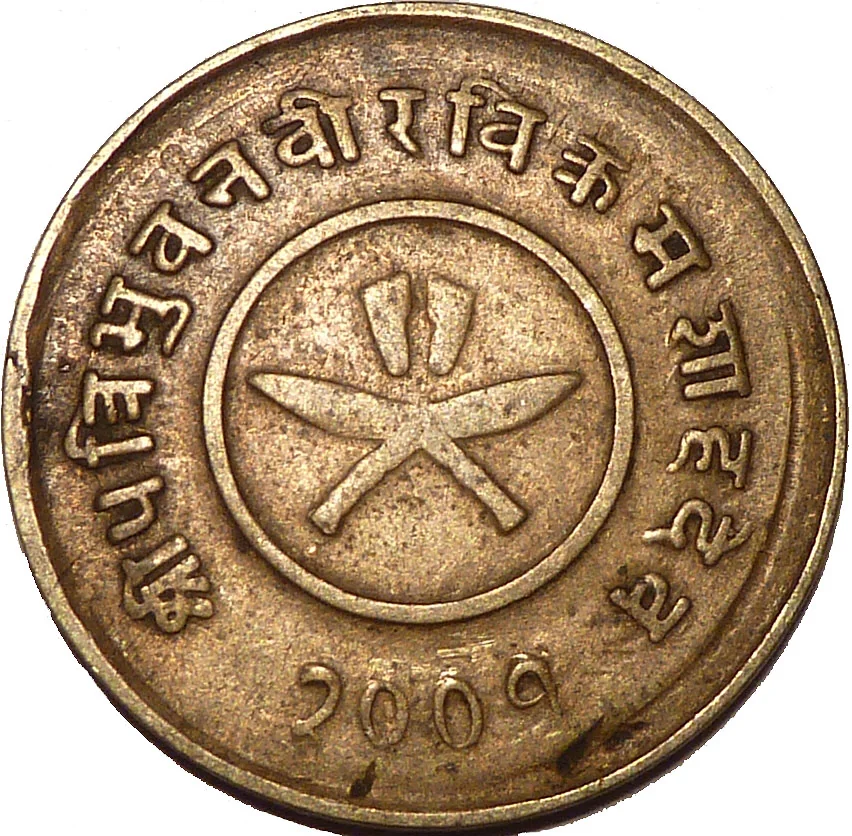
Obverse
Description:
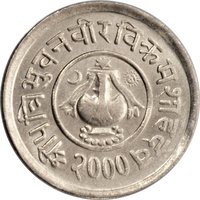
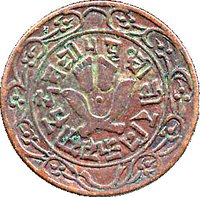
Crossed daggers over footprints in a circle.
Inscription:
२००१
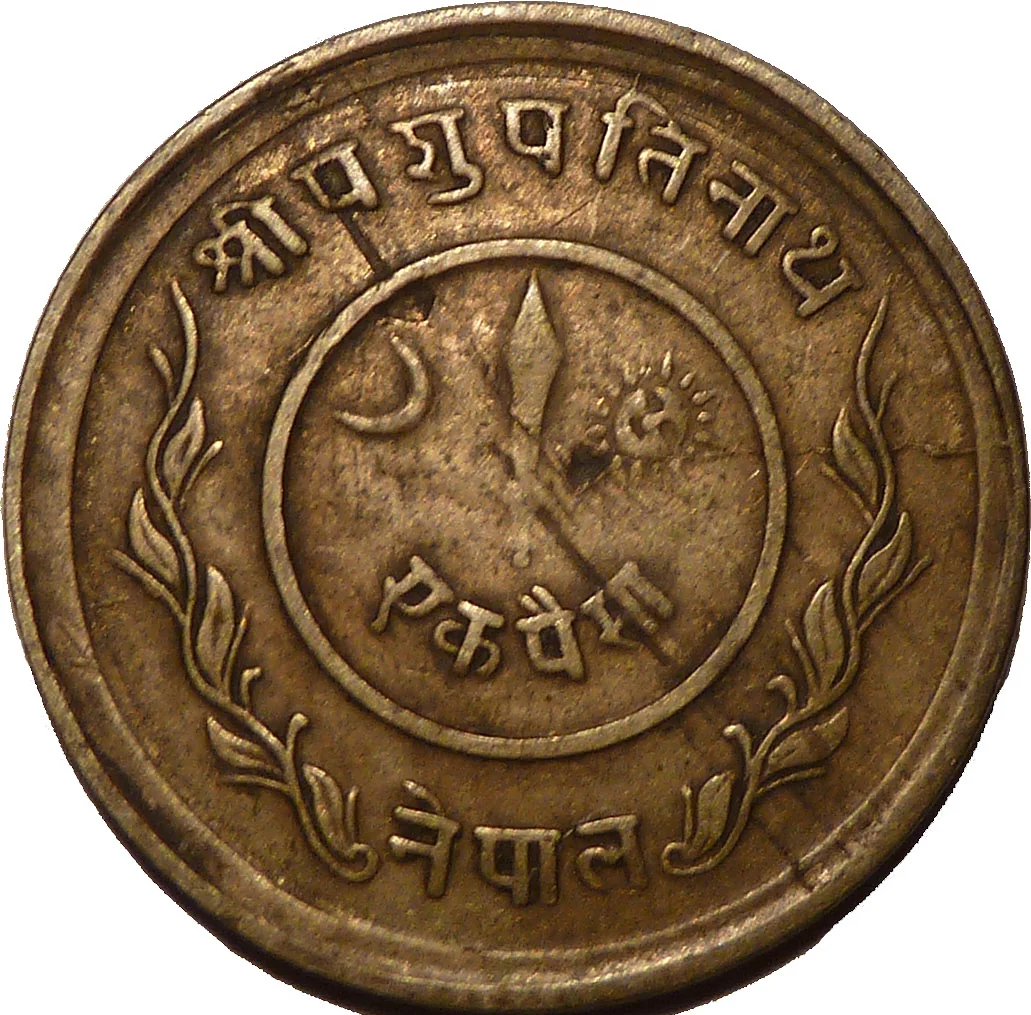
Reverse
Description:
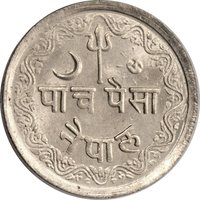
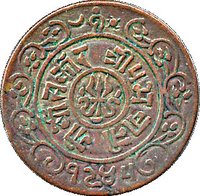
A central circle holds a moon, sword, and sun, encircled by leaves and Devanagari script.
Edge
Plain
Mintings
| Year | Mint Mark | Mintage | Quality | Collection |
|---|---|---|---|---|
| 1944 | — | — | ||
| 1946 | — | — | ||
| 1947 | — | — | ||
| 1948 | — | — | ||
| 1949 | — | — |
Historical background
In 1944, Nepal's currency situation was intrinsically tied to its complex relationship with British India. The primary circulating medium was the Indian Rupee, which held legal tender status alongside the Nepalese Rupee (NPR). This dual-currency system reflected Nepal's economic dependency, as its trade was overwhelmingly oriented toward India. The Nepalese Rupee itself was pegged at a fixed rate of 1 NPR = 1.6 Indian Rupees, a parity established in 1932 that would remain in place for decades. This peg, while providing stability, meant Nepal's monetary policy was effectively set in Calcutta and London, not Kathmandu.
The domestic currency was issued by the private Sadar Muluki Khana (the Treasury), under the authority of the Rana dynasty. Coinage, particularly the silver Mohar, still held cultural significance but was being eclipsed by paper notes for larger transactions. Notably, the 1944 period saw the circulation of notes printed in India, often bearing the portrait of Prime Minister Juddha Shumsher Jang Bahadur Rana. These notes were not fully convertible and were primarily used for internal government transactions and remittances, while Indian currency facilitated cross-border trade.
This monetary arrangement underscored Nepal's political and economic reality in the final years of World War II. While officially independent, the country operated within the sterling area and the Indian economic sphere. The system provided necessary stability for financing the Rana regime's expenditures and the lucrative recruitment of Gurkha soldiers for the British Indian Army, but it did little to develop an autonomous national financial infrastructure. The currency landscape of 1944 was thus a symbol of a semi-feudal state integrated into, and subordinate to, the colonial economic order of British India.
The domestic currency was issued by the private Sadar Muluki Khana (the Treasury), under the authority of the Rana dynasty. Coinage, particularly the silver Mohar, still held cultural significance but was being eclipsed by paper notes for larger transactions. Notably, the 1944 period saw the circulation of notes printed in India, often bearing the portrait of Prime Minister Juddha Shumsher Jang Bahadur Rana. These notes were not fully convertible and were primarily used for internal government transactions and remittances, while Indian currency facilitated cross-border trade.
This monetary arrangement underscored Nepal's political and economic reality in the final years of World War II. While officially independent, the country operated within the sterling area and the Indian economic sphere. The system provided necessary stability for financing the Rana regime's expenditures and the lucrative recruitment of Gurkha soldiers for the British Indian Army, but it did little to develop an autonomous national financial infrastructure. The currency landscape of 1944 was thus a symbol of a semi-feudal state integrated into, and subordinate to, the colonial economic order of British India.
🌱 Common