

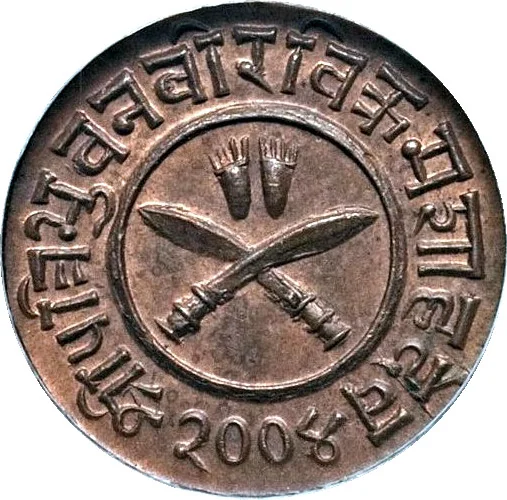
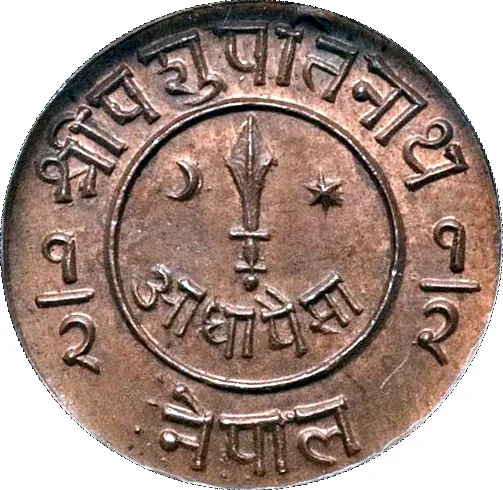
½ Paisa – Nepal
Nepal
Context
Year: 1947
Vikram Samvat Year: 2004
Issuer: Nepal 
Ruler: Tribhuvan Bir Bikram Shah
Currency:
(since 1932)
Demonetized: Yes
References
KM: #Click to copy to clipboard705
Numista: #37019
Value
Exchange value: 0.005 NPR
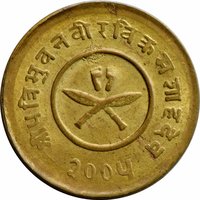
Obverse
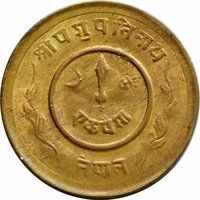
Reverse
Edge
Mintings
| Year | Mint Mark | Mintage | Quality | Collection |
|---|---|---|---|---|
| 1947 | — | — |
Historical background
In 1947, Nepal's currency situation was fundamentally shaped by its unique political and economic relationship with British India. The Nepalese rupee was pegged at a fixed rate to the Indian rupee, which was the dominant currency in circulation within the kingdom, especially for larger transactions and external trade. This monetary integration was a legacy of the 1924 Nepal-Britain Treaty and reflected Nepal's economically dependent status, as its economy was heavily oriented towards India for trade, employment (through the Gurkha regiments), and access to the global market.
Domestically, the currency system was a complex dual one. While Indian notes circulated widely, the government of the Rana dynasty also issued its own silver mohars and copper paisas for smaller, local transactions. However, the value and acceptance of these local coins were unstable and often localized. The Rana regime, focused on maintaining its own authority and luxury, lacked a centralized monetary authority or a modern banking system, leading to inconsistencies in currency supply and valuation across the country.
The year 1947 was a pivotal moment of external pressure, as it witnessed the independence and partition of India. This event immediately destabilized the existing financial order, as the future of the Indian rupee itself was in transition. For Nepal, the urgent question became whether to maintain its peg to the new Indian rupee or to assert greater monetary sovereignty. The uncertainty of this period directly set the stage for the major monetary reforms that would follow in the 1950s, including the establishment of Nepal's own central bank and the introduction of a distinct national currency in 1956.
Domestically, the currency system was a complex dual one. While Indian notes circulated widely, the government of the Rana dynasty also issued its own silver mohars and copper paisas for smaller, local transactions. However, the value and acceptance of these local coins were unstable and often localized. The Rana regime, focused on maintaining its own authority and luxury, lacked a centralized monetary authority or a modern banking system, leading to inconsistencies in currency supply and valuation across the country.
The year 1947 was a pivotal moment of external pressure, as it witnessed the independence and partition of India. This event immediately destabilized the existing financial order, as the future of the Indian rupee itself was in transition. For Nepal, the urgent question became whether to maintain its peg to the new Indian rupee or to assert greater monetary sovereignty. The uncertainty of this period directly set the stage for the major monetary reforms that would follow in the 1950s, including the establishment of Nepal's own central bank and the introduction of a distinct national currency in 1956.
💎 Extremely Rare