

Obverse
Description:
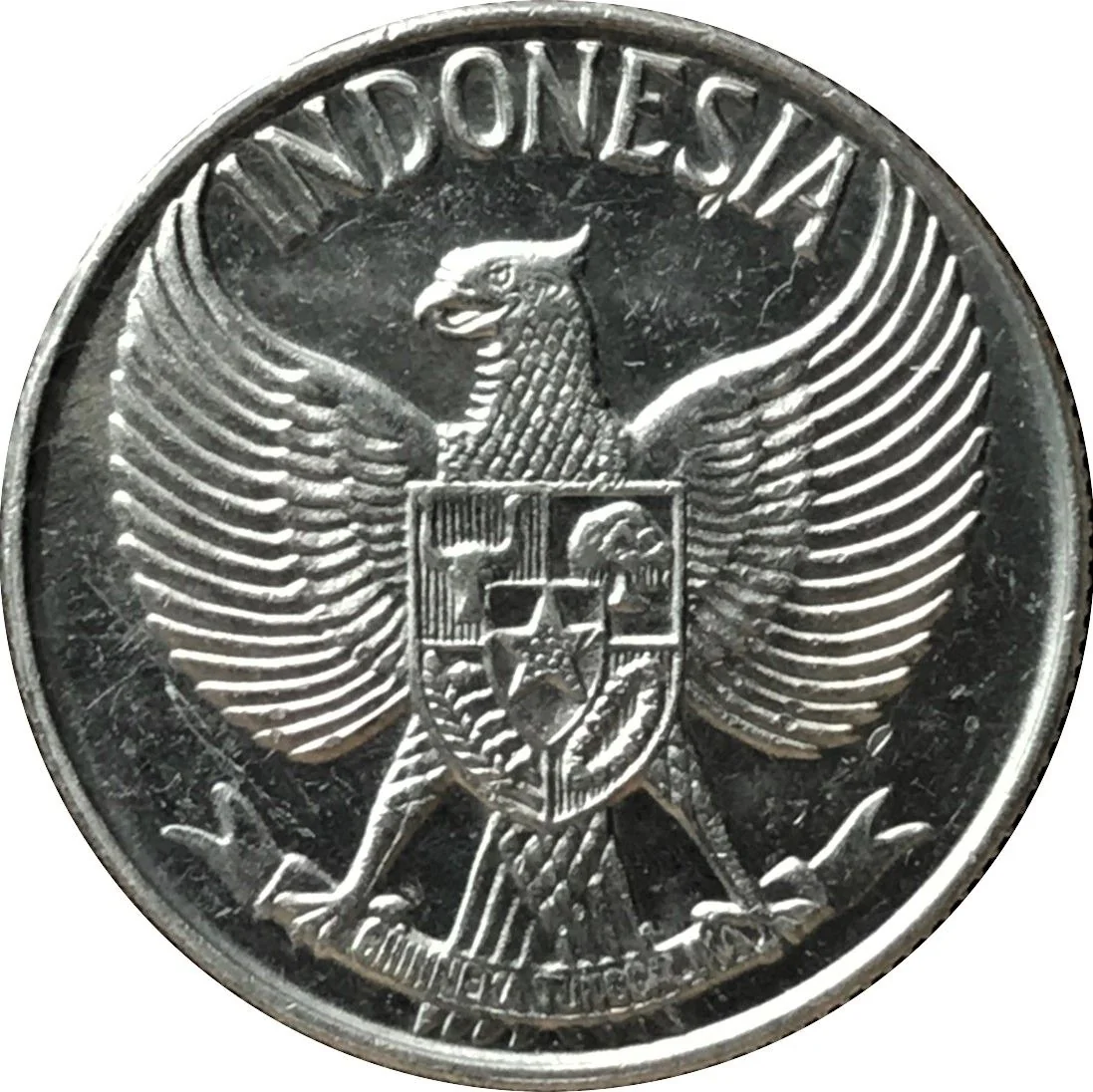
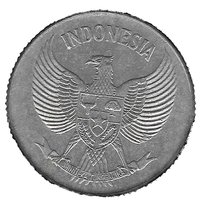
The national emblem is the Garuda, a Javan hawk-eagle, holding a scroll with the national motto and a shield symbolizing Pancasila, the Five Principles.
Inscription:
INDONESIA
BHINNEKA TUNGGAL IKA
BHINNEKA TUNGGAL IKA
Translation:
Indonesia
Unity in Diversity
Unity in Diversity
Script: Latin
Languages: Indonesian, Javanese
Reverse
Description:
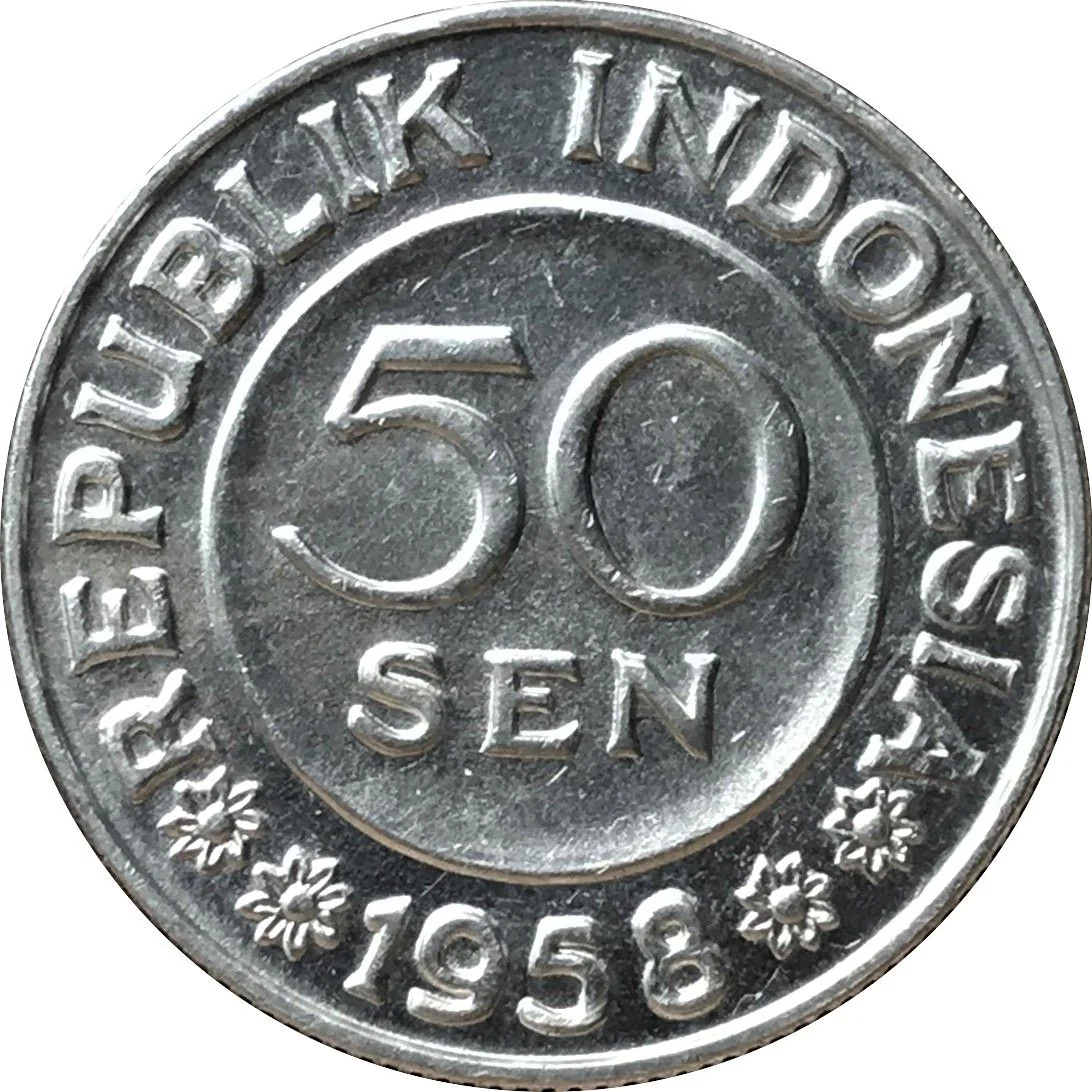
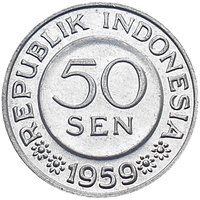
Flowering sphere
Inscription:
REPUBLIK INDONESIA
50
SEN
1958
50
SEN
1958
Translation:
REPUBLIC OF INDONESIA
50
CENTS
1958
50
CENTS
1958
Script: Latin
Language: Indonesian
Edge
Reeded
Mintings
| Year | Mint Mark | Mintage | Quality | Collection |
|---|---|---|---|---|
| 1958 | — | 33,740,000 |
Historical background
In 1958, Indonesia's currency situation was characterized by severe inflation and monetary instability, a direct consequence of the government's deficit financing to suppress regional rebellions, most notably the PRRI/Permesta uprising in Sumatra and Sulawesi. President Sukarno's administration, facing a critical shortfall in revenue, resorted to printing vast quantities of new rupiah notes to fund military operations and government expenditures. This rapid expansion of the money supply, unbacked by economic productivity, triggered a classic inflationary spiral, dramatically eroding the currency's purchasing power and public confidence.
The crisis was exacerbated by the fragmentation of the nation's monetary system. The rebel-held regions in the Outer Islands, which were crucial export earners for commodities like rubber and tin, began withholding foreign exchange earnings from the central government in Jakarta. In response, the central bank issued separate "Purple" and "Red" series banknotes in 1958, designed to circulate only in specific regions, in an attempt to invalidate the currency held by the rebels and stem the flow of funds to their cause. This created a complex and chaotic multi-currency environment, further disrupting internal trade and economic cohesion.
Ultimately, the currency turmoil of 1958 was a stark symptom of the political and economic strains threatening the young republic. The inflationary financing deepened economic hardship for the population, while the regional currency measures highlighted the challenges of central authority. This period set the stage for the more extreme hyperinflation that would follow in the mid-1960s, underscoring how the government's fiscal policies, driven by political survival, were destabilizing the nation's financial foundations.
The crisis was exacerbated by the fragmentation of the nation's monetary system. The rebel-held regions in the Outer Islands, which were crucial export earners for commodities like rubber and tin, began withholding foreign exchange earnings from the central government in Jakarta. In response, the central bank issued separate "Purple" and "Red" series banknotes in 1958, designed to circulate only in specific regions, in an attempt to invalidate the currency held by the rebels and stem the flow of funds to their cause. This created a complex and chaotic multi-currency environment, further disrupting internal trade and economic cohesion.
Ultimately, the currency turmoil of 1958 was a stark symptom of the political and economic strains threatening the young republic. The inflationary financing deepened economic hardship for the population, while the regional currency measures highlighted the challenges of central authority. This period set the stage for the more extreme hyperinflation that would follow in the mid-1960s, underscoring how the government's fiscal policies, driven by political survival, were destabilizing the nation's financial foundations.

🌱 Common