


Obverse
Description:
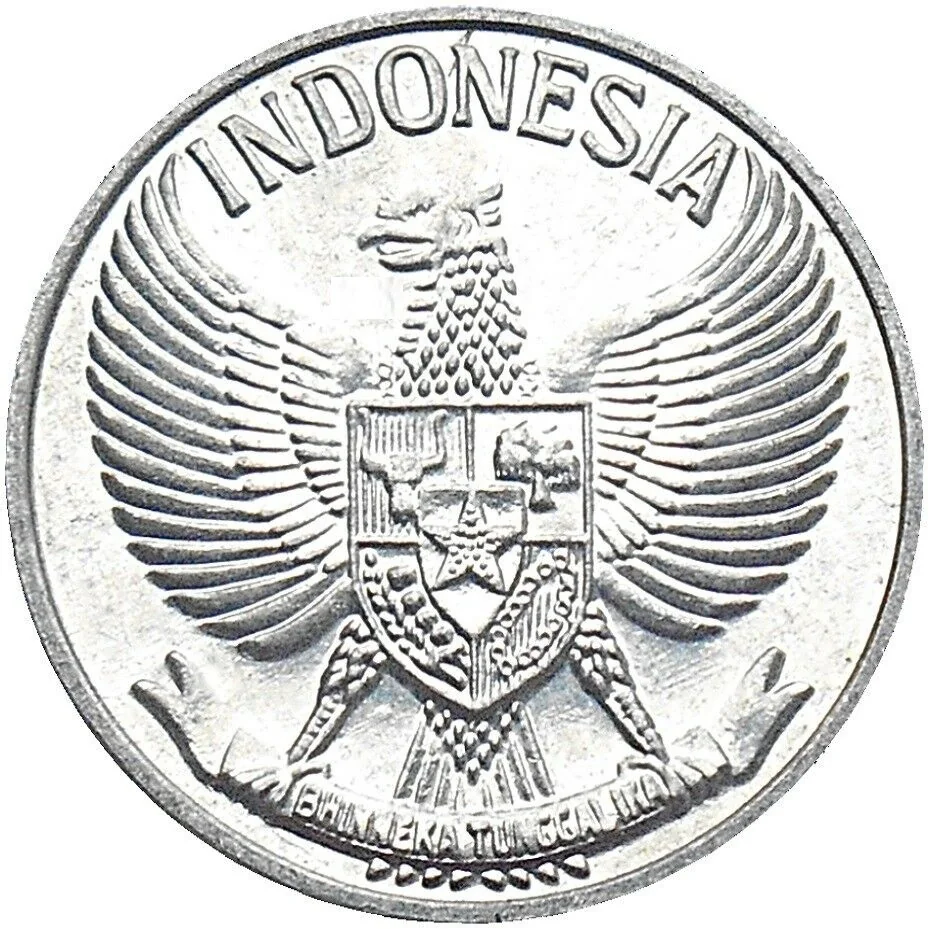
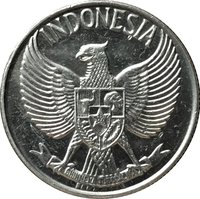
The national emblem is the Garuda, a Javan hawk-eagle, holding a scroll with the national motto and a shield symbolizing Pancasila, the Five Principles.
Inscription:
INDONESIA
BHINNEKA TUNGGAL IKA
BHINNEKA TUNGGAL IKA
Translation:
UNITY IN DIVERSITY
Script: Latin
Languages: Indonesian, Javanese
Reverse
Description:
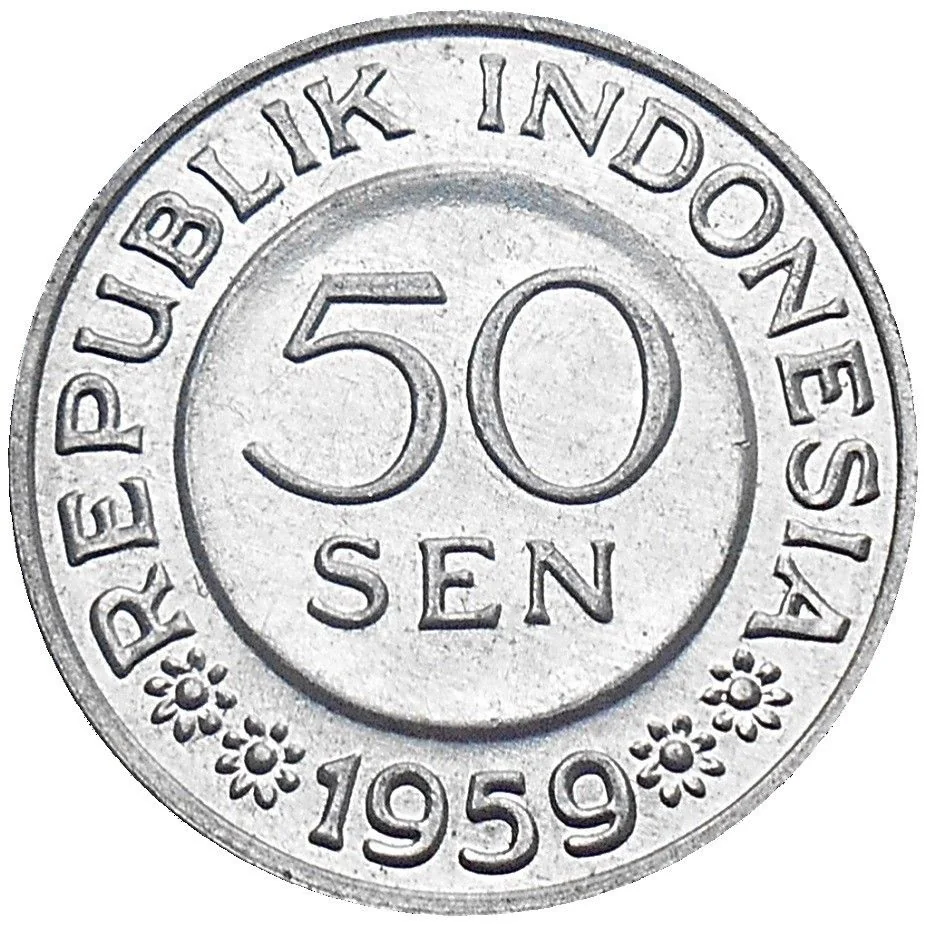
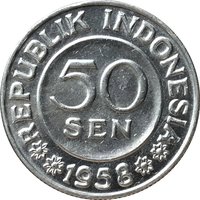
Flowering sphere
Inscription:
REPUBLIK INDONESIA
50
SEN
1961
50
SEN
1961
Translation:
REPUBLIC OF INDONESIA
50
CENTS
1961
50
CENTS
1961
Script: Latin
Language: Indonesian
Edge
Reeded
Mintings
| Year | Mint Mark | Mintage | Quality | Collection |
|---|---|---|---|---|
| 1959 | — | 100,009,000 | ||
| 1961 | — | 150,000,000 |
Historical background
In 1959, Indonesia faced a severe economic crisis marked by hyperinflation, a large budget deficit, and a critical shortage of foreign exchange. The root causes were multifaceted: a decline in global commodity prices hurt export revenues, while years of high government spending—particularly on nationalization programs and military campaigns—had financed by the central bank simply printing more money. This led to a vicious cycle where the official Rupiah became massively overvalued, a thriving black market for foreign currency emerged, and public confidence in the currency collapsed.
President Sukarno’s government responded with a radical and controversial monetary policy known as "Sanering" (monetary purification) on August 25, 1959. This involved a sudden devaluation where banknotes of 500 and 1000 Rupiah were demonetized and reduced to 10% of their face value (50 and 100 Rupiah, respectively). Simultaneously, bank deposits over 25,000 Rupiah were frozen and a 90% devaluation was applied to certain foreign exchange accounts. The goal was to drastically reduce the money supply in circulation, curb inflation, and eliminate the black market by forcibly aligning the currency with reality.
The policy ultimately failed to achieve its long-term economic objectives. While it temporarily reduced liquidity, it did not address the fundamental fiscal indiscipline or boost production. Instead, it severely eroded public trust in the banking system and the government, punishing savers and the middle class. The economic instability deepened, contributing to the wider political turmoil that would culminate in Sukarno's decline and the transition to Suharto's "New Order" later in the 1960s. The 1959 currency shock remains a stark example of the perils of attempting to solve deep structural economic problems with abrupt, coercive monetary measures.
President Sukarno’s government responded with a radical and controversial monetary policy known as "Sanering" (monetary purification) on August 25, 1959. This involved a sudden devaluation where banknotes of 500 and 1000 Rupiah were demonetized and reduced to 10% of their face value (50 and 100 Rupiah, respectively). Simultaneously, bank deposits over 25,000 Rupiah were frozen and a 90% devaluation was applied to certain foreign exchange accounts. The goal was to drastically reduce the money supply in circulation, curb inflation, and eliminate the black market by forcibly aligning the currency with reality.
The policy ultimately failed to achieve its long-term economic objectives. While it temporarily reduced liquidity, it did not address the fundamental fiscal indiscipline or boost production. Instead, it severely eroded public trust in the banking system and the government, punishing savers and the middle class. The economic instability deepened, contributing to the wider political turmoil that would culminate in Sukarno's decline and the transition to Suharto's "New Order" later in the 1960s. The 1959 currency shock remains a stark example of the perils of attempting to solve deep structural economic problems with abrupt, coercive monetary measures.
🌱 Very Common