

5 pesetas – Spain
Add to wishlist
Spain
Context
Year: 1999
Issuer: Spain
Ruler: Juan Carlos I
Currency:
(1868—2001)
Demonetization: 28 February 2002
Total mintage: 216,230,000
Material
References
KM: #
Numista: #1266
Value
Exchange value: 5 ESP
Inflation-adjusted value: 9.27 ESP
Obverse
Description:
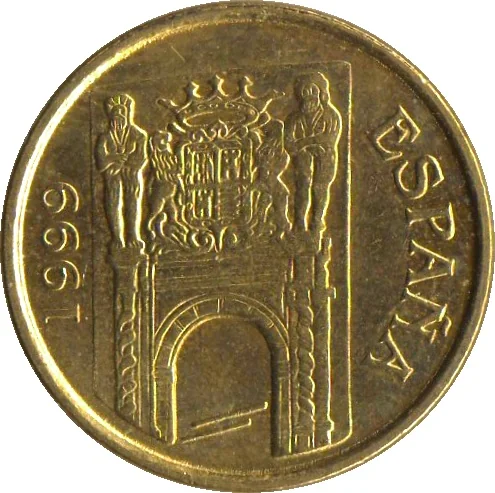
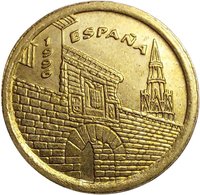
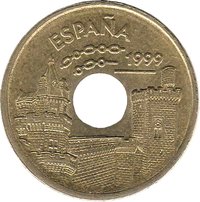
Gate of the House of the Orchard of the Bombs (crowned shield with supporters on arch).
Inscription:
1999 ESPAÑA
Translation:
1999 SPAIN
Script: Latin
Language: Spanish
Engraver: Garcilaso Rollán Sánchez
Reverse
Description:
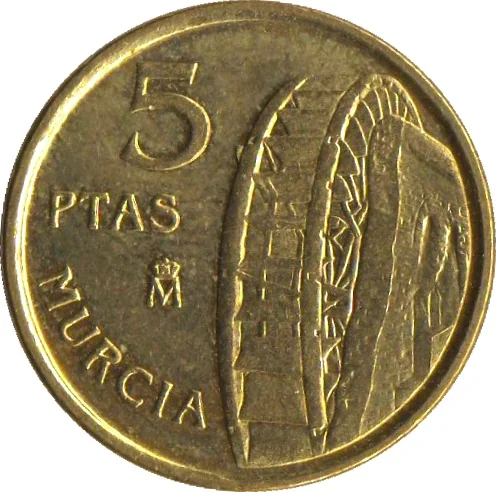
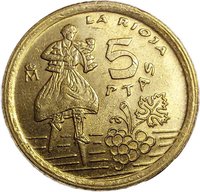
Murcia's iconic waterwheel.
Inscription:
5 PTAS
M
MURCIA
M
MURCIA
Script: Latin
Engraver: Esther González Pastor
Edge
Plain
Mints
| Name | Mark |
|---|---|
| Royal Mint of Madrid | (M) |
Mintings
| Year | Mint Mark | Mintage | Quality | Collection |
|---|---|---|---|---|
| 1999 | M | 216,230,000 |
Historical background
In 1999, Spain was in a state of monetary transition, actively preparing for the imminent launch of the euro. As a founding member of the European Economic and Monetary Union (EMU), it had met the strict Maastricht convergence criteria—on inflation, interest rates, budget deficits, and public debt—and had irrevocably fixed the exchange rate of its national currency, the peseta, to the euro on January 1st of that year. This meant that for the entire year, the peseta traded at a fixed rate of approximately 166.386 pesetas to one euro, eliminating currency fluctuation risks within the Eurozone. The Spanish economy operated under a dual legal framework where all financial and accounting systems began a complex conversion to the new currency.
The year was characterized by extensive logistical and public preparation for the physical introduction of euro banknotes and coins, scheduled for January 1, 2002. While electronic euros existed for non-cash transactions, the peseta remained the sole tangible currency in daily circulation. The government and financial institutions launched major public information campaigns to familiarize citizens with the new currency's value, appearance, and the coming changeover process. Prices were increasingly displayed in both pesetas and euros to ease the transition, a practice known as "dual display."
Economically, adopting the euro promised lower transaction costs, greater price transparency, and enhanced stability for Spain's growing and open economy. However, 1999 also presented challenges, including concerns about the loss of independent monetary policy and the need for strict fiscal discipline under the Eurozone's Stability and Growth Pact. In essence, 1999 was a pivotal holding year for Spain—a period of technical fixedness and public acclimatization, bridging the era of the historic peseta and the forthcoming single European currency.
The year was characterized by extensive logistical and public preparation for the physical introduction of euro banknotes and coins, scheduled for January 1, 2002. While electronic euros existed for non-cash transactions, the peseta remained the sole tangible currency in daily circulation. The government and financial institutions launched major public information campaigns to familiarize citizens with the new currency's value, appearance, and the coming changeover process. Prices were increasingly displayed in both pesetas and euros to ease the transition, a practice known as "dual display."
Economically, adopting the euro promised lower transaction costs, greater price transparency, and enhanced stability for Spain's growing and open economy. However, 1999 also presented challenges, including concerns about the loss of independent monetary policy and the need for strict fiscal discipline under the Eurozone's Stability and Growth Pact. In essence, 1999 was a pivotal holding year for Spain—a period of technical fixedness and public acclimatization, bridging the era of the historic peseta and the forthcoming single European currency.
Series: Autonomous communities of Spain
🌱 Very Common