

25 Pesetas (Conquest of Melilla) – Spain
Circulating commemorative coins
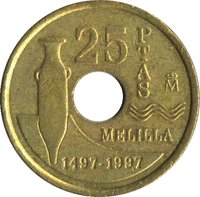
Commemoration: 500th anniversary of the Conquest of Melilla
Series: Autonomous communities of Spain
Spain
Context
Year: 1997
Issuer: Spain 
Ruler: Juan Carlos I
Currency:
(1868—2001)
Demonetization: 28 February 2002
Total mintage: 461,688,000
Material
Diameter: 19.5 mm
Weight: 4.2 g
Thickness: 1.6 mm
Shape: Round with a round hole
Magnetic: No
Technique: Milled
Alignment: Coin alignment
flip
References
KM: #Click to copy to clipboard983
Numista: #1264
Value
Exchange value: 25 ESP
Inflation-adjusted value: 48.13 ESP
Obverse
Description:
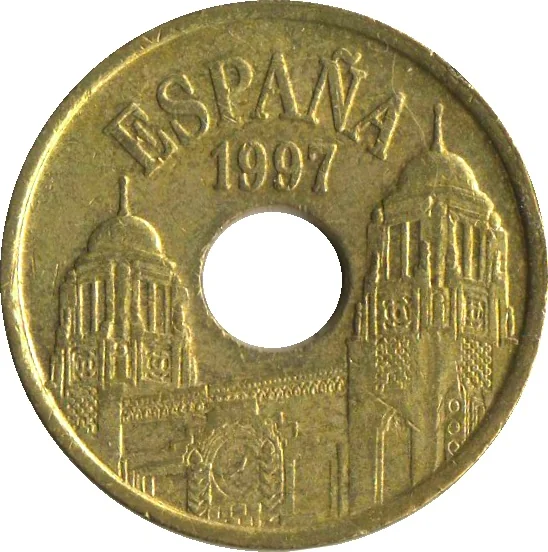
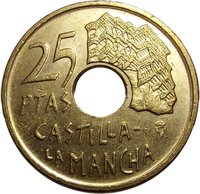
Palace of the Assembly towers in Melilla.
Inscription:
ESPAÑA
1997
1997
Translation:
Spain 1997
Script: Latin
Language: Spanish
Engraver: Luis Antonio Garcia Ruiz
Reverse
Description:
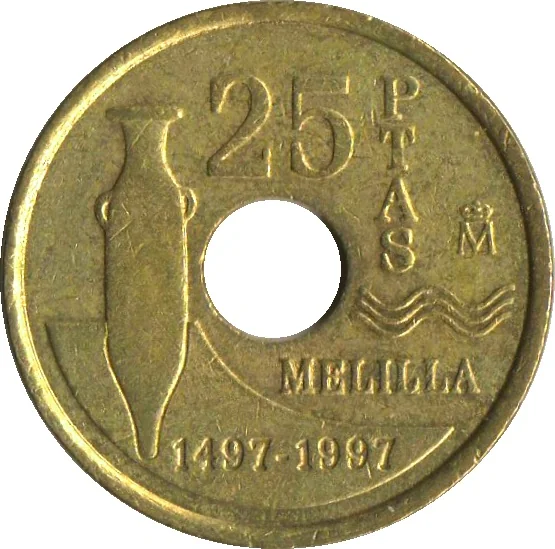
Ancient amphora split by center hole.
Inscription:
25 PTAS
M
MELILLA
1497-1997
M
MELILLA
1497-1997
Script: Latin
Engraver: Luis Antonio Garcia Ruiz
Edge
Plain
Mints
| Name | Mark |
|---|---|
| Royal Mint of Madrid | (M) |
Mintings
| Year | Mint Mark | Mintage | Quality | Collection |
|---|---|---|---|---|
| 1997 | M | 461,688,000 |
Historical background
In 1997, Spain's currency situation was defined by its pivotal position within the European Exchange Rate Mechanism (ERM), the system designed to stabilize exchange rates in the lead-up to Economic and Monetary Union (EMU). The Spanish peseta, having weathered a severe devaluation crisis in 1992-93 that forced its exit and subsequent re-entry into the ERM with wider fluctuation bands, was now stable. This stability was underpinned by a concerted national effort to meet the stringent Maastricht Treaty convergence criteria—low inflation, sound public finances, stable exchange rates, and low long-term interest rates—required for adopting the single European currency.
The year was one of intense preparation and optimism, as Spain successfully reduced its budget deficit to below 3% of GDP and brought inflation under control. The peseta's central rate within the ERM was firmly anchored, and financial markets operated with a prevailing expectation that Spain would be among the first wave of countries to qualify for the euro. This confidence was bolstered by a broad political and social consensus, led by Prime Minister José María Aznar's government, which prioritized fiscal austerity and structural reforms to ensure Spain's place at the core of the new Europe.
Consequently, 1997 represented the final, stable chapter of the peseta's long history. The focus had decisively shifted from managing a national currency to fulfilling the technical prerequisites for its replacement. The currency situation was no longer one of vulnerability but of controlled transition, with Spain on a clear and irreversible path toward abandoning the peseta and embracing the euro, which would be formally launched for electronic transactions in 1999.
The year was one of intense preparation and optimism, as Spain successfully reduced its budget deficit to below 3% of GDP and brought inflation under control. The peseta's central rate within the ERM was firmly anchored, and financial markets operated with a prevailing expectation that Spain would be among the first wave of countries to qualify for the euro. This confidence was bolstered by a broad political and social consensus, led by Prime Minister José María Aznar's government, which prioritized fiscal austerity and structural reforms to ensure Spain's place at the core of the new Europe.
Consequently, 1997 represented the final, stable chapter of the peseta's long history. The focus had decisively shifted from managing a national currency to fulfilling the technical prerequisites for its replacement. The currency situation was no longer one of vulnerability but of controlled transition, with Spain on a clear and irreversible path toward abandoning the peseta and embracing the euro, which would be formally launched for electronic transactions in 1999.
Series: Autonomous communities of Spain
🌱 Very Common