

500 mils – Cyprus
Add to wishlist
Circulating commemorative coins
Commemoration: F.A.O.
Cyprus
Obverse
Description:
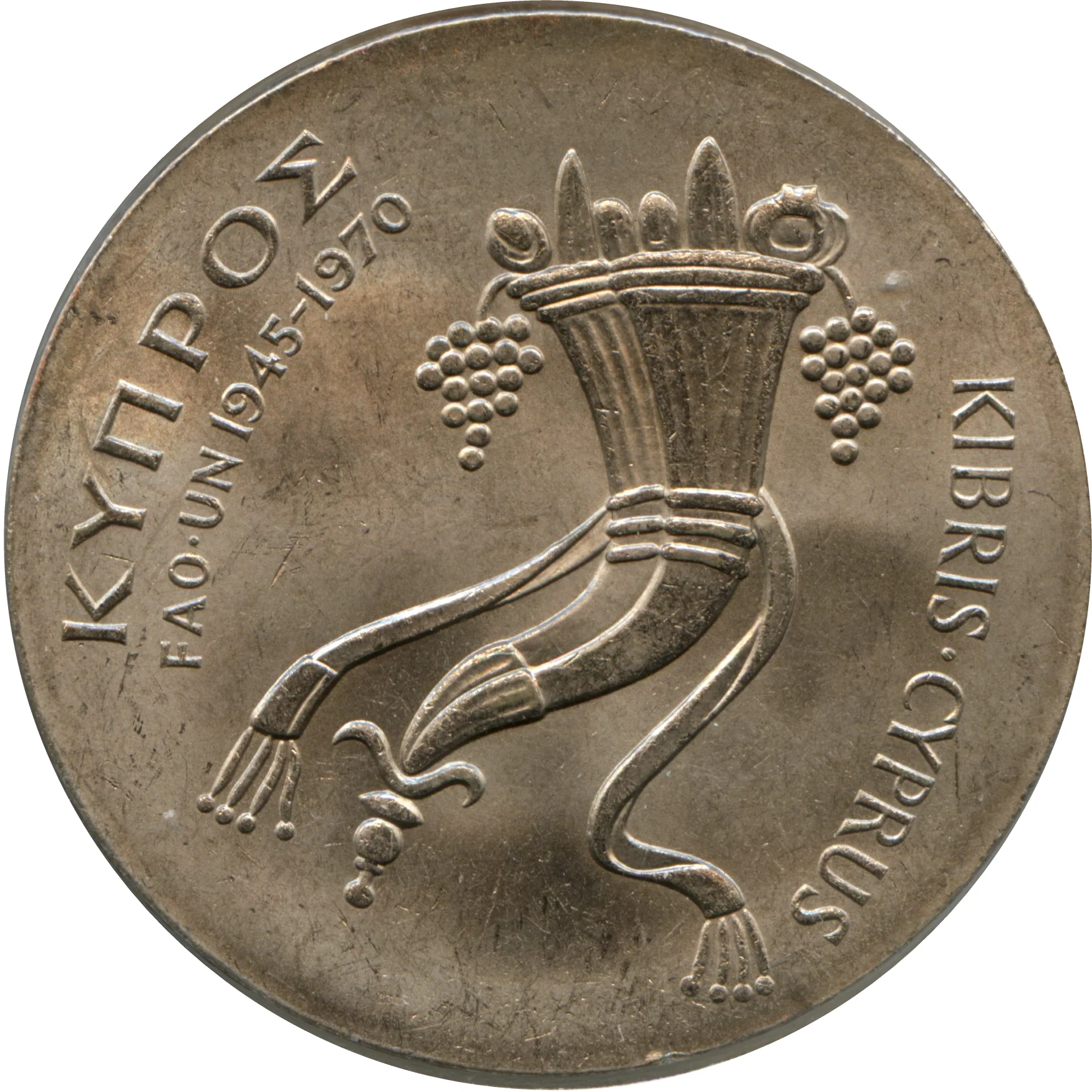
Double cornucopia, as on Ptolemy II's coins.
Inscription:
ΚΥΠΡΟΣ
FAO·UN 1945-1970
KIBRIS·CYPRUS
FAO·UN 1945-1970
KIBRIS·CYPRUS
Translation:
CYPRUS
FAO·UN 1945-1970
CYPRUS·CYPRUS
FAO·UN 1945-1970
CYPRUS·CYPRUS
Engraver: Antis Ioannides
Reverse
Edge
Plain
Categories
| Organization> FAO |
| Plant> Fruit |
| Symbol> Cornucopia |
Mints
| Name | Mark |
|---|---|
| Royal Mint (Tower Hill) | — |
Mintings
| Year | Mint Mark | Mintage | Quality | Collection |
|---|---|---|---|---|
| 1970 | — | 80,000 |
Historical background
In 1970, the Republic of Cyprus was a decade into its independence, and its currency situation was defined by stability and a formal colonial legacy. The official currency remained the Cypriot pound (CYP), often denoted as £C, which was pegged at par to the British pound sterling. This peg was a direct continuation of the pre-independence monetary system, providing a stable exchange rate that facilitated trade and economic planning. The island's economy was still largely agrarian and developing, with a growing tourism sector, and this sterling link offered credibility and anchored monetary policy.
The currency itself was issued by the Cyprus Currency Board, established in 1963. This board operated a conservative, rule-based system where the supply of Cypriot pounds was fully backed by foreign reserves, primarily sterling holdings. This arrangement limited the government's ability to finance spending through money creation but was crucial for maintaining confidence in the new nation's currency. Consequently, the Cypriot pound enjoyed a strong reputation for stability, with banknotes and coins circulating alongside British currency, which was also still legal tender on the island.
Beneath this stable surface, however, lay the political and economic fissures that followed the intercommunal strife of 1963-64. The de facto division of the island into Greek Cypriot and Turkish Cypriot sectors had begun to create parallel economic realities. While the Cypriot pound remained the unified legal currency, its practical administration and the broader financial system were increasingly influenced by the separate development of the two communities, setting the stage for future monetary complications. Thus, 1970 represents a point of apparent monetary stability, underpinned by a colonial-era peg, yet existing within a politically fractured state.
The currency itself was issued by the Cyprus Currency Board, established in 1963. This board operated a conservative, rule-based system where the supply of Cypriot pounds was fully backed by foreign reserves, primarily sterling holdings. This arrangement limited the government's ability to finance spending through money creation but was crucial for maintaining confidence in the new nation's currency. Consequently, the Cypriot pound enjoyed a strong reputation for stability, with banknotes and coins circulating alongside British currency, which was also still legal tender on the island.
Beneath this stable surface, however, lay the political and economic fissures that followed the intercommunal strife of 1963-64. The de facto division of the island into Greek Cypriot and Turkish Cypriot sectors had begun to create parallel economic realities. While the Cypriot pound remained the unified legal currency, its practical administration and the broader financial system were increasingly influenced by the separate development of the two communities, setting the stage for future monetary complications. Thus, 1970 represents a point of apparent monetary stability, underpinned by a colonial-era peg, yet existing within a politically fractured state.
🌱 Common