



50 stotinki – Bulgaria
Add to wishlist
Bulgaria
Context
Year: 1959
Issuer: Bulgaria
Period:
(1946—1990)
Currency:
(1952—1962)
Demonetization: 1 January 1962
Material
Diameter: 23 mm
Weight: 3.8 g
Thickness: 1.35 mm
Shape: Round
Composition: Copper-nickel
Technique: Milled
Alignment: Medal alignment

flip

References
KM: #
Numista: #10122
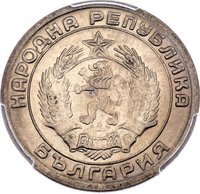
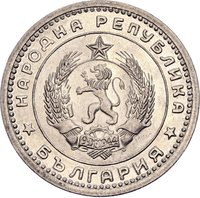
Obverse
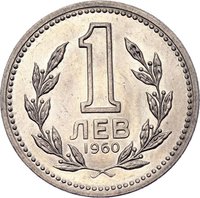
Reverse
Edge
Reeded
Mints
| Name | Mark |
|---|---|
| Bulgarian Mint | — |
Mintings
| Year | Mint Mark | Mintage | Quality | Collection |
|---|---|---|---|---|
| 1959 | — | — |
Historical background
In 1959, Bulgaria operated under a strictly controlled socialist command economy, with its currency, the Lev, managed by the Bulgarian National Bank as an instrument of state planning rather than a market-driven medium of exchange. The country was a close satellite of the Soviet Union, and its monetary policy was modeled on the Soviet system, emphasizing stability in official statistics and the facilitation of state-directed industrial and agricultural output. The official exchange rate was fixed arbitrarily by the state, bearing no relation to supply and demand, and was used primarily for accounting purposes in centralized trade, especially with other Comecon (Council for Mutual Economic Assistance) bloc nations.
Domestically, the currency situation was characterized by a stark duality. While citizens used the Lev for daily transactions, there was a pervasive system of shortages, hidden inflation, and a thriving black market for goods that were scarce in the state-run stores. The purchasing power of wages was largely determined by access to subsidized goods and connections rather than the nominal amount of currency held. Furthermore, a separate, non-convertible "foreign exchange Lev" existed for international accounting, and the government maintained extreme restrictions on holding or trading foreign currencies like the US Dollar, which were illegal for ordinary citizens and punishable by severe penalties.
Overall, the currency situation in 1959 reflected the broader realities of a closed, planned economy. The Lev was not a tradable international currency but a domestic administrative tool. Economic priorities were set by the state's Five-Year Plan, with the currency system designed to enforce these priorities by controlling all aspects of financial life, isolating the economy from global markets, and suppressing market-driven price mechanisms in favor of state-administered prices that often bore little relation to actual cost or value.
Domestically, the currency situation was characterized by a stark duality. While citizens used the Lev for daily transactions, there was a pervasive system of shortages, hidden inflation, and a thriving black market for goods that were scarce in the state-run stores. The purchasing power of wages was largely determined by access to subsidized goods and connections rather than the nominal amount of currency held. Furthermore, a separate, non-convertible "foreign exchange Lev" existed for international accounting, and the government maintained extreme restrictions on holding or trading foreign currencies like the US Dollar, which were illegal for ordinary citizens and punishable by severe penalties.
Overall, the currency situation in 1959 reflected the broader realities of a closed, planned economy. The Lev was not a tradable international currency but a domestic administrative tool. Economic priorities were set by the state's Five-Year Plan, with the currency system designed to enforce these priorities by controlling all aspects of financial life, isolating the economy from global markets, and suppressing market-driven price mechanisms in favor of state-administered prices that often bore little relation to actual cost or value.

🌱 Common