

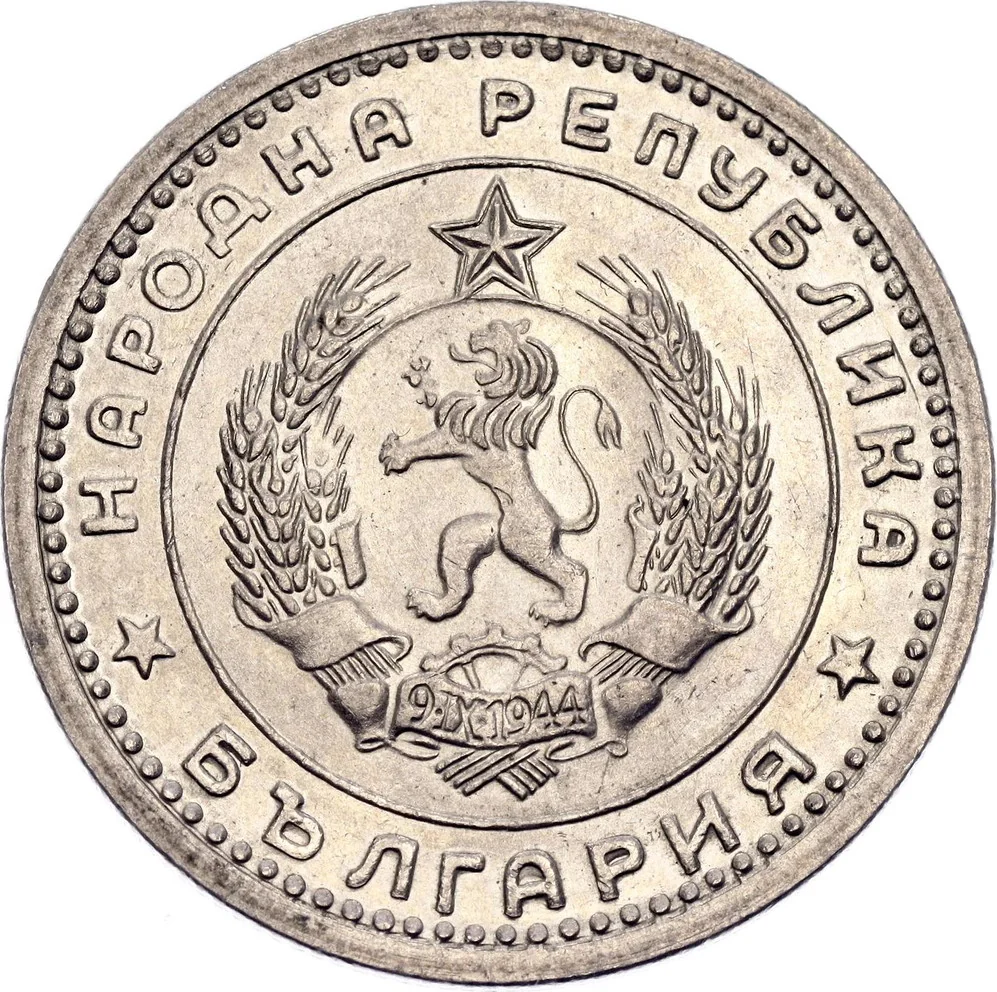
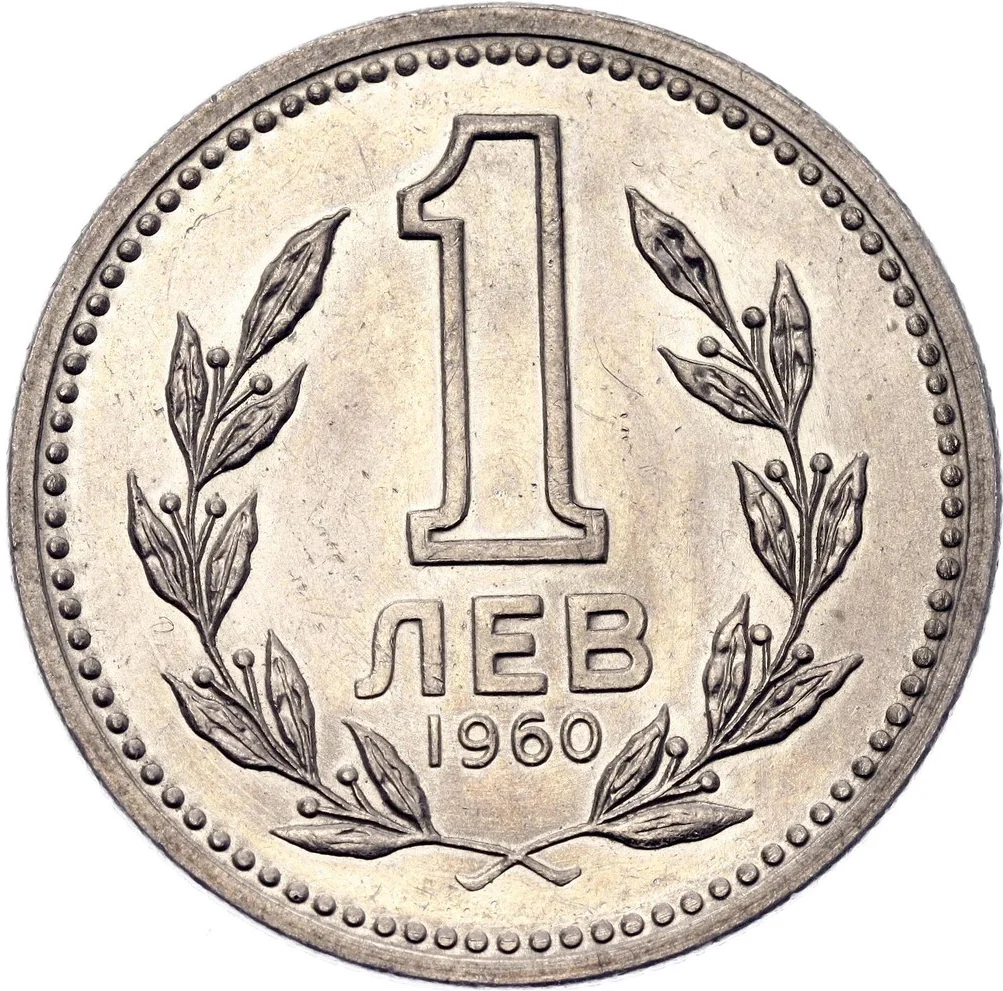
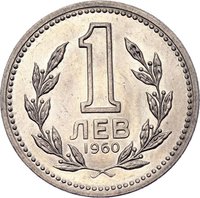
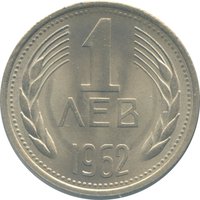
1 Lev – Bulgaria
Bulgaria
Context
Year: 1960
Issuer: Bulgaria 
Period: 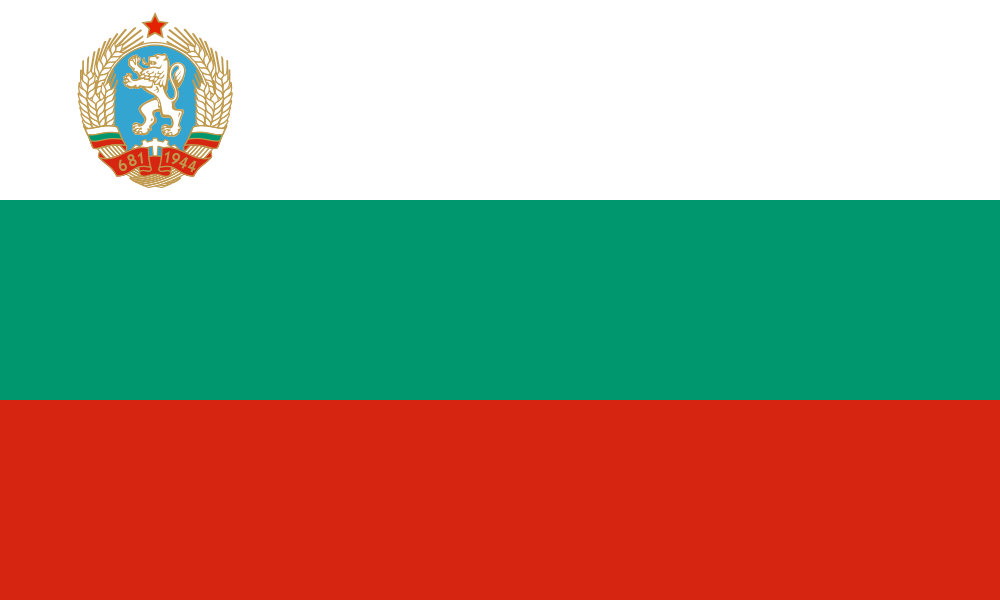
(1946—1990)
Currency:
(1952—1962)
Demonetization: 1 January 1962
Material
Diameter: 25 mm
Weight: 5.1 g
Thickness: 1.4 mm
Shape: Round
Composition: Copper-nickel
Technique: Milled
Alignment: Medal alignment
flip
References
KM: #Click to copy to clipboard57
Numista: #7778
Obverse
Reverse
Edge
Milled
Categories
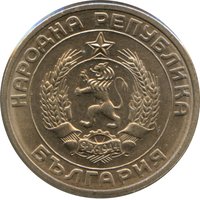
| Symbols> Coat of Arms |
| Symbol> Wreath |
Mints
| Name | Mark |
|---|---|
| Bulgarian Mint | — |
Mintings
| Year | Mint Mark | Mintage | Quality | Collection |
|---|---|---|---|---|
| 1960 | — | — |
Historical background
In 1960, Bulgaria operated under a strictly controlled, non-convertible currency system typical of the Soviet Bloc's centrally planned economies. The official currency was the Bulgarian Lev (BGN), which was pegged at a fixed, artificial exchange rate to the Soviet Ruble, the anchor currency of the Council for Mutual Economic Assistance (COMECON). This rate was set by the Bulgarian state and the Gosbank (the Soviet State Bank), divorcing the Lev's value from market forces and Western currencies. Internally, this system facilitated state planning and price controls, but it also masked economic inefficiencies and created a disconnect between the official economy and real purchasing power.
Internationally, the Lev was inconvertible, meaning it could not be freely exchanged for foreign hard currencies like the US Dollar or British Pound. All foreign trade was a state monopoly, conducted through a complex system of bilateral trade agreements and clearing accounts within COMECON. For limited transactions with Western nations, Bulgaria utilized a separate "foreign exchange lev" or hard currency reserves acquired through exports, but access for ordinary citizens was virtually non-existent. This created a pervasive black market for hard currency, where the US Dollar commanded a value many times higher than the official exchange rate, reflecting the lev's overvaluation and the scarcity of Western goods.
Domestically, the currency situation reinforced the state's total economic control. Wages and prices were set by central planners, and savings in lev were largely symbolic, as the availability of consumer goods was limited and subject to periodic shortages. The system prioritized funding for heavy industry and state projects over consumer needs. Consequently, while the official currency appeared stable on paper, the reality for Bulgarians in 1960 was an economy of queues, limited choices, and a hidden parallel economy where tangible goods and foreign currency held the real value.
Internationally, the Lev was inconvertible, meaning it could not be freely exchanged for foreign hard currencies like the US Dollar or British Pound. All foreign trade was a state monopoly, conducted through a complex system of bilateral trade agreements and clearing accounts within COMECON. For limited transactions with Western nations, Bulgaria utilized a separate "foreign exchange lev" or hard currency reserves acquired through exports, but access for ordinary citizens was virtually non-existent. This created a pervasive black market for hard currency, where the US Dollar commanded a value many times higher than the official exchange rate, reflecting the lev's overvaluation and the scarcity of Western goods.
Domestically, the currency situation reinforced the state's total economic control. Wages and prices were set by central planners, and savings in lev were largely symbolic, as the availability of consumer goods was limited and subject to periodic shortages. The system prioritized funding for heavy industry and state projects over consumer needs. Consequently, while the official currency appeared stable on paper, the reality for Bulgarians in 1960 was an economy of queues, limited choices, and a hidden parallel economy where tangible goods and foreign currency held the real value.
🌱 Common