

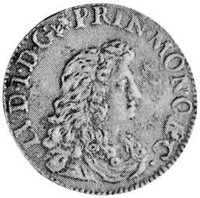
Obverse
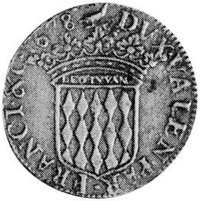
Reverse
Description:
Maltese cross with diamond corners.
Inscription:
CRVX HOSTIVM VICTRIX 1673
Script: Latin
Edge
Mints
| Name | Mark |
|---|---|
| Monaco | — |
Mintings
| Year | Mint Mark | Mintage | Quality | Collection |
|---|---|---|---|---|
| 1673 | — | — | ||
| 1683 | — | — | ||
| 1693 | — | — |
Historical background
In 1673, Monaco’s currency situation was intrinsically tied to its complex political and economic relationship with France. Though a sovereign principality under the rule of the Grimaldi family, Monaco existed within the French sphere of influence and was part of a patchwork of territories with varying monetary systems. The French livre was the dominant reference currency for major transactions and state finance, but in daily circulation, Monaco faced a chaotic mix of physical coinage. This included not only French coins but also Spanish pistoles, Italian scudi, and other regional currencies brought by trade across the Mediterranean, leading to constant challenges of valuation and exchange.
This monetary plurality was a direct result of Monaco’s role as a small, strategic port. Its economy relied on trade, tolls from the Corniche road, and limited agriculture, attracting merchants and travelers who paid in a variety of specie. Prince Louis I, who ruled from 1662 to 1701, did not mint a distinct, sovereign Monegasque currency at this time. Instead, the principality’s monetary policy was largely reactive, focused on regulating the rates at which these foreign coins could be used locally through official tariffs, attempting to bring order to the marketplace and secure seigniorage revenue for the princely treasury.
The year 1673 falls within a period of increasing French pressure and integration. While full monetary union was still over a century away, French economic dominance was steadily growing. The circulation of French currency was actively encouraged, and monetary ordinances from Paris increasingly influenced local policy. Thus, the background of Monaco’s currency in 1673 is one of transition and dependency: a sovereign entity navigating a de facto multi-currency system, while its monetary autonomy gradually eroded in favor of the French crown’s expanding control, setting the stage for future formal absorption into the French monetary zone.
This monetary plurality was a direct result of Monaco’s role as a small, strategic port. Its economy relied on trade, tolls from the Corniche road, and limited agriculture, attracting merchants and travelers who paid in a variety of specie. Prince Louis I, who ruled from 1662 to 1701, did not mint a distinct, sovereign Monegasque currency at this time. Instead, the principality’s monetary policy was largely reactive, focused on regulating the rates at which these foreign coins could be used locally through official tariffs, attempting to bring order to the marketplace and secure seigniorage revenue for the princely treasury.
The year 1673 falls within a period of increasing French pressure and integration. While full monetary union was still over a century away, French economic dominance was steadily growing. The circulation of French currency was actively encouraged, and monetary ordinances from Paris increasingly influenced local policy. Thus, the background of Monaco’s currency in 1673 is one of transition and dependency: a sovereign entity navigating a de facto multi-currency system, while its monetary autonomy gradually eroded in favor of the French crown’s expanding control, setting the stage for future formal absorption into the French monetary zone.
✨ Legendary