

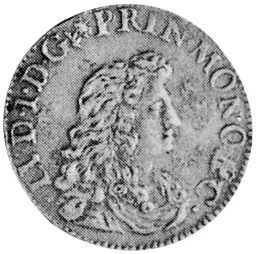
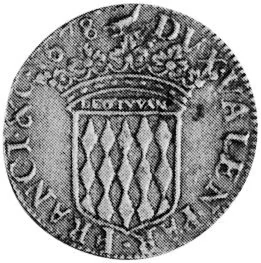
1⁄12 Ecu – Monaco
Monaco

Obverse
Description:
Bust of Louis I, right-facing.
Inscription:
· LDV· I · D · G · · PRIN · MONOEC ·
Script: Latin
Reverse
Description:
Crowned flat-top shield with five diamonds.
Inscription:
· DVX · VALEN · PAR · FRANCI · &c · 1678
Script: Latin
Edge
Plain
Categories
| Symbol> Fleur-de-lis |
| Person> Monarch |
| Symbol> Crown |
| Symbols> Coat of Arms |
Mints
| Name | Mark |
|---|---|
| Monaco | — |
Mintings
| Year | Mint Mark | Mintage | Quality | Collection |
|---|---|---|---|---|
| 1674 | q | — | ||
| 1678 | d | — | ||
| 1681 | cm/sr | — |
Historical background
In 1674, Monaco’s currency situation was intrinsically tied to its political and economic relationship with France. Though a sovereign principality, Monaco operated within the powerful monetary orbit of its much larger neighbor. The official legal tender in circulation was predominantly French, specifically the Louis d'or gold coin and the écu silver coin, following the monetary reforms of King Louis XIV. The Principality, lacking its own mint, effectively outsourced its currency system to France, which provided monetary stability but also underscored Monaco’s economic dependency.
This reliance was formalized through treaties and practical necessity. The 1641 Treaty of Péronne, which placed Monaco under French protection, had cemented close economic ties. For daily commerce in Monaco-Ville and La Condamine, transactions were conducted in French livre tournois, sous, and deniers. The acceptance and prevalence of French coinage facilitated trade with neighboring Provence and the wider French market, which was essential for the small state's supply of goods and its economic survival. Counterfeit or debased coins from elsewhere in Europe were a constant concern, as they were across the continent.
Despite the French dominance, the period was not without monetary experimentation. Prince Louis I, who ruled from 1662 to 1701, is known to have authorized the striking of a small number of Monégasque copper coins, the denier and double, around this era. However, these were tokens of sovereignty rather than a serious challenge to the French monetary system. They served for small, local change and as symbolic assertions of princely authority, but they did not displace the French gold and silver that formed the bedrock of higher-value trade and state finance in 1674 Monaco.
This reliance was formalized through treaties and practical necessity. The 1641 Treaty of Péronne, which placed Monaco under French protection, had cemented close economic ties. For daily commerce in Monaco-Ville and La Condamine, transactions were conducted in French livre tournois, sous, and deniers. The acceptance and prevalence of French coinage facilitated trade with neighboring Provence and the wider French market, which was essential for the small state's supply of goods and its economic survival. Counterfeit or debased coins from elsewhere in Europe were a constant concern, as they were across the continent.
Despite the French dominance, the period was not without monetary experimentation. Prince Louis I, who ruled from 1662 to 1701, is known to have authorized the striking of a small number of Monégasque copper coins, the denier and double, around this era. However, these were tokens of sovereignty rather than a serious challenge to the French monetary system. They served for small, local change and as symbolic assertions of princely authority, but they did not displace the French gold and silver that formed the bedrock of higher-value trade and state finance in 1674 Monaco.

✨ Legendary