

1 Sol – Bolivia
Circulating commemorative coins
Commemoration: Potosino people to Belzú
Series: Belzú monetary medals
Bolivia

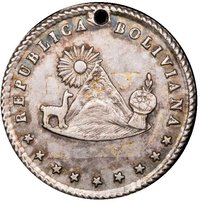
Obverse
Description:
Potosí town landscape with sun above, location below.
Inscription:
EL PUEBLO
POTOSINO
POTOSINO
Script: Latin
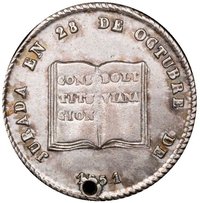
Reverse
Edge
Reeded.
Categories
| Person> Military leader |
| Person> Politician |
| Geography> Town |
| Symbol> Sun |
Mints
| Name | Mark |
|---|---|
| Potosi | — |
Mintings
| Year | Mint Mark | Mintage | Quality | Collection |
|---|---|---|---|---|
| 1852 | — | — |
Historical background
In 1852, Bolivia's currency situation was characterized by severe scarcity and instability, a direct legacy of the economic devastation following the War of the Pacific (1879-1883) and earlier internal conflicts. The nation's silver mines, historically the source of its wealth and the backbone of its currency, were in a state of decline, reducing the domestic production of precious metal for coinage. This scarcity was compounded by the widespread circulation of a chaotic mix of foreign coins—primarily Peruvian and Chilean pesos, Bolivian coins from various mintings, and even counterfeits—which undermined any uniform monetary standard and hindered commerce.
The government, under General Manuel Isidoro Belzu, struggled to assert control. The state mint, the Casa de la Moneda in Potosí, could not produce enough coinage to meet demand, leading to a reliance on private mints and imported coins. This period saw the official use of the Boliviano, subdivided into 100 centavos, but its value and acceptance were inconsistent. The lack of a strong, centralized banking system further exacerbated the problem, as there was no institution to regulate supply or provide credit to stimulate the crippled economy.
Consequently, the monetary landscape was one of confusion and localized valuation, where the worth of coins depended heavily on their metal content, origin, and the discretion of local merchants. This instability acted as a significant drag on economic recovery and national integration, discouraging investment and complicating tax collection for the state. The currency woes of 1852 were a symptomatic reflection of Bolivia's broader post-war challenges: depleted resources, political turbulence, and the difficult task of rebuilding a fractured national economy.
The government, under General Manuel Isidoro Belzu, struggled to assert control. The state mint, the Casa de la Moneda in Potosí, could not produce enough coinage to meet demand, leading to a reliance on private mints and imported coins. This period saw the official use of the Boliviano, subdivided into 100 centavos, but its value and acceptance were inconsistent. The lack of a strong, centralized banking system further exacerbated the problem, as there was no institution to regulate supply or provide credit to stimulate the crippled economy.
Consequently, the monetary landscape was one of confusion and localized valuation, where the worth of coins depended heavily on their metal content, origin, and the discretion of local merchants. This instability acted as a significant drag on economic recovery and national integration, discouraging investment and complicating tax collection for the state. The currency woes of 1852 were a symptomatic reflection of Bolivia's broader post-war challenges: depleted resources, political turbulence, and the difficult task of rebuilding a fractured national economy.

✨ Legendary