

1 Ducat – Austrian Empire
Austria
Context
Years: 1780–1782
Country: Austria 
Issuer: Austrian Empire
Ruler: Joseph II
Currency:
(1754—1857)
Demonetized: Yes
Material
References
KM: #Click to copy to clipboard1872
Numista: #266172
Value
Bullion value: $573.74
Obverse
Description:
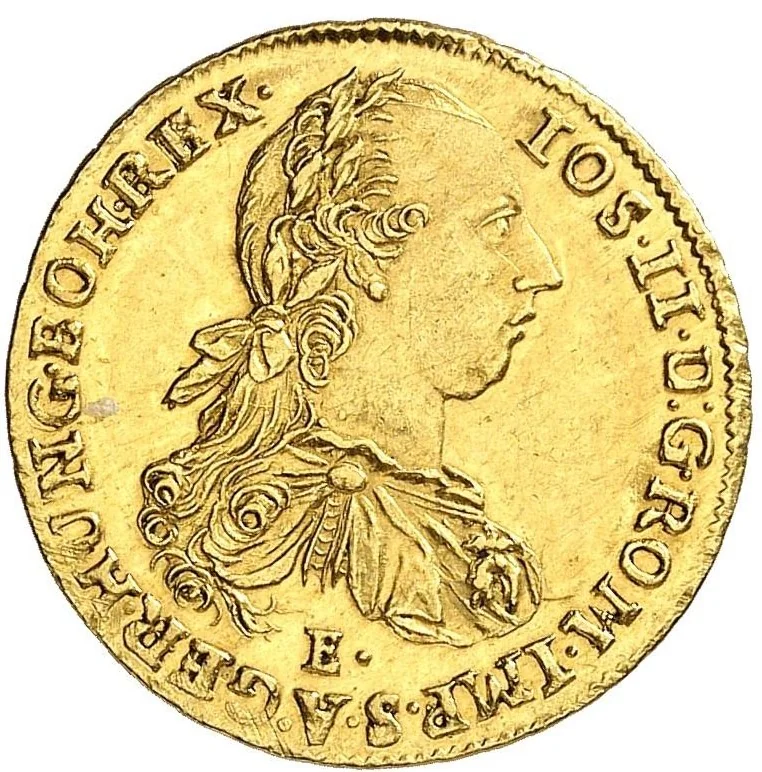
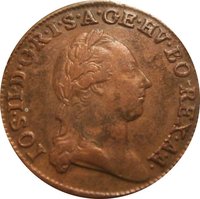
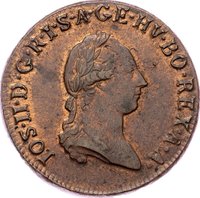
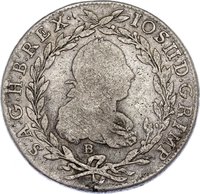
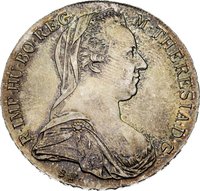
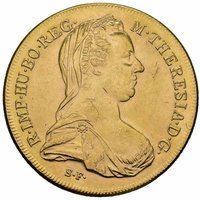
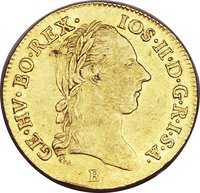
Laureate bust right, draped shoulder. Legend around, mint mark below.
Inscription:
IOS II D G ROM IMP S A GER HUNG BOH REX
E.
E.
Script: Latin
Reverse
Description:
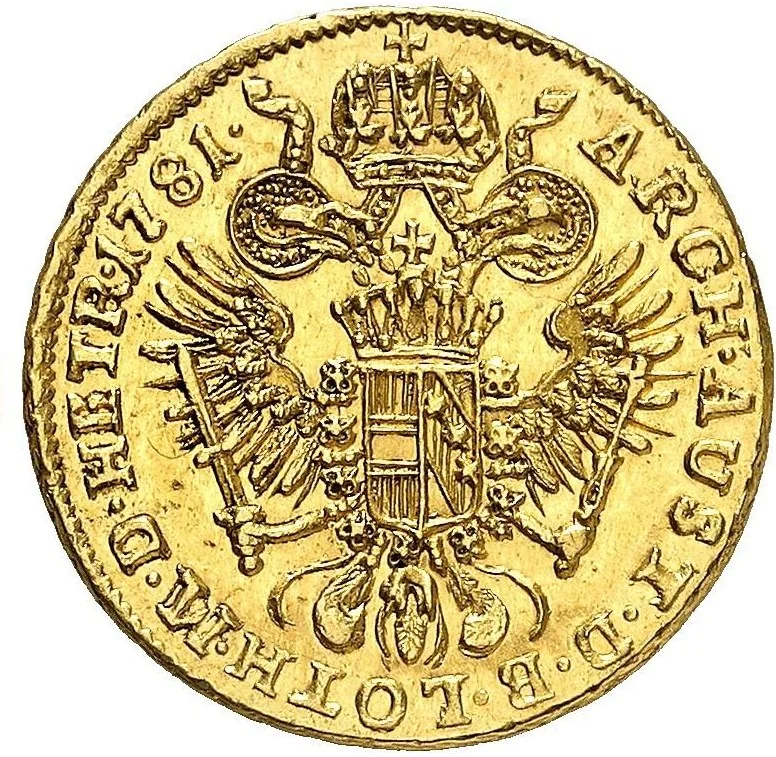
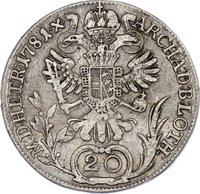
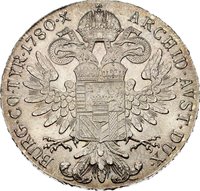
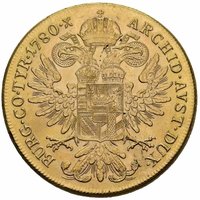
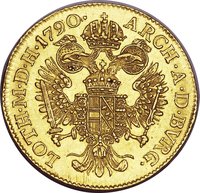
Imperial double-headed eagle with the Austrian-Lorraine shield on its breast, encircled by the Golden Fleece chain. Legend surrounds, ending with the date.
Inscription:
ARCH AUST D B LOTH M D HETR 1781
Script: Latin
Edge
Plain
Categories
| Symbol> Crown |
| Symbols> Coat of Arms |
| Symbol> Double-headed eagle |
Mints
| Name | Mark |
|---|---|
| Münze Österreich | A |
| Alba Iulia | E |
| Baia Mare | G |
Historical background
In 1780, the currency situation within the Habsburg Monarchy, often referred to as the Austrian Empire, was characterized by profound complexity and instability, a legacy of the costly Seven Years' War (1756-1763) and the ongoing reforms of Empress Maria Theresa. The state treasury was depleted, and the government relied heavily on debt financing and the debasement of coinage to meet its obligations. The monetary system was not unified; it operated on a bimetallic standard of silver Gulden (florins) and gold Ducats, but a plethora of regional and historical coins circulated alongside them, their values fluctuating across the empire's diverse lands, from Austria and Bohemia to Hungary and the Austrian Netherlands.
The primary response to this fiscal crisis was the continued issuance of paper money, known as Bancozettel, from the state-owned Wiener Stadtbanco. First introduced in 1762 to fund the war, these banknotes were not fully convertible to specie (hard coin) and their value began to depreciate against silver shortly after their creation. By 1780, a growing gap existed between the face value of the paper currency and its actual market worth, creating a dual system where goods often had two prices—one in silver and a higher one in paper. This erosion of trust in the paper money sowed confusion in commerce and placed a burden on the populace, particularly those on fixed incomes.
Empress Maria Theresa's death in 1780 marked a transition, but the structural monetary problems persisted for her successor, Joseph II. The underlying issue was a fiscal policy that used currency emission as a tool for state financing rather than backing it with sufficient precious metals or economic productivity. Consequently, the stage was set for the further depreciation of the Bancozettel in the coming decades, a process that would culminate in a major currency crisis and state bankruptcy in 1811. The situation in 1780 was thus a precarious and unsustainable equilibrium, representing the early phase of a chronic paper money inflation that would plague the empire for nearly half a century.
The primary response to this fiscal crisis was the continued issuance of paper money, known as Bancozettel, from the state-owned Wiener Stadtbanco. First introduced in 1762 to fund the war, these banknotes were not fully convertible to specie (hard coin) and their value began to depreciate against silver shortly after their creation. By 1780, a growing gap existed between the face value of the paper currency and its actual market worth, creating a dual system where goods often had two prices—one in silver and a higher one in paper. This erosion of trust in the paper money sowed confusion in commerce and placed a burden on the populace, particularly those on fixed incomes.
Empress Maria Theresa's death in 1780 marked a transition, but the structural monetary problems persisted for her successor, Joseph II. The underlying issue was a fiscal policy that used currency emission as a tool for state financing rather than backing it with sufficient precious metals or economic productivity. Consequently, the stage was set for the further depreciation of the Bancozettel in the coming decades, a process that would culminate in a major currency crisis and state bankruptcy in 1811. The situation in 1780 was thus a precarious and unsustainable equilibrium, representing the early phase of a chronic paper money inflation that would plague the empire for nearly half a century.
✨ Legendary