

4 Ducats – Austrian Empire
Austria
Context
Years: 1778–1779
Country: Austria 
Issuer: Austrian Empire
Ruler: Maria Theresa
Currency:
(1754—1857)
Demonetized: Yes
Material
References
KM: #Click to copy to clipboard1871
Numista: #159507
Value
Bullion value: $2301.01
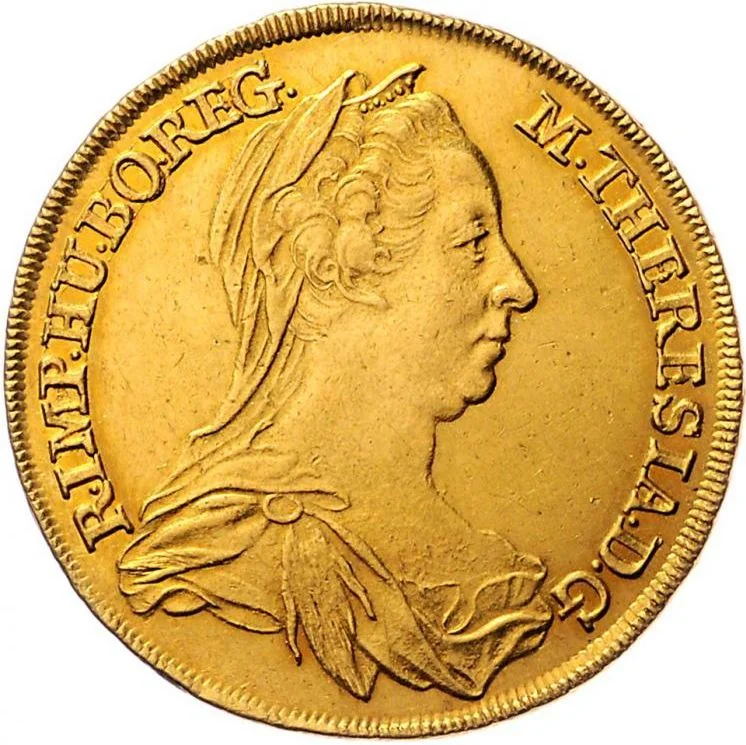
Obverse
Description:
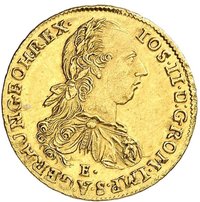
Veiled portrait. Legend begins at 2 o'clock.
Inscription:
M THERESIA D G // R IMP HU BO REG
Script: Latin
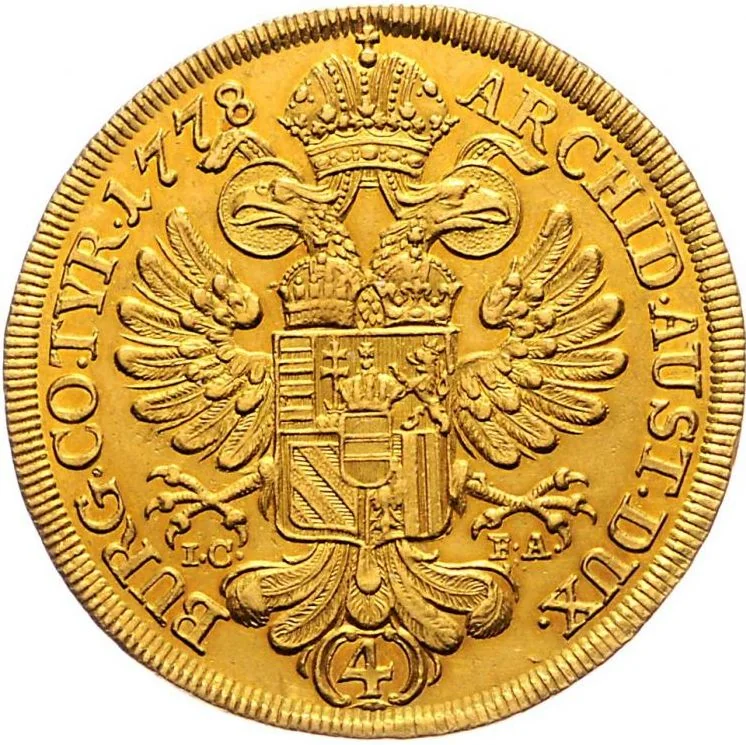
Reverse
Description:
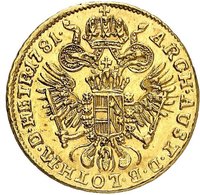
Imperial double-headed eagle with central Austrian arms, topped by Hungary's patriarchal cross and Bohemia's lion, below ancient Burgundy and Tyrol. Value between tail feathers; mint marks flank the tail.
Inscription:
ARCHID AUST DUX (4) BURG CO TYR 1778
ICFA
ICFA
Script: Latin
Edge
Mints
| Name | Mark |
|---|---|
| Münze Österreich | — |
Mintings
| Year | Mint Mark | Mintage | Quality | Collection |
|---|---|---|---|---|
| 1778 | ICFA | — | ||
| 1779 | ICFA | — |
Historical background
In 1778, the currency system of the Habsburg Monarchy was a complex and fragile patchwork, still reeling from the financial strain of the Seven Years' War (1756-1763). The state's primary revenue was insufficient to cover its military and administrative costs, leading to chronic budget deficits. To bridge this gap, the government repeatedly resorted to debasing the coinage—reducing the precious metal content in coins while maintaining their face value—and issuing vast quantities of paper money known as Bancozettel from the state-owned Vienna City Bank. This created a dangerous duality: a silver-based Konventionsmünze for large transactions and international trade, and a rapidly depreciating paper currency for daily use.
The immediate context of 1778 was the War of the Bavarian Succession (1778-1779), a conflict with Prussia over the inheritance of Bavaria. This short but costly war, often called the "Potato War," placed further immense strain on state finances. To fund the military mobilization, the Habsburg state, under Empress Maria Theresa and her co-regent Joseph II, was forced to accelerate the printing of Bancozettel, leading to a sharp decline in their value against silver. This inflation eroded public confidence and caused significant economic dislocation, particularly for those on fixed incomes and soldiers whose pay was in the depreciating paper notes.
Consequently, 1778 represents a critical point of escalating monetary crisis within a longer period of financial instability. The government's reliance on the printing press to finance war expenditure set a dangerous precedent that would worsen in the coming decades. While Maria Theresa and her advisors, notably Count Friedrich Wilhelm von Haugwitz, had implemented important fiscal and administrative reforms earlier in her reign, the pressures of war in 1778 overwhelmed these structures. The situation underscored the monarchy's fundamental need for deeper fiscal reform, a challenge that would remain unresolved and ultimately contribute to the severe hyperinflation of the Bancozettel during the Napoleonic Wars.
The immediate context of 1778 was the War of the Bavarian Succession (1778-1779), a conflict with Prussia over the inheritance of Bavaria. This short but costly war, often called the "Potato War," placed further immense strain on state finances. To fund the military mobilization, the Habsburg state, under Empress Maria Theresa and her co-regent Joseph II, was forced to accelerate the printing of Bancozettel, leading to a sharp decline in their value against silver. This inflation eroded public confidence and caused significant economic dislocation, particularly for those on fixed incomes and soldiers whose pay was in the depreciating paper notes.
Consequently, 1778 represents a critical point of escalating monetary crisis within a longer period of financial instability. The government's reliance on the printing press to finance war expenditure set a dangerous precedent that would worsen in the coming decades. While Maria Theresa and her advisors, notably Count Friedrich Wilhelm von Haugwitz, had implemented important fiscal and administrative reforms earlier in her reign, the pressures of war in 1778 overwhelmed these structures. The situation underscored the monarchy's fundamental need for deeper fiscal reform, a challenge that would remain unresolved and ultimately contribute to the severe hyperinflation of the Bancozettel during the Napoleonic Wars.
✨ Legendary