

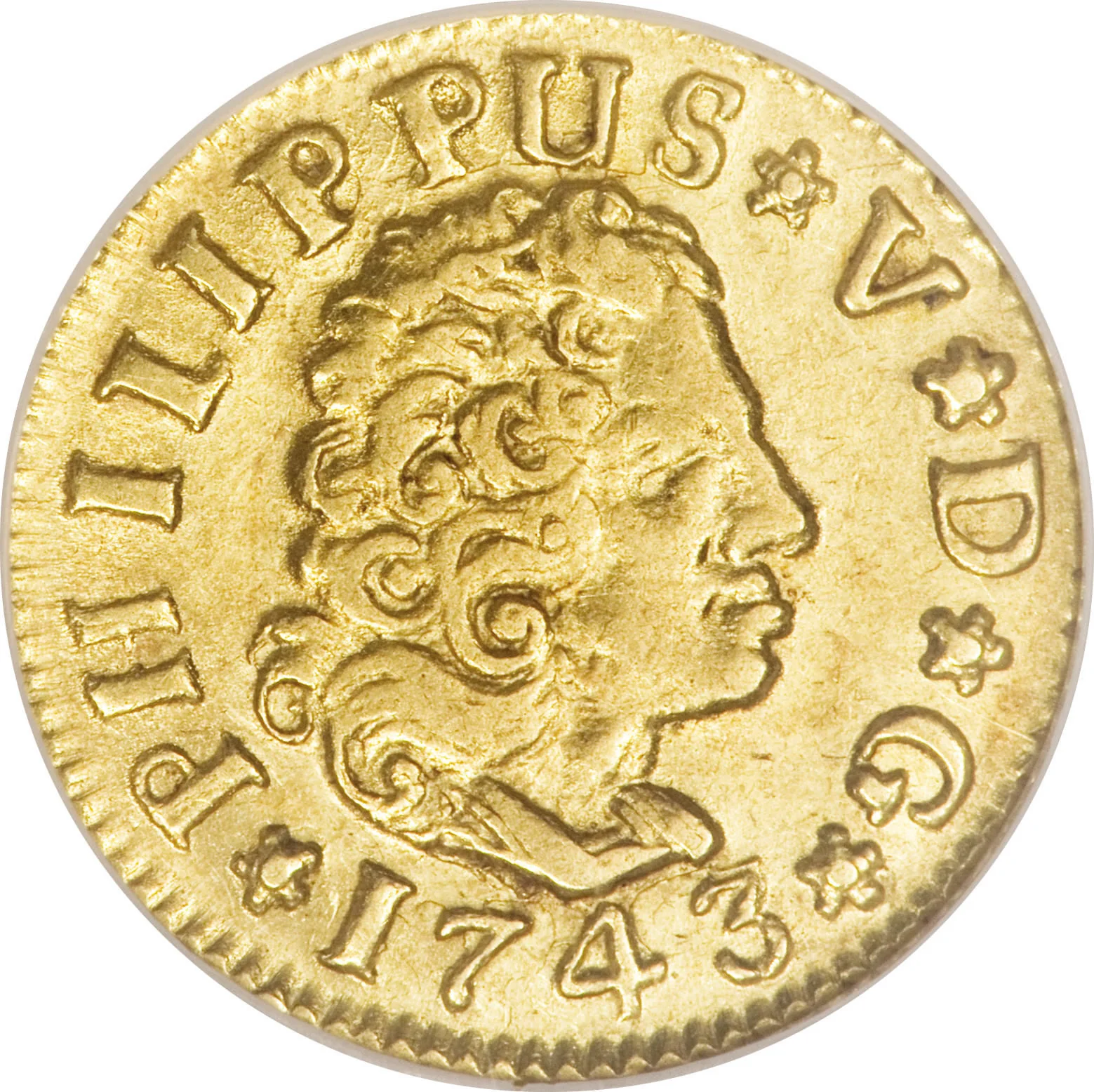
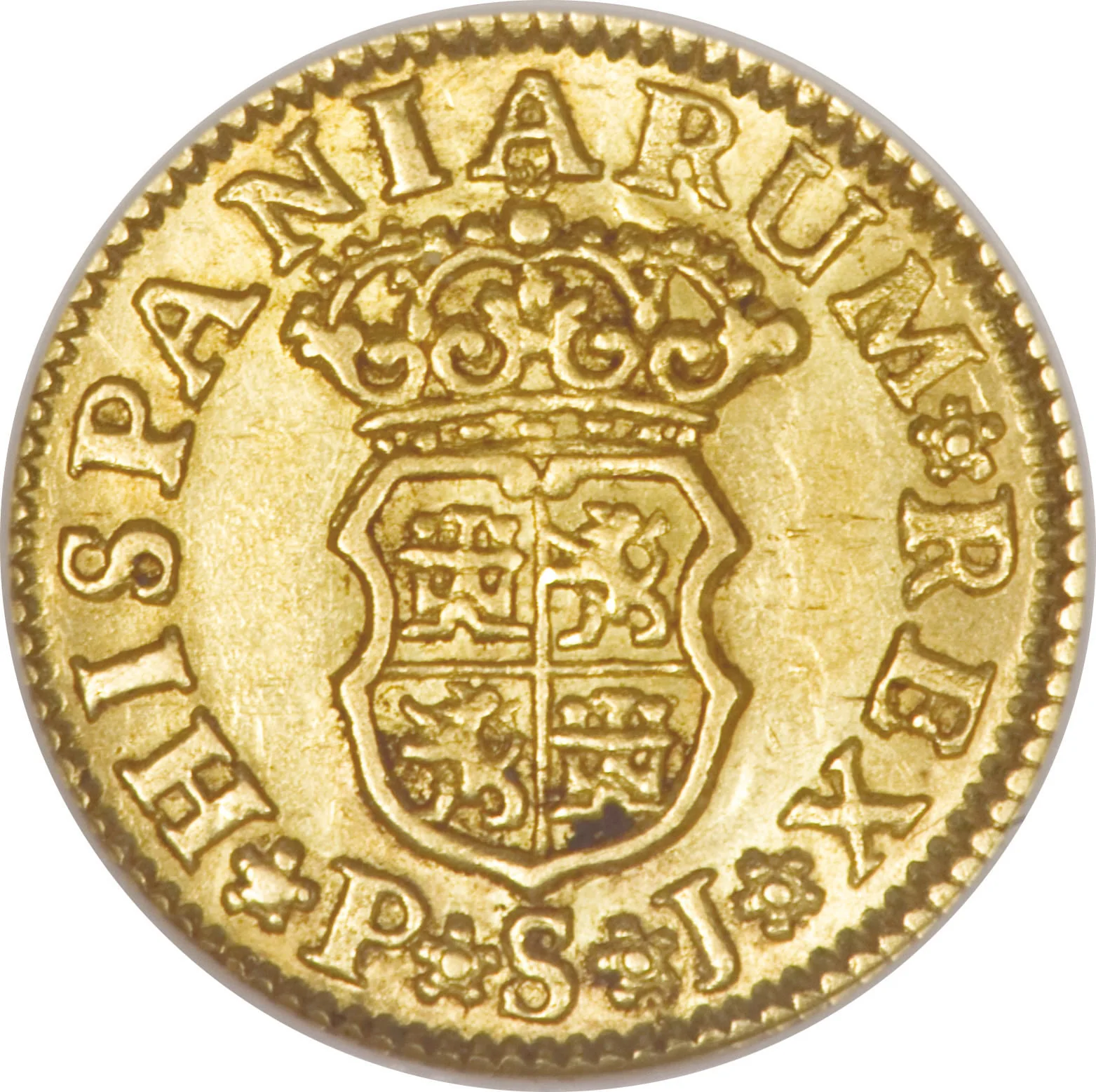
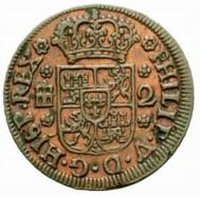
Obverse
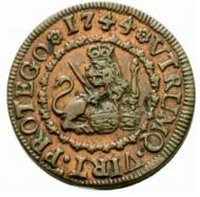
Reverse
Edge
Categories
| Symbols> Coat of Arms |
Mints
| Name | Mark |
|---|---|
| Royal Mint of Madrid | (M) |
| Royal Mint of Seville | S |
Mintings
| Year | Mint Mark | Mintage | Quality | Collection |
|---|---|---|---|---|
| 1742 | MJF | — | ||
| 1742 | SJP | — | ||
| 1742 | SPJ | — | ||
| 1743 | MJF | 228,480 | ||
| 1743 | SPJ | — | ||
| 1744 | MAJ | 297,416 | ||
| 1744 | MJF | — | ||
| 1744 | SPJ | — | ||
| 1745 | MAJ | 185,395 | ||
| 1745 | SPJ | — | ||
| 1746 | MAJ | 54,835 | ||
| 1746 | SPJ | — |
Historical background
In 1742, Spain operated under a complex and strained monetary system, a legacy of the Habsburg era that was proving difficult to reform. The primary unit of account was the silver real, with 8 reales making a peso or "piece of eight," and 20 reales constituting a gold escudo. However, the reality in circulation was a chaotic mix of domestic and foreign coins, including clipped and debased Spanish pieces alongside prolific Portuguese, French, and Spanish-American coins of varying purity. This fragmentation severely hampered trade and state finance, as the intrinsic value of coins often differed from their nominal face value.
The root of the instability lay in chronic state deficit financing, particularly under King Philip V during the War of the Austrian Succession (1740-1748). To raise funds, the crown repeatedly resorted to debasement—reducing the silver content in coins—and the issuance of vellón, a base metal coinage of copper or billon. These cheaply minted vellón coins were declared legal tender at artificially high values, leading to Gresham's Law in action: "bad money drives out good." Hoarders and international traders saved full-weight silver and gold, removing it from the domestic economy, while an inflationary flood of low-value copper overwhelmed local markets, causing hardship for the populace.
Despite the chaos, 1742 fell within a period of attempted Bourbon reform. Following the model of France, officials like José del Campillo were advocating for a centralized, national currency to replace the disparate provincial mints and to stabilize the relationship between gold and silver. While major reforms, such as the creation of a unified mint and the decimal-based real de vellón, would be implemented later in the 1740s and 1750s, the monetary situation in 1742 was one of profound disorder, characterized by inflation, confusion, and a pressing need for the modernization that the Bourbon dynasty sought to impose.
The root of the instability lay in chronic state deficit financing, particularly under King Philip V during the War of the Austrian Succession (1740-1748). To raise funds, the crown repeatedly resorted to debasement—reducing the silver content in coins—and the issuance of vellón, a base metal coinage of copper or billon. These cheaply minted vellón coins were declared legal tender at artificially high values, leading to Gresham's Law in action: "bad money drives out good." Hoarders and international traders saved full-weight silver and gold, removing it from the domestic economy, while an inflationary flood of low-value copper overwhelmed local markets, causing hardship for the populace.
Despite the chaos, 1742 fell within a period of attempted Bourbon reform. Following the model of France, officials like José del Campillo were advocating for a centralized, national currency to replace the disparate provincial mints and to stabilize the relationship between gold and silver. While major reforms, such as the creation of a unified mint and the decimal-based real de vellón, would be implemented later in the 1740s and 1750s, the monetary situation in 1742 was one of profound disorder, characterized by inflation, confusion, and a pressing need for the modernization that the Bourbon dynasty sought to impose.
💎 Very Rare