

2 maravedis – Spain
Add to wishlist
Spain
Material
References
KM: #
Numista: #27537
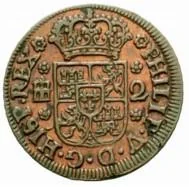
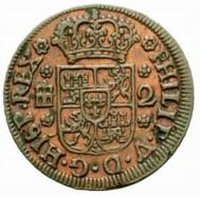
Obverse
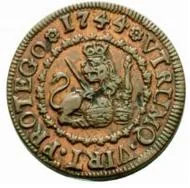
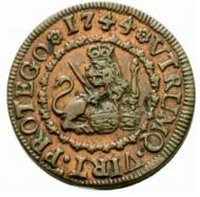
Reverse
Description:
Crowned lion holding a scepter and saber, with two globes at its feet.
Inscription:
VTRVMQ · VIRT · PROTEGO
❀ 1744 ❀
❀ 1744 ❀
Script: Latin
Edge
Mints
| Name | Mark |
|---|---|
| Royal Mint of Segovia | — |
Mintings
| Year | Mint Mark | Mintage | Quality | Collection |
|---|---|---|---|---|
| 1744 | — | — | ||
| 1745 | — | — | ||
| 1746 | — | — |
Historical background
In 1744, Spain operated under a complex and strained monetary system, a legacy of the Habsburg era that was proving difficult to reform. The primary unit of account was the real, with 8 reales making a peso or "piece of eight," and 20 reales constituting a scudo. However, the physical currency in circulation was a chaotic mix of domestic and foreign coins, including Spanish-minted silver reales and gold escudos, but also vast quantities of Portuguese, French, and Spanish-American coins of varying weight and purity. This proliferation of different values, alongside widespread clipping and counterfeiting, created chronic confusion in trade and public finance.
The situation was exacerbated by the financial demands of the War of the Austrian Succession (1740-1748), in which Spain was a key participant. King Philip V's government, continuing the Bourbon dynasty's efforts to centralize power, faced immense pressure to fund military campaigns. This led to repeated debasements of the coinage—reducing the precious metal content—to generate short-term revenue. These actions eroded public trust in the currency, drove good-quality coin out of circulation (Gresham's Law), and contributed to inflation, particularly in vital frontier regions like Catalonia where troop concentrations were high.
Despite these pressures, 1744 fell within a period of attempted stabilization under the ministers of Philip V (who died that July) and his successor Ferdinand VI. Efforts were being made to reassert royal control over the mints, standardize valuations, and curb the flood of foreign coin. However, the fundamental structural problems—a lack of uniform national currency, the crown's dependence on American silver shipments (which were fluctuating), and the weight of wartime debt—meant that true monetary stability remained elusive. The currency situation of 1744 thus reflects a kingdom caught between imperial legacy, geopolitical ambition, and the arduous early stages of Bourbon economic modernization.
The situation was exacerbated by the financial demands of the War of the Austrian Succession (1740-1748), in which Spain was a key participant. King Philip V's government, continuing the Bourbon dynasty's efforts to centralize power, faced immense pressure to fund military campaigns. This led to repeated debasements of the coinage—reducing the precious metal content—to generate short-term revenue. These actions eroded public trust in the currency, drove good-quality coin out of circulation (Gresham's Law), and contributed to inflation, particularly in vital frontier regions like Catalonia where troop concentrations were high.
Despite these pressures, 1744 fell within a period of attempted stabilization under the ministers of Philip V (who died that July) and his successor Ferdinand VI. Efforts were being made to reassert royal control over the mints, standardize valuations, and curb the flood of foreign coin. However, the fundamental structural problems—a lack of uniform national currency, the crown's dependence on American silver shipments (which were fluctuating), and the weight of wartime debt—meant that true monetary stability remained elusive. The currency situation of 1744 thus reflects a kingdom caught between imperial legacy, geopolitical ambition, and the arduous early stages of Bourbon economic modernization.

🌟 Uncommon