

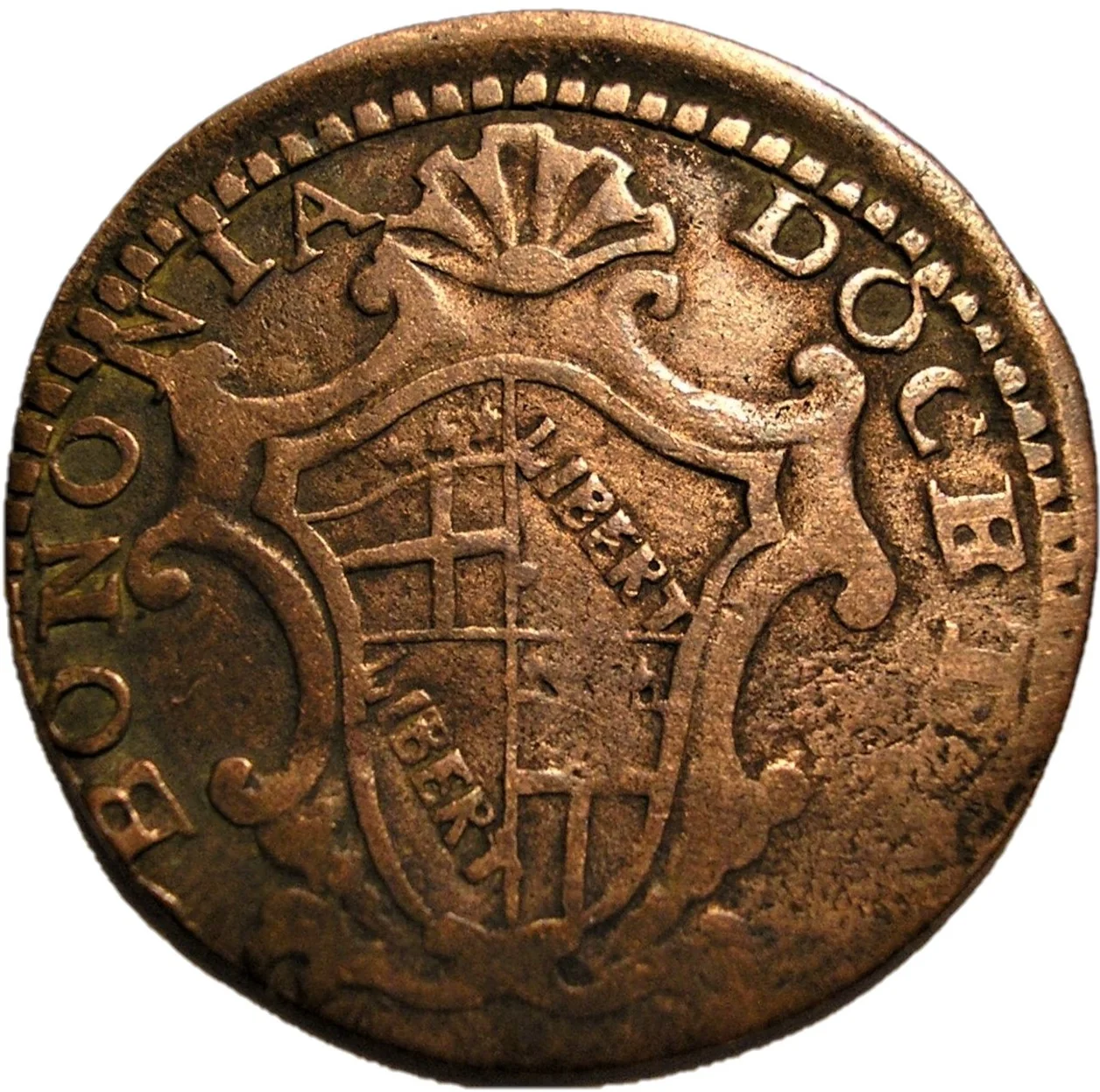
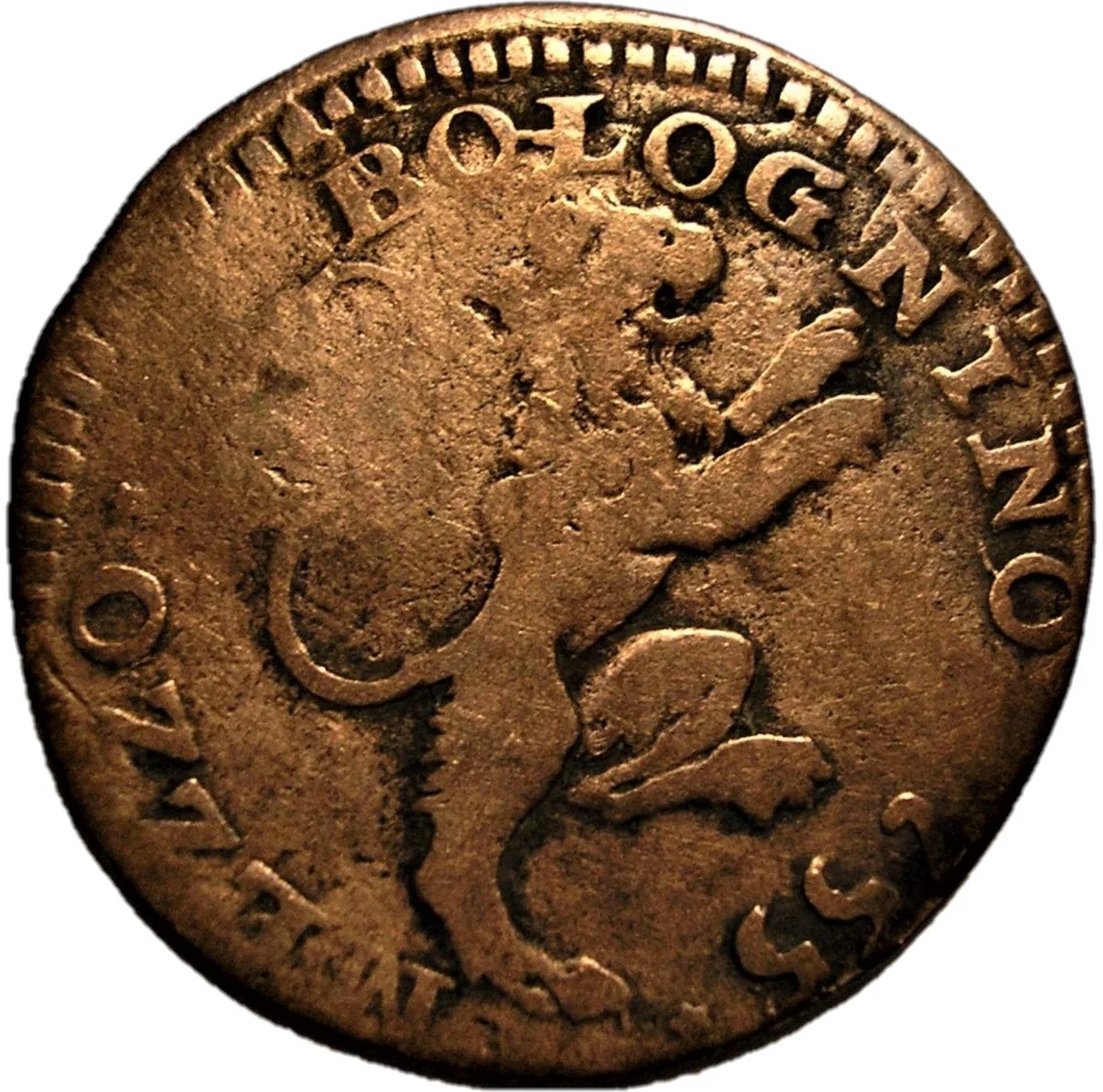
½ Bolognino – Bologna
Italy
Context
Years: 1740–1756
Country: Italy 
Issuer: Bologna
Ruler: Benedict XIV
Currency:
(1534—1835)
Demonetized: Yes
Material
References
KM: #Click to copy to clipboard220
Numista: #257956
Obverse
Reverse
Description:
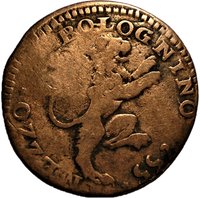
Rampant lion facing right, with legend encircling and date beneath its paw.
Inscription:
MEZZO ★ BOLOGNINO 1755 ★
Script: Latin
Edge
Plain
Mints
| Name | Mark |
|---|---|
| Bologna | — |
Mintings
| Year | Mint Mark | Mintage | Quality | Collection |
|---|---|---|---|---|
| 1740 | — | — | ||
| 1741 | — | — | ||
| 1742 | — | — | ||
| 1743 | — | — | ||
| 1744 | — | — | ||
| 1745 | — | — | ||
| 1747 | — | — | ||
| 1753 | — | — | ||
| 1755 | — | — | ||
| 1756 | — | — |
Historical background
In 1740, Bologna operated within the complex monetary landscape of the Papal States, to which it belonged. The city did not mint its own coinage; instead, its currency system was dominated by the papal scudo, a silver coin that served as the primary unit of account for larger transactions and state finances. However, daily commerce was conducted using a bewildering variety of physical coins, including local papal issues like baiocchi and giuli, as well as a significant influx of foreign silver from neighboring states such as the Republic of Venice, the Duchy of Modena, and the Grand Duchy of Tuscany. This proliferation created constant challenges of valuation and exchange.
The monetary situation was further strained by a chronic shortage of small-denomination coinage, essential for everyday market purchases. This scarcity often forced merchants and citizens to accept clipped or debased coins at discounted rates, leading to frequent disputes and economic friction. Moreover, the value of coins was not strictly tied to their face value but to their metallic content and weight, requiring money-changers (banchi di cambio) to play a central role in the city's economic life, assessing and exchanging this heterogeneous mix of specie for a fee.
Politically, monetary policy was controlled by the papal authorities in Rome, leaving Bologna with little direct autonomy to address its local currency woes. The year 1740 itself was one of particular instability, as it marked the death of Pope Clement XII and the subsequent conclave that elected Pope Benedict XIV, a native Bolognese. While this raised hopes for reform, the immediate effect was a period of administrative uncertainty that exacerbated the existing monetary confusion, highlighting the tension between Bologna's practical economic needs and its subordinate position within the Papal State's rigid fiscal framework.
The monetary situation was further strained by a chronic shortage of small-denomination coinage, essential for everyday market purchases. This scarcity often forced merchants and citizens to accept clipped or debased coins at discounted rates, leading to frequent disputes and economic friction. Moreover, the value of coins was not strictly tied to their face value but to their metallic content and weight, requiring money-changers (banchi di cambio) to play a central role in the city's economic life, assessing and exchanging this heterogeneous mix of specie for a fee.
Politically, monetary policy was controlled by the papal authorities in Rome, leaving Bologna with little direct autonomy to address its local currency woes. The year 1740 itself was one of particular instability, as it marked the death of Pope Clement XII and the subsequent conclave that elected Pope Benedict XIV, a native Bolognese. While this raised hopes for reform, the immediate effect was a period of administrative uncertainty that exacerbated the existing monetary confusion, highlighting the tension between Bologna's practical economic needs and its subordinate position within the Papal State's rigid fiscal framework.
✨ Legendary