

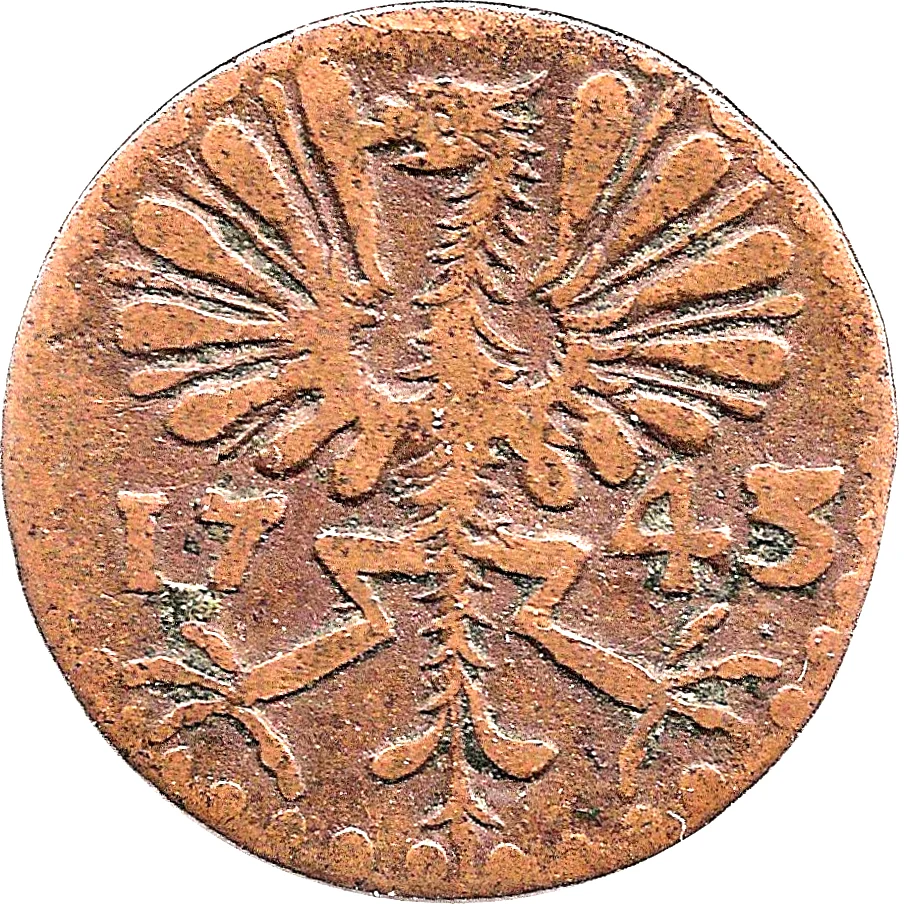

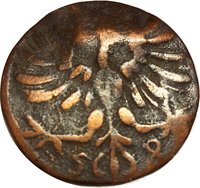
Obverse
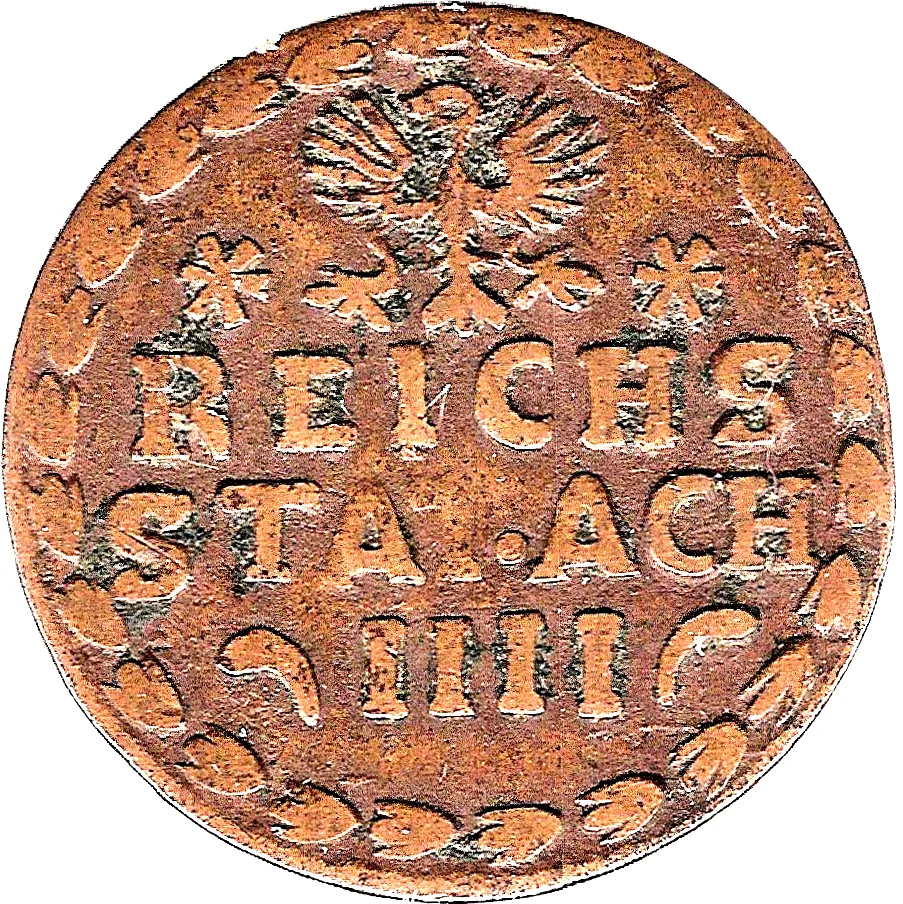
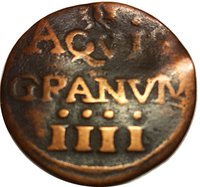
Reverse
Edge
Mintings
| Year | Mint Mark | Mintage | Quality | Collection |
|---|---|---|---|---|
| 1670 | — | 150,000 | ||
| 1671 | — | 80,000 | ||
| 1674 | — | — | ||
| 1676 | — | 150,000 | ||
| 1678 | — | 60,000 | ||
| 1681 | — | 60,000 | ||
| 1685 | — | 100,000 | ||
| 1686 | — | 60,000 | ||
| 1687 | — | 20,000 | ||
| 1688 | — | 200,000 | ||
| 1690 | — | 50,000 | ||
| 1691 | — | 30,000 | ||
| 1693 | — | — | ||
| 1696 | — | — | ||
| 1713 | — | 40,000 | ||
| 1715 | — | 50,000 | ||
| 1716 | — | 200,000 | ||
| 1732 | — | 20,000 | ||
| 1734 | — | 150,000 | ||
| 1737 | — | 300,000 | ||
| 1738 | — | 350,000 | ||
| 1741 | — | 120,000 | ||
| 1742 | — | 120,000 | ||
| 1743 | — | 800,000 | ||
| 1744 | — | 800,000 | ||
| 1745 | — | 600,000 | ||
| 1751 | — | 800,000 | ||
| 1752 | — | 200,000 | ||
| 1753 | — | 200,000 | ||
| 1754 | — | 500,000 | ||
| 1757 | — | 300,000 | ||
| 1758 | — | 300,000 | ||
| 1759 | — | 150,000 |
Historical background
In 1670, the Free Imperial City of Aachen operated within the complex and fragmented monetary landscape of the Holy Roman Empire. As an imperial city, it enjoyed the privilege of minting its own coinage, a right exercised through its municipal mint. However, its currency did not exist in isolation; it circulated alongside a multitude of other coins from neighboring territories like the Duchy of Jülich and the Electorate of Cologne, as well as high-value international coins like the Dutch rijksdaalder and Spanish thalers. This created a constant challenge of exchange rates and valuation, managed by the city council through periodic official Münztaxen (coinage ordinances) that set the legal value of the various coins in circulation.
The primary small denomination for daily trade was the Albus, a silver-based coin, with 12 Albus equal to one Reichsthaler. However, the period was marked by the pervasive problem of debasement, where coins were minted with less precious metal than their face value declared. This was often driven by the city's need to generate revenue, especially to recover from the severe destruction of the Thirty Years' War, which had ended just two decades prior. The temptation to issue lighter or less pure coins to fund municipal expenses led to inflation and eroded public trust, a common issue across the Empire.
Consequently, Aachen's merchants and money changers had to be astute, navigating a daily reality of worn, clipped, and counterfeit coins. The city authorities attempted to maintain stability by strictly regulating the activities of money changers and periodically recalling old coinage for re-minting. Yet, in 1670, the system remained inherently unstable, a delicate balance between municipal authority, the economic needs of a thriving textile and metalworking center, and the overwhelming imperial monetary disorder that would eventually lead to more standardized reforms later in the century.
The primary small denomination for daily trade was the Albus, a silver-based coin, with 12 Albus equal to one Reichsthaler. However, the period was marked by the pervasive problem of debasement, where coins were minted with less precious metal than their face value declared. This was often driven by the city's need to generate revenue, especially to recover from the severe destruction of the Thirty Years' War, which had ended just two decades prior. The temptation to issue lighter or less pure coins to fund municipal expenses led to inflation and eroded public trust, a common issue across the Empire.
Consequently, Aachen's merchants and money changers had to be astute, navigating a daily reality of worn, clipped, and counterfeit coins. The city authorities attempted to maintain stability by strictly regulating the activities of money changers and periodically recalling old coinage for re-minting. Yet, in 1670, the system remained inherently unstable, a delicate balance between municipal authority, the economic needs of a thriving textile and metalworking center, and the overwhelming imperial monetary disorder that would eventually lead to more standardized reforms later in the century.
🌟 Limited