

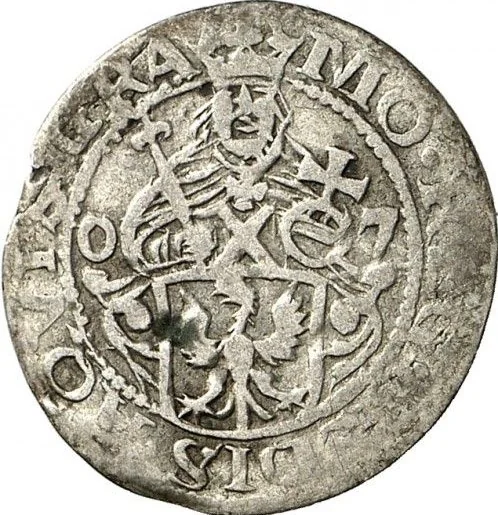

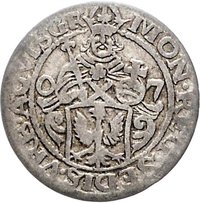
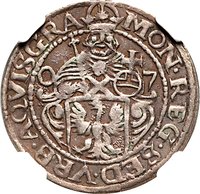
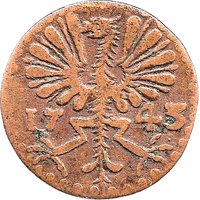
Obverse
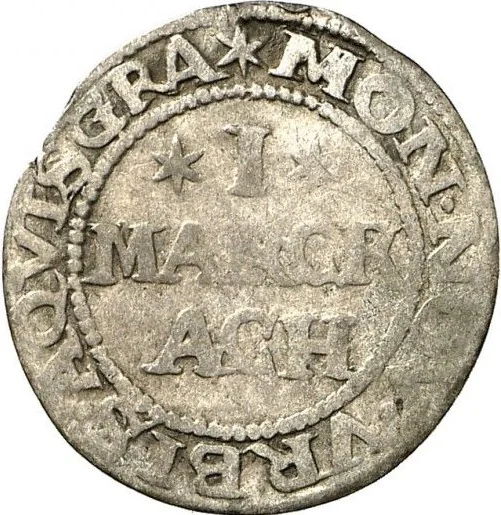
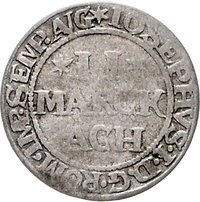
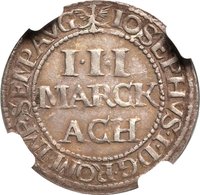
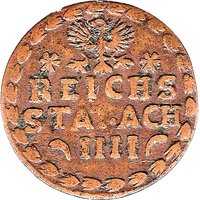
Reverse
Description:
Inscription: three lines of value and date within a circle, surrounded by a legend.
Inscription:
MON NOVA VRBIS AQVI
I
MARCK
ACH
I
MARCK
ACH
Script: Latin
Edge
Mints
| Name | Mark |
|---|---|
| Aachen | — |
Mintings
| Year | Mint Mark | Mintage | Quality | Collection |
|---|---|---|---|---|
| 1707 | — | — |
Historical background
In 1707, the Free Imperial City of Aachen, like much of the Holy Roman Empire, operated within a complex and often chaotic monetary landscape. The city did not possess the sovereign right to mint its own coins; instead, it officially used the currency of the surrounding Duchy of Jülich, primarily the Reichsthaler and its smaller subdivisions like Albus and Hellermünze. This arrangement, however, was theoretical more than absolute. In practice, Aachen's vibrant trade, famed annual fairs, and position at a crossroads of Europe meant its markets were flooded with a multitude of foreign coins. Dutch Ducats, Spanish Pistoles, French Écus, and various German state thalers all circulated simultaneously, their values constantly fluctuating based on metal content and trust.
This proliferation of currencies created significant challenges for merchants and city authorities. The core problem was the chronic instability of exchange rates and the widespread practice of clipping and debasement, where coins were shaved or minted with less precious metal than their face value declared. To bring order, the Aachen city council regularly issued Münztaxen—official ordinances that fixed the legal exchange rates for the dozens of coin types in circulation within its walls. The ordinance of 1707 would have been one such attempt, a legal framework aiming to standardize transactions, prevent fraud, and ensure the city's tolls and taxes were collected in reliable value.
Ultimately, the situation in 1707 was one of managed confusion. Aachen's monetary system was a fragile patchwork, dependent on constant regulatory intervention to function. While the city's economic vitality allowed it to navigate this complexity better than smaller territories, it remained at the mercy of broader European trends. The ongoing War of the Spanish Succession (1701-1714), which raged nearby, exacerbated the situation, causing bullion shortages and increasing the influx of suspect military coinage, thus putting the city's 1707 exchange regulations under immediate and severe strain.
This proliferation of currencies created significant challenges for merchants and city authorities. The core problem was the chronic instability of exchange rates and the widespread practice of clipping and debasement, where coins were shaved or minted with less precious metal than their face value declared. To bring order, the Aachen city council regularly issued Münztaxen—official ordinances that fixed the legal exchange rates for the dozens of coin types in circulation within its walls. The ordinance of 1707 would have been one such attempt, a legal framework aiming to standardize transactions, prevent fraud, and ensure the city's tolls and taxes were collected in reliable value.
Ultimately, the situation in 1707 was one of managed confusion. Aachen's monetary system was a fragile patchwork, dependent on constant regulatory intervention to function. While the city's economic vitality allowed it to navigate this complexity better than smaller territories, it remained at the mercy of broader European trends. The ongoing War of the Spanish Succession (1701-1714), which raged nearby, exacerbated the situation, causing bullion shortages and increasing the influx of suspect military coinage, thus putting the city's 1707 exchange regulations under immediate and severe strain.
✨ Legendary