


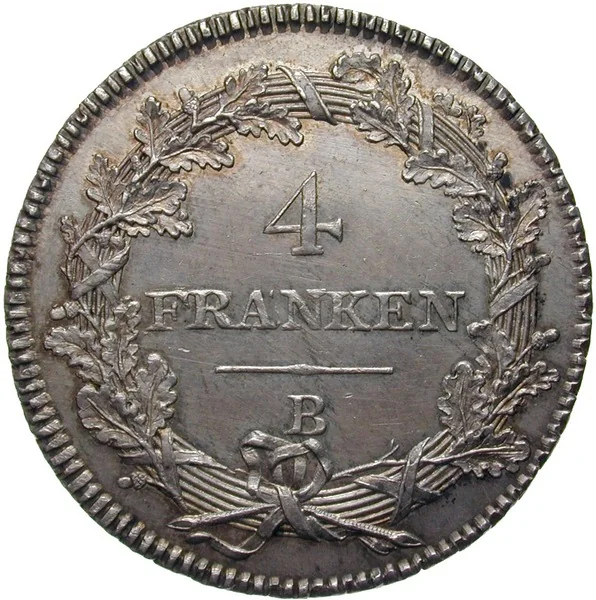
4 Francs – Helvetic Republic
Switzerland
Context
Years: 1799–1801
Country: Switzerland 
Issuer: Helvetic Republic
Period:
(1798—1803)
Currency:
(1798—1803)
Demonetized: Yes
Material

References
KM: #Click to copy to clipboardA10
Numista: #23312
Value
Bullion value: $72.40
Obverse
Description:
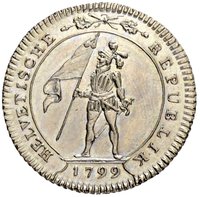
Old Swiss soldier facing left, holding a flag and sword, with oak branches and acorns above.
Inscription:
HELVETISHE REPUBLIK
1799
1799
Script: Latin
Engraver: Johann Franz Huber
Reverse
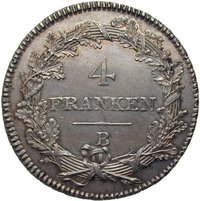
Description:
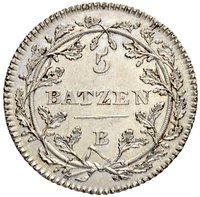
Oak wreath with acorns and a ribbon.
Inscription:
4
FRANKEN
⸻
B
FRANKEN
⸻
B
Script: Latin
Engraver: Johann Franz Huber
Edge
Mints
| Name | Mark |
|---|---|
| Bern | B |
Historical background
The Helvetic Republic, established in 1798 under French revolutionary pressure, inherited a chaotic monetary landscape from the old Swiss Confederation. Prior to its creation, Switzerland was a patchwork of over 75 different authorities minting their own coins, with foreign currency, particularly French, Austrian, and Italian, circulating widely. This lack of a unified system created significant obstacles to trade and administration within the new centralized state. The revolutionary government's immediate goal was to replace this mosaic with a single, decimal-based national currency aligned with the French franc, as part of a broader project of modernization and integration into the French economic sphere.
By 1799, the Republic faced severe monetary crisis. The ambitious plan to introduce a new Swiss franc (divided into 10 batzen or 100 rappen) was undermined from the outset by a critical lack of precious metal. The state's coffers were drained by war, the need to pay French occupation costs, and widespread internal resistance. Consequently, the government resorted to issuing massive quantities of paper money—mandats and obligations—without sufficient backing. This led to rapid depreciation and a collapse in public confidence; the paper currency was widely refused, and the population clung to old silver and foreign coins.
Thus, in 1799, the Helvetic Republic was caught in a destructive cycle: it needed a stable currency to legitimize its authority and fund its operations, but its financial desperation forced it to issue worthless paper, which further eroded its legitimacy and economic stability. The monetary chaos exacerbated the Republic's political and social crises, contributing to the widespread unrest and hardship that characterized its short, turbulent existence. The situation would only begin to stabilize after the Act of Mediation in 1803, which dissolved the Republic and restored a federal structure.
By 1799, the Republic faced severe monetary crisis. The ambitious plan to introduce a new Swiss franc (divided into 10 batzen or 100 rappen) was undermined from the outset by a critical lack of precious metal. The state's coffers were drained by war, the need to pay French occupation costs, and widespread internal resistance. Consequently, the government resorted to issuing massive quantities of paper money—mandats and obligations—without sufficient backing. This led to rapid depreciation and a collapse in public confidence; the paper currency was widely refused, and the population clung to old silver and foreign coins.
Thus, in 1799, the Helvetic Republic was caught in a destructive cycle: it needed a stable currency to legitimize its authority and fund its operations, but its financial desperation forced it to issue worthless paper, which further eroded its legitimacy and economic stability. The monetary chaos exacerbated the Republic's political and social crises, contributing to the widespread unrest and hardship that characterized its short, turbulent existence. The situation would only begin to stabilize after the Act of Mediation in 1803, which dissolved the Republic and restored a federal structure.

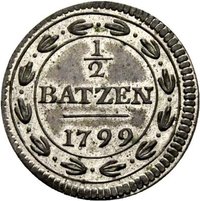

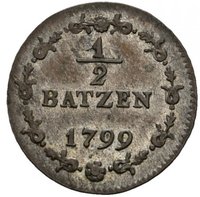

✨ Legendary