

Denmark
Context

Material
References
KM: #Click to copy to clipboard652
Numista: #109008
Value
Bullion value: $4.86
Obverse
Description:
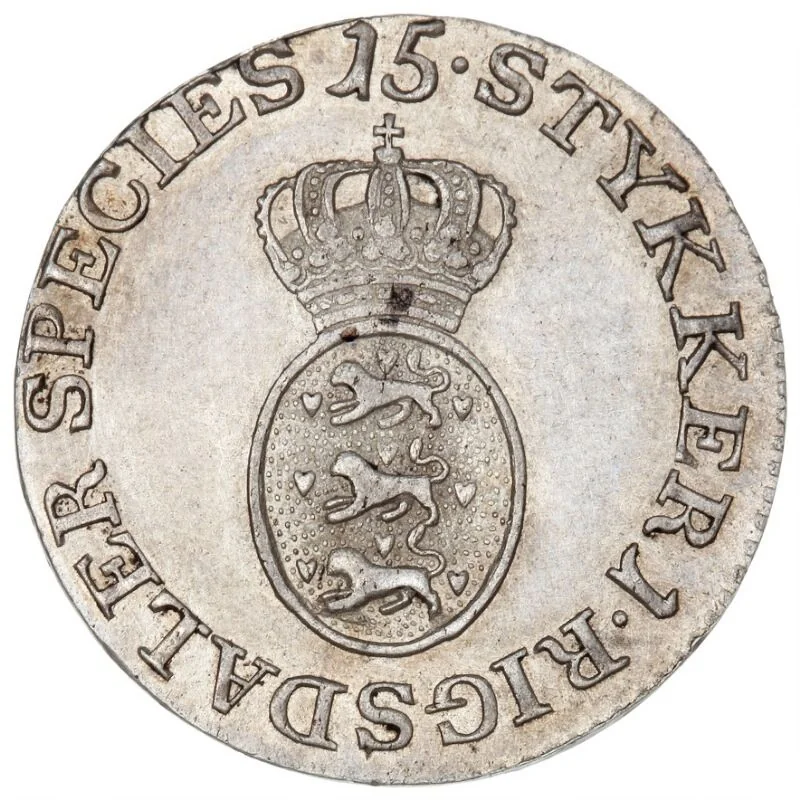
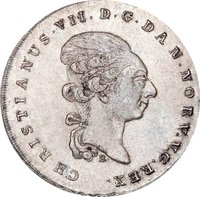
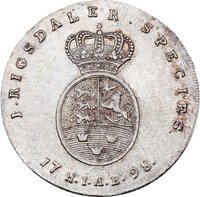
Oval shield with Denmark's coat of arms, rim inscribed with value in fractional Species Daler.
Inscription:
12 STYKKER 1.RIGSDALER SPECIES
Script: Latin
Reverse
Description:
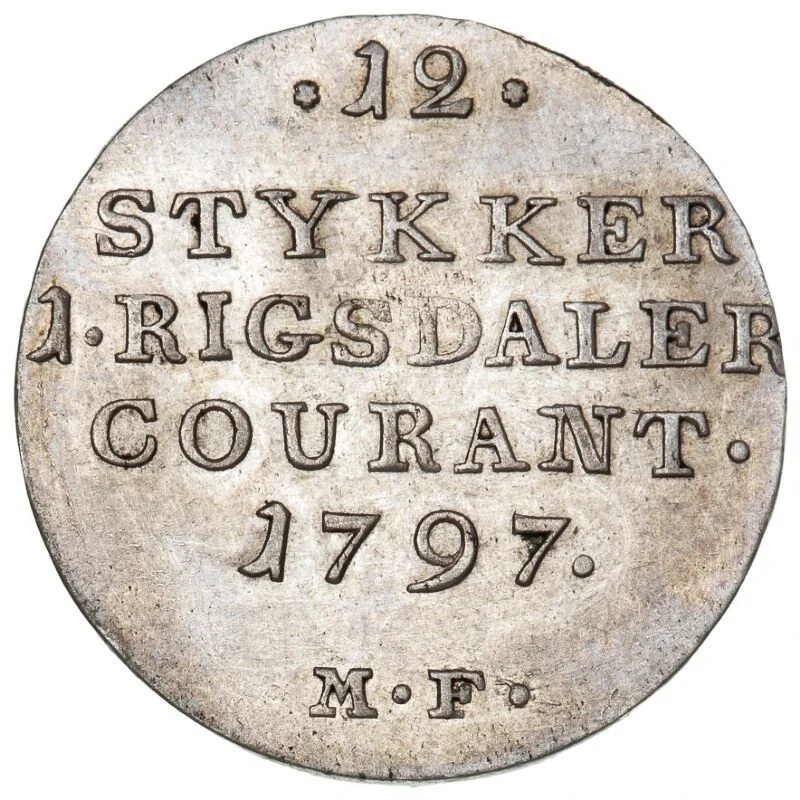
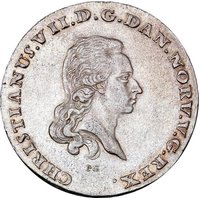
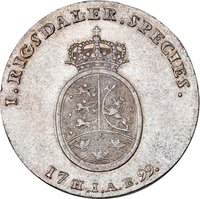
Value as fraction of Courant Daler.
On four lines.
Date below.
On four lines.
Date below.
Inscription:
*12*
STYKKER
1.RIGSDALER
COURANT.
1797.
M.F.
STYKKER
1.RIGSDALER
COURANT.
1797.
M.F.
Script: Latin
Edge
Mints
| Name | Mark |
|---|---|
| Altona, Schleswig-Holstein | — |
Mintings
| Year | Mint Mark | Mintage | Quality | Collection |
|---|---|---|---|---|
| 1796 | — | — | ||
| 1797 | — | — | ||
| 1799 | — | — |
Historical background
In 1796, Denmark found itself in a precarious monetary situation, deeply entangled in the economic turmoil of the Napoleonic Wars. Though formally neutral, Denmark’s trade was severely disrupted by the British naval blockade and the Continental System, crippling a key pillar of its economy. This pressure exacerbated an existing crisis: the Danish state bank, the Kurantbanken, had for decades been financing government deficits by printing excessive amounts of paper currency, the kurantdaler. By 1796, this currency was not backed by silver and had depreciated significantly against the more trusted rigsdaler specie, creating a damaging dual-currency system.
The core problem was a severe lack of public confidence. The overissued kurantdaler circulated at a fluctuating and discounted market rate, while transactions for foreign trade and large domestic contracts were anchored to the silver-based rigsdaler. This complex system led to uncertainty, hampered commerce, and effectively transferred wealth from creditors and wage-earners paid in the depreciating paper to the state and its debtors. The government's attempts to fix the exchange rate by decree had repeatedly failed, as market forces and the sheer volume of paper notes undermined such mandates.
Consequently, the year 1796 fell within a prolonged period of financial instability that would culminate in the state bankruptcy of 1813. The economic strain of maintaining a large navy to defend neutrality, coupled with the loss of tariff revenue from blocked trade, left the crown with little choice but to continue its reliance on the printing press. Therefore, the currency situation of 1796 was characterized by a widening gap between paper and silver, eroding purchasing power, and a growing sense of monetary crisis that would take decades to fully resolve.
The core problem was a severe lack of public confidence. The overissued kurantdaler circulated at a fluctuating and discounted market rate, while transactions for foreign trade and large domestic contracts were anchored to the silver-based rigsdaler. This complex system led to uncertainty, hampered commerce, and effectively transferred wealth from creditors and wage-earners paid in the depreciating paper to the state and its debtors. The government's attempts to fix the exchange rate by decree had repeatedly failed, as market forces and the sheer volume of paper notes undermined such mandates.
Consequently, the year 1796 fell within a prolonged period of financial instability that would culminate in the state bankruptcy of 1813. The economic strain of maintaining a large navy to defend neutrality, coupled with the loss of tariff revenue from blocked trade, left the crown with little choice but to continue its reliance on the printing press. Therefore, the currency situation of 1796 was characterized by a widening gap between paper and silver, eroding purchasing power, and a growing sense of monetary crisis that would take decades to fully resolve.
💎 Very Rare