

1 speciedaler – Denmark
Add to wishlist
Denmark
Context
Material
References
KM: #
Numista: #132003
Value
Bullion value: $62.43
Obverse
Description:
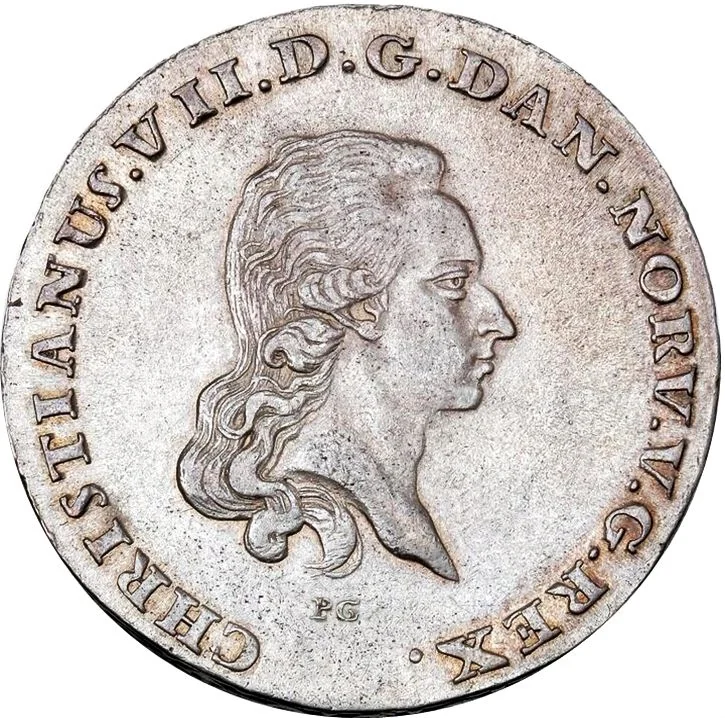
King Christian VII facing right, with loose flowing hair. Legend around rim. Engraver's initials "PG" on neck truncation.
Inscription:
CHRISTIANVS • VII •D • G • DAN • NORV • V • G • REX •
PG
PG
Script: Latin
Engraver: Peter Leonard Gianelli
Reverse
Description:
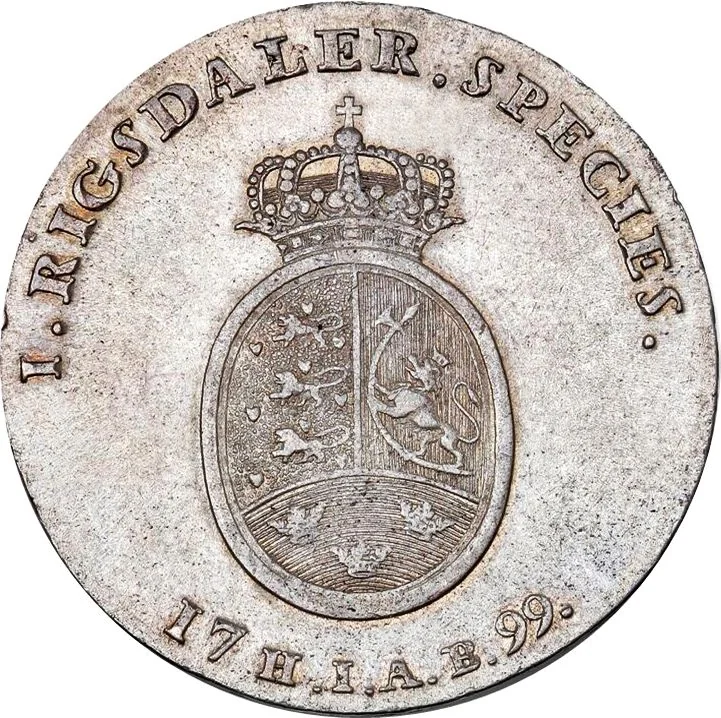
Shield with Danish, Norwegian, and Swedish arms. Value above, date flanking mintmaster initials below.
Inscription:
I . RIGSDALER . SPECIES .
17 H.I.A.B. 99 .
17 H.I.A.B. 99 .
Script: Latin
Engraver: Peter Leonard Gianelli
Edge
Categories
| Symbols> Coat of Arms |
Mints
| Name | Mark |
|---|---|
| Royal Danish Mint | HIAB |
Mintings
| Year | Mint Mark | Mintage | Quality | Collection |
|---|---|---|---|---|
| 1799 | HIAB | — |
Historical background
In 1799, Denmark found itself in a precarious monetary situation, deeply entangled in the economic turmoil of the Napoleonic Wars. Since 1797, the state had been financing its military expenditures and trade deficits through the extensive issuance of paper money, known as kurantsedler, by the state-owned Kurantbanken. This unbacked currency was not convertible to silver, leading to a rapid and severe depreciation. By 1799, the paper currency had lost nearly half its nominal value against silver specie, causing rampant inflation, soaring prices for essential goods, and a profound loss of public confidence in the monetary system.
The crisis was exacerbated by Denmark's neutral yet vulnerable position in the European conflict. While neutrality allowed for profitable shipping and trade, it also made the Danish economy a target for British pressure and fluctuating commodity prices. The disparity between the depreciating paper currency used domestically and the stable silver required for international settlements created a dual-currency economy, disrupting commerce. Merchants and the public hoarded silver coins, which disappeared from circulation—a classic example of Gresham's Law, where "bad money drives out good."
Facing a collapsing monetary system, the Danish government enacted the Currency Regulation of 1799 (Myntforordningen af 1799). This decree attempted to stabilize the situation by officially recognizing the devalued paper money as the sole legal tender, effectively demonetizing silver for domestic transactions. It fixed the exchange rate between the kurantdaler and the silver rigsdaler at an artificial level, but this did not restore trust. The regulation was largely unsuccessful in halting depreciation and instead formalized the inflationary reality, setting the stage for a deeper financial crisis that would culminate in a state bankruptcy in 1813.
The crisis was exacerbated by Denmark's neutral yet vulnerable position in the European conflict. While neutrality allowed for profitable shipping and trade, it also made the Danish economy a target for British pressure and fluctuating commodity prices. The disparity between the depreciating paper currency used domestically and the stable silver required for international settlements created a dual-currency economy, disrupting commerce. Merchants and the public hoarded silver coins, which disappeared from circulation—a classic example of Gresham's Law, where "bad money drives out good."
Facing a collapsing monetary system, the Danish government enacted the Currency Regulation of 1799 (Myntforordningen af 1799). This decree attempted to stabilize the situation by officially recognizing the devalued paper money as the sole legal tender, effectively demonetizing silver for domestic transactions. It fixed the exchange rate between the kurantdaler and the silver rigsdaler at an artificial level, but this did not restore trust. The regulation was largely unsuccessful in halting depreciation and instead formalized the inflationary reality, setting the stage for a deeper financial crisis that would culminate in a state bankruptcy in 1813.
✨ Legendary